16Clubs, festivals and the rooms that shaped the gear
The short version: A handful of rooms decided what dance-music production sounds and looks like. The New York lofts and discos of the 1970s, built by and for Black, Latino and largely gay dancers, made the sound system the headliner; Chicago's Warehouse gave house music its name; London, Manchester and Berlin carried that idea into the superclub; and UK and US law shaped how rave culture moved into licensed venues and very large festivals. Today a venue's installed "house" package is what every DJ and tour negotiates against.
The rooms
The Loft, New York (1970). David Mancuso's first "Love Saves the Day" party was on 14 February 1970 at his home at 645-647 Broadway, for about 100 people; its engineer, Alex Rosner, later put the crowd at "probably about sixty percent black and seventy percent gay"23. It was invitation-only, sold no alcohol, charged $2 and gave away organic food23. The sound was audiophile home hi-fi scaled up - McIntosh and AR amplifiers, Klipschorn speakers, later a cluster of JBL tweeters over the dance floor - with Rosner as engineer23. Mancuso avoided pitch control, and in the late 1970s stopped beatmatching altogether and played records in full23. A 1972 police raid for unlicensed cabaret was followed by a later city ruling that private parties could run if nothing was sold, which "later benefited the Paradise Garage and other private clubs"23.
Paradise Garage, New York (1977-1987). Michael Brody's club at 84 King Street was modeled on the Loft and is credited as the first club to put the DJ at the center24. Its crowd is described as "primarily African-American gay men"13. Richard Long's custom system - his showroom, constantly modified - made it famous295. Justin Berkmann, who later founded Ministry of Sound, told NPR it was "the best sound system ever made in a nightclub", and said Larry Levan constantly adjusted bass and treble to stop ears tiring146. Berkmann also says the rumor that the Garage system went to Ministry is false; Ministry's was a facsimile146. The lease ended in 1987, and the building was demolished in 201824.
Studio 54, New York (1977). The theatrical lineage, as opposed to the hi-fi one. Jules Fisher and Paul Marantz designed the dance floor and rigging, with confetti, snow and fog effects, a movable lighting bridge added in 1978 and a fly system in 1979384. Richard Long installed sound there too295. Its first incarnation closed in 1980 after the founders pleaded guilty to tax evasion and the club lost its liquor license384.
The Warehouse and Music Box, Chicago. The Warehouse at 206 South Jefferson Street opened in 1977 under Robert Williams, with Frankie Knuckles as resident, playing to a crowd that was initially mostly Black gay men and women14; "house" music is generally said to take its name from the club, via Williams' "house" party posters and, per one history, a shortening of the club's name26. Knuckles left in late 1982 or 1983, depending on the source; the owners' next club, the Music Box (1983-88), had Ron Hardy as resident2614.
The Haçienda, Manchester (1982). Factory Records' club opened on 21 May 1982 with a Ben Kelly interior, financed by Factory, New Order and Tony Wilson; New Order's bassist Peter Hook later said it lost up to £18 million385. Its Ibiza-themed "Hot" night in July 1988 brought acid house, a Chicago sound, to Manchester's dance floor; it lost its license and closed in 1997385.
Ministry of Sound, London (1991). Opened in a disused bus garage in Elephant & Castle on 21 September 1991 and inspired by the Garage, it spent £500,000 each on its sound system and on soundproofing, and added a 64-speaker Dolby Atmos system in 2016373. Wikipedia repeats a claim that the room was tested to 156 dB without leakage; treat that as lore.
Fabric, London (1999). Opened 29 October 1999 in Farringdon with three rooms, each with independent sound; Room One's "bodysonic" floor uses 400 bass transducers so the floor itself vibrates386. Islington Council revoked its license in September 2016 after two drug-related deaths; it reopened under strict new conditions in 2017386.
Berghain, Berlin (2004). Opened in December 2004 in a former power plant, with Panorama Bar upstairs; its first Funktion-One "Dance Stack" went in in 2005 and was replaced with an updated Funktion-One system in 202342. A German court designated it a cultural institution in 2016, cutting its tax rate, and phone cameras are stickered at the door42.
Two production philosophies run through these rooms (our reading). The hi-fi listening-room lineage - the Loft, the Garage, Ministry, Berghain - prizes a custom, tuned sound system. The theatrical lineage - Studio 54, later Las Vegas - prizes rigging, effects and spectacle. And licensing has repeatedly decided which rooms survive: the Loft's cabaret ruling, Studio 54's liquor license, the Haçienda in 1997, Fabric in 2016.
Rave, and the laws that followed it
The UK's "Second Summer of Love" began in 1988 and peaked in 1989, from clubs like Shoom to orbital raves around the M2534. The state responded in stages. The 1990 Entertainments (Increased Penalties) Act raised fines for unlicensed parties from £2,000 to £20,000 and allowed up to six months in prison34. The Criminal Justice and Public Order Act 1994 went further. Its section 63, still in force, defines music at an outdoor night-time gathering to include "sounds wholly or predominantly characterised by the emission of a succession of repetitive beats", and lets a police superintendent order people to leave once 20 or more are present in England and Wales (originally 100, still 100 in Scotland); later sections allow seizure and forfeiture of sound equipment387. Autechre responded with a track built on 65 drum patterns, so that nothing repeated388. The argument that this pushed rave culture into licensed superclubs is common and plausible, but the law's text does not say so; treat it as interpretation.
In the US, the RAVE Act failed in 2002, then passed in 2003 as the Illicit Drug Anti-Proliferation Act, attached to an unrelated bill. It extended the federal "crack house" statute to places used "whether permanently or temporarily" for drug use, with civil penalties of $250,000 or twice gross receipts per violation389390. Its chilling effect on harm reduction is documented: the drug-checking group DanceSafe says promoters fear liability and often will not advertise drug checking, and Electric Forest ordered its booth closed in 2015391. Drug checkers interviewed by researchers knew of no prosecutions of promoters for allowing it; in our reading, the fear of liability is enough to have the effect392. The access and harm reduction section has the wider picture.
The festival boom
- Electric Daisy Carnival. Insomniac's EDC debuted in 1997 at the Shrine Expo Hall in Los Angeles; after the 2010 death of a 15-year-old at the LA Coliseum it went 18+, and it moved to Las Vegas Motor Speedway in 2011. Promoter-reported attendance was 525,000 in both 2023 and 2024393, and over 525,000 again in 2025394.
- Ultra Music Festival. First held on 13 March 1999 on Miami Beach for about 10,000; about 165,000 attended over three days in 2022395396. Its city license at Bayfront Park runs through 2027 at a $2 million rental fee rising 4% a year396. Wikipedia reports the 2026 edition as the first major US festival powered by batteries; we could not confirm that beyond Wikipedia395.
- Tomorrowland. First held in Boom, Belgium, in August 2005 for about 10,000; its mainstage has followed an annual theme since 2009 and reached 270 meters wide in 2022397. In 2025 it reported more than 400,000 visitors across two weekends, 16 stages and 15,000 crew358.
All of these are promoter or media figures, and they count attendance across days, not individual people.
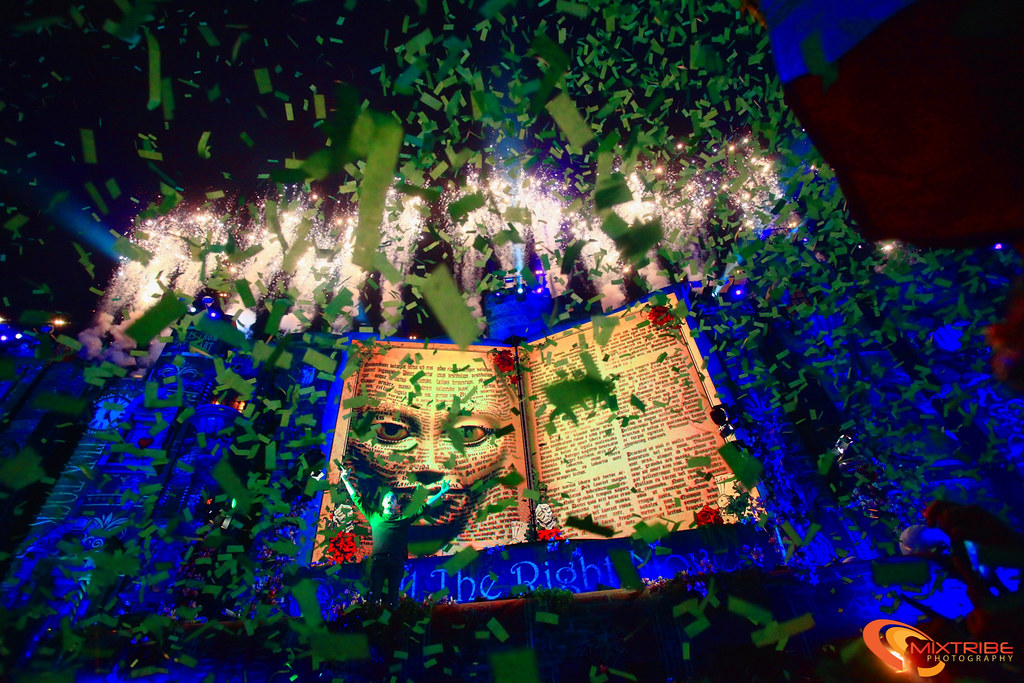 ALESSO - TomorrowWorld 2013 Chattahoochee Hills, Atlanta Georgia USAPhoto hosted by Mixtribe Photo (MIXTRIBE) - open the original
The house package and the Vegas superclub
A venue's house package - its installed PA, lighting, video and DJ booth - is what a touring DJ or production advances against on the rider. The Las Vegas residency clubs show the top end. Hakkasan at the MGM Grand, as documented in 2014, had more than 13,400 square feet of 6 mm LED, mostly Robe fixtures plus Sharpys, and a ChamSys console running 64 DMX universes, with a data gateway that lets emergency lighting take over the rig398. Omnia at Caesars Palace opened in 2015 at a reported $107 million, with a kinetic chandelier of eight rings on 21 winches weighing about 22,000 pounds and an L-Acoustics system399400. XS at the Wynn added pyro, lasers and a 14,000-LED DJ booth in 2015; Wikipedia reports a planned closure from September 2026 for renovation, which we could not confirm independently401.
That emergency-lighting detail at Hakkasan illustrates a general rule (our generalization): a club's lighting network must hand over to house lights when the fire alarm goes. The fire rules themselves are covered under effects above; one example of how they spread is Massachusetts, where a 2004 law after The Station fire required sprinklers in nightclubs with occupancy of 100 or more and added criminal penalties for blocked exits and unpermitted pyrotechnics402.
Sources for this section
30 of the guide's 555 sources. Numbers match the full reference list.
-
NYC LGBT Historic Sites Project: Paradise Garage - nyclgbtsites.org ↩↩↩↩↩↩↩
-
City of Chicago: The Warehouse landmark designation report (2023, PDF) - chicago.gov ↩↩↩↩↩↩↩↩↩↩↩↩↩
-
Wikipedia: The Loft (New York City) - en.wikipedia.org ↩↩↩↩↩↩↩↩
-
Wikipedia: Paradise Garage - en.wikipedia.org ↩↩↩↩
-
Wikipedia: Warehouse (nightclub) - en.wikipedia.org ↩↩↩
-
Wikipedia: Second Summer of Love - en.wikipedia.org ↩↩↩
-
Wikipedia: Berghain - en.wikipedia.org ↩↩↩↩
-
Wikipedia: Richard Long (sound designer) - en.wikipedia.org ↩↩↩↩↩
-
Pollstar: From Ashes to Anthem - Tomorrowland Overcomes Main Stage Fire (2025) - news.pollstar.com ↩↩↩
-
Wikipedia: Ministry of Sound - en.wikipedia.org ↩↩
-
Wikipedia: Studio 54 - en.wikipedia.org ↩↩
-
Wikipedia: The Hacienda - en.wikipedia.org ↩↩
-
Wikipedia: Fabric (club) - en.wikipedia.org ↩↩
-
legislation.gov.uk: Criminal Justice and Public Order Act 1994, s.63 - legislation.gov.uk ↩
-
Wikipedia: Criminal Justice and Public Order Act 1994 - en.wikipedia.org ↩
-
Wikipedia: RAVE Act - en.wikipedia.org ↩
-
Congress.gov: S.226 (108th Congress) - congress.gov ↩
-
Filter: Festival Drug Checking (2024) - filtermag.org ↩
-
DrugPolicyFacts: RAVE Act and drug checking (summarising Palamar et al., 2019) - drugpolicyfacts.org ↩↩
-
Wikipedia: Electric Daisy Carnival - en.wikipedia.org ↩
-
EDMTunes: EDC Las Vegas 2025 - A Festival for the Record Books - edmtunes.com ↩
-
Wikipedia: Ultra Music Festival - en.wikipedia.org ↩↩
-
Miami New Times: Ultra Will Return to Bayfront Park Through 2027 - miaminewtimes.com ↩↩
-
Wikipedia: Tomorrowland (festival) - en.wikipedia.org ↩
-
Live Design: Hakkasan Las Vegas Nightclub (2014) - livedesignonline.com ↩
-
Wikipedia: Omnia (nightclub) - en.wikipedia.org ↩
-
L-Acoustics: Omnia Tech Brief - l-acoustics.com ↩
-
Wikipedia: XS (nightclub) - en.wikipedia.org ↩
-
Security Sales: Massachusetts Enacts Fire Safety Legislation for Nightclubs (2004) - securitysales.com ↩