01How music came to need production
The short version: For most of history, a show's "production" was the building and whatever flame lit the stage. Then, in roughly eighty years, music learned to be stored (recording), carried (radio), made enormous (amplification), generated by circuits (electronic instruments), and finally performed by playing the stored version back to a crowd. Each step moved the spectacle a little further away from the musician's body and a little closer to the equipment.
Before electricity: the room was the PA
Before the 1880s, a performance was as loud as its performers and as bright as its fire. The usual marker for the change is the Savoy Theatre in London, which opened on 10 October 1881 and is described as the first public building in the world lit entirely by electricity, using about 1,200 Swan incandescent lamps fed by a 120-horsepower generator on open ground nearby2. "Entirely" needs a footnote of its own: the first generator was too small, so the stage itself stayed on gas until 28 December 1881, when Richard D'Oyly Carte broke a lit bulb in front of the audience to prove it was safe2. His pitch for electric light was practical rather than poetic - the lamps, he said, "consume no oxygen, and cause no perceptible heat"2. It is an early, well-documented case of a production decision made for the comfort of a crowd, and it will not be the last.
Sound becomes a thing you can keep
Edison's phonograph is traditionally dated to 12 August 1877, though the Library of Congress notes that some historians think it was probably built several months later; the patent was filed on 24 December 1877. It recorded on tinfoil that lasted "only a few playings"3. Wax cylinders followed in the late 1880s, and Emile Berliner patented the flat-disc gramophone on 8 November 1887 - in the Library of Congress's phrase, "the lateral-cut flat disc doomed the vertical-cut cylinder"4. Edison did not concede to discs until 19133.
Broadcasting has a messier birth certificate. Reginald Fessenden's famous Christmas Eve 1906 broadcast from Brant Rock, Massachusetts is disputed: Radio World found no press coverage from 1906 and traced the story to a letter Fessenden wrote in 1932, though a demonstration on 21 December 1906 is documented5. The safer date for scheduled broadcasting is 2 November 1920, when Westinghouse's KDKA in East Pittsburgh read out election returns at 100 watts; the IEEE calls it a world pioneer of commercial broadcasting while noting that other stations claim to be older6.
Amplification, and the first sound engineers
The moving-coil loudspeaker arrived in public on 10 December 1915, when Jensen and Pridham's Magnavox was demonstrated in Golden Gate Park, San Francisco, playing music and carrying a speech by the governor7. By 1919 Magnavox speakers carried a speech by President Woodrow Wilson that was reportedly audible "a mile away from the stadium"7. Public address had become a technology, and a technology needs someone to run it.
For rock and pop, that someone is usually Bill Hanley. He founded Hanley Sound in 1954 in Medford, Massachusetts, is known as "the Father of Festival Sound", and is credited with moving the mixing desk out into the audience - the position we now call front of house - and with using more microphones than was then normal8. He worked Newport in 1965, the night Dylan went electric, and at Woodstock in 1969 his crew covered more than 400,000 people with what was described as one of the most expensive, elaborate and powerful sound systems ever built8. His stated goal still describes the job: "to give those seated in the last seat in the house the same experience of those seated in the front row"8.
The Beatles' 1965 Shea Stadium show, played through the stadium's own PA to about 55,000 screaming people, is often cited as the moment it became clear that touring sound needed its own equipment and its own specialists. That framing is interpretation rather than documented fact, and the pages that describe the show could not be checked for this guide, so treat it as folklore with a good point.
The instruments go electric
The theremin is usually dated to 1920, though the Moog Foundation's timeline lists it as "Russia, 1924"9. In Paris around 1948, Pierre Schaeffer and colleagues at the French radio system's Studio d'Essai developed musique concrète - music assembled from recorded sound on tape10. Ten years later, Edgard Varèse's Poème électronique played through 400 loudspeakers at the 1958 Brussels World's Fair10, which makes it, in our reading, one of the first multi-speaker spatial sound installations - as much a production as a piece. In 1964 Robert Moog's transistorized, voltage-controlled modular synthesizer appeared in the US, "programmed with patch cords", with Don Buchla's 100 series developing in parallel on the West Coast; the Minimoog of 1970 was built to be played live9.
Playback becomes performance
The decisive step is the one where playing a record in public stops being a substitute for a band and becomes the event. That happened in several places at once, and most of the dates in this part of the story are conventions rather than certainties.
In 1940s and 1950s Kingston, rival sound systems - mobile rigs of turntables, amplifiers and large homemade speakers - competed for crowds at street dances, and by the mid-1950s they were more popular at parties than live musicians11. Selectors chose the records, DJs toasted over them, and rival systems fought sound clashes with exclusive one-off dubplates11. The culture traveled with Caribbean migration to the UK, and DJ Kool Herc carried its habits, heavy bass included, to the Bronx11. Herc's back-to-school party at 1520 Sedgwick Avenue on 11 August 1973 is the conventional birthday of hip-hop, a date that Rolling Stone itself frames as part "history" and part "mystery"12.
Disco, house and techno followed in the same spirit, and they came out of Black, Latino and queer communities. In 1970s New York, the Loft and later the Paradise Garage drew Black and Latino, largely gay dancers; the Garage's crowd is described as "primarily African-American gay men"13. Chicago's Warehouse - the club most historians say "house" music is named after - was built around Frankie Knuckles playing to a crowd that was initially mostly Black and gay14. Techno was made by young Black musicians in and around Detroit in the 1980s15. Those records then crossed to the UK's acid house scene and its "Second Summer of Love" in 1988, where Caribbean-British sound system culture, carried over from Kingston, was already shaping a second lineage that would run through jungle, UK garage, grime and dubstep. The rooms and gear of that era get their own section below. The point here is the shift itself. The Kingston sound system was already the instrument being performed - which makes sound system scale, in our view, the first form of the production this guide is about.
Why that created "production"
Put the pieces together and the thesis falls out (this is our inference, labeled as such). Electric light was a deliberate design choice by 18812. Dedicated live-sound craft existed because of people like Hanley, who needed the back row to hear what the front row heard8. Spatial, multi-speaker presentation existed by 195810. When the thing on stage became a finished recording played by a DJ, the musicians' bodies, instruments and visible effort stopped carrying the show. The spectacle had to come from somewhere else: the scale of the sound system, then light, then video, then the architecture of the booth and the room. Everything in the rest of this guide is a department of that "somewhere else".
02The scenes that built it
The short version: Electronic dance music has no single birthplace. It came out of a handful of local scenes, most of them started by people the mainstream music business ignored: sound system crews in Kingston, Black and Latino, largely gay, dancers in New York, Black and Latino LGBTQ dancers in Chicago, young Black musicians in Detroit, then British ravers, Berlin clubs in empty buildings, Goa travelers and Rotterdam hardcore kids. Each scene solved the same production problem in its own way - how to make recorded music feel like an event - and each left habits that are still on the rider today: the custom sound system, the long night with no bar, the warehouse, the field, the dress code, the festival that became a company.
What we mean by electronic dance music
This guide uses "electronic dance music" as the umbrella for all of it: disco's descendants, house, techno, jungle, trance, dubstep, amapiano and the rest. "EDM" means something narrower. The academic Hillegonda Rietveld writes that electronic dance music has been an umbrella term since the 1980s, but that close to 2010 the American music industry promoted rave-related festivals as "e.d.m." to shed the baggage of earlier moral panics, which produced a pop-oriented subgenre "now known as 'edm'"16. DJ Mag's digital editor makes the same point from the scene side: EDM is "not an umbrella term" but a label for the commercialization of dance music from 201017. So when this guide says "EDM", it means that US industry era and its big-room festival sound, and nothing else. No genre in this section is ranked above another, and "underground" is used to describe how a scene operated, not to judge it.
18 scenes, one family
Where the rooms, the sound systems and the people came from. Every card is sourced; none is ranked above another.
RoomsStreet dances in neighborhoods with no dancehalls or concert spaces
SoundTruck-borne rigs with generators and wardrobe-sized speaker cabinets; a selector on the records, a DJ toasting, and one-off dubplates as the draw.
Built byWorking-class Kingston crews, among them Tom the Great Sebastian (Tom Wong), Duke Reid's Trojan, Coxsone Dodd's Downbeat and King Tubby's Hometown Hi-Fi.
sourceRoomsCarnival street corners, such as Channel One's at Leamington Road Villas since 1983
SoundStatic sound systems played in the street, which the 1973 organizer Leslie Palmer called "the voice of the youth".
Built byLondon's Caribbean community: Claudia Jones, Rhaune Laslett and Leslie Palmer as organizers, Linett Kamala as carnival's first female DJ, and Mellotone as its first all-female sound system.
sourceRoomsThe Loft, Paradise Garage
SoundSound designed first: Alex Rosner at the Loft, Richard Long with Larry Levan at the Garage; no alcohol, so parties ran until noon.
Built byBlack and Latino, largely gay dancers; David Mancuso, Larry Levan and the Garage's members, a crowd the NYC LGBT Historic Sites Project describes as "primarily African-American gay men".
sourceRoomsThe Warehouse, the Music Box, the Power Plant
SoundA Richard Long system you could hear from the street, the booth on the loading dock, a dark room with fog, then cheap Roland drum machines and WBMX radio mixes.
Built byBlack gay men and women and Latino dancers first; Robert Williams, Frankie Knuckles, Ron Hardy, the Hot Mix 5 and producers such as Phuture.
sourceRoomsHigh-school "prep" party circuit, the Music Institute at 1315 Broadway
SoundMachine-made tracks on artist-run labels such as Metroplex, later with Underground Resistance's anonymity and anti-corporate stance.
Built byYoung Black musicians from the Detroit area, led by Juan Atkins, Derrick May and Kevin Saunderson, then "Mad" Mike Banks and Jeff Mills.
sourceRoomsShoom, Future, Spectrum, The Trip, then warehouses and fields
SoundWarehouse and field parties promoted by flyer, word of mouth and pager, playing Chicago and Detroit records.
Built byDanny and Jenni Rampling, Paul Oakenfold, Nicky Holloway and Johnny Walker after hearing Alfredo on Ibiza, and raves such as Sunrise, Energy and Biology.
sourceRoomsCommons and fields, most famously Castlemorton Common
SoundCollective-run sound systems at multi-day unlicensed gatherings.
Built bySound system collectives including Spiral Tribe, Bedlam, Circus Warp and DiY.
sourceRoomsAWOL, Roast, Telepathy; pirate station Kool FM
SoundBreakbeats under ragga basslines and sound system samples, carried by MCs, pirates and sub-bass rigs.
Built byBlack British sound system culture and the scene's DJs, MCs and pirate broadcasters.
sourceRoomsPirate stations such as Rinse FM and Deja Vu
SoundMCs and pirate radio, working under pressure from the police risk-assessment Form 696.
Built byEast London MCs and producers, with Dizzee Rascal's Mercury Prize in 2003.
sourceRoomsFWD>> at the Velvet Rooms and Plastic People; DMZ in Brixton
SoundSub-bass weight traced to the Jamaican sound system party scene.
Built byFWD>>, Croydon's Big Apple Records, Digital Mystikz and Loefah.
sourceRoomsUfo, Tresor, Ostgut, Berghain
SoundRepurposed vaults and power plants, phone and photo policies as atmosphere, and close ties to Detroit through Tresor Records.
Built byDimitri Hegemann and the Tresor team, Detroit artists on the label, and the queer fetish party culture behind Berghain.
sourceRoomsAmnesia, Pacha, Space
SoundOpen-air terrace clubs and eclectic all-night sets mixing house with disco, rock, jazz, funk, soul and synth pop.
Built byAlfredo Fiorito, born in Rosario, Argentina, the resident who defined Balearic beat.
sourceRoomsBeach and forest parties; later Boom in Portugal
SoundTwo tape decks, then DAT, at outdoor parties; later decor-led, multi-day stages with sunrise sets and harm-reduction spaces.
Built byDJs such as Goa Gil, Fred Disko and Laurent, then London nights such as Return to the Source.
sourceRoomsClubs including the Ancienne Belgique and Boccaccio, depending on the account
SoundRecords slowed down on the deck, by the usual story a 45 played at 33 rpm with the pitch at +8.
Built byBelgian club DJs; accounts credit Dikke Ronny or Marc Grouls, and the origin story is unverified.
sourceRoomsHardcore parties in Rotterdam
SoundHardcore records with an explicit anti-racist stance against far-right attempts to claim the scene.
Built byRotterdam's hardcore scene, including Paul Elstak, DJ Chosen Few and Party Animals.
sourceRoomsStadium-scale festivals such as Electric Daisy Carnival
SoundRave-derived festivals repackaged as rock-style shows with a pop-oriented, big-room sound.
Built byThe US music industry and festival promoters, building on decades of earlier scenes.
sourceRoomsTownship and Pretoria parties (origin disputed)
SoundThe log drum, linked to the kwaito pioneer M'du Masilela.
Built byGauteng's DJs and producers, with no single founder.
sourceRoomsNeighborhood parties in areas such as Tepito
SoundSound systems playing cumbia, salsa and guaracha while the sonidero sends saludos over the music.
Built byMexico City's sonidero crews and the migrant communities who carried the culture north.
sourceJamaica: the sound system as instrument
The template for everything that follows was set in working-class Kingston, in neighborhoods that had no dancehalls or concert spaces18. Sources disagree on the start date: one account puts sound systems in the 1940s, with Tom the Great Sebastian, founded by the Chinese-Jamaican businessman Tom Wong, as the first commercially successful one, while Rolling Stone UK says the late 1940s1118. By the mid-1950s sound systems were more popular than live bands at parties11.
The production details are worth knowing because they recur for seventy years. Early systems were loaded onto trucks with a generator, turntables and large speakers; a selector chose the records and a DJ rapped, or "toasted", over them; and in the late 1950s Hedley Jones built wardrobe-sized cabinets known as the "House of Joy"11. The attraction was the exclusive: a one-off dubplate cut for a single system11. Rival crews sent spies to each other's dances, and at a late-1957 clash at Forrester's Hall, Prince Buster broke Duke Reid's stylus19. Reid, a former police sergeant who ran the Trojan system, was crowned "King of Sounds and Blues" three years running in the mid-1950s; Coxsone Dodd brought American R&B records back from a 1953 US trip for his Downbeat system and later founded Studio One. In September 1961 a man was arrested for stealing one of Downbeat's dubplates19. Exclusive content as a security problem is not a new idea.
King Tubby (Osbourne Ruddock) founded Hometown Hi-Fi in 1958, and it was the first sound system to bring reverb to the general public20. In 1971 he set up a used MCI desk in the front room at 18 Dromilly Avenue and made dub by stripping out vocals, adding delay and reverb, and sweeping the desk's high-pass filter20 - which is, in our reading, the ancestor of every filter sweep on a DJ mixer. Police destroyed his sound system in 1975; the source does not support the often-repeated claim of a formal ban20. One more correction from the same author: despite common claims, Tubby was not a staff dub-cutter at Duke Reid's Treasure Isle studio, where he maintained equipment20.
The culture traveled with Caribbean migration. In New York, Downbeat the Ruler in the Bronx was among the first US sound systems, and DJ Kool Herc brought sound system habits to hip-hop11. In London, Claudia Jones organized the first Caribbean carnival indoors at St Pancras Town Hall on 30 January 1959; Rhaune Laslett started the street festival in Notting Hill in 1966; and static sound systems arrived in the 1970s, which the 1973 organizer Leslie Palmer called "the voice of the youth"21. Channel One has played the same corner, Leamington Road Villas and Westbourne Park Road, since 198321. Linett Kamala became carnival's first female DJ in 1985, and Mellotone, co-founded by Marilyn Dennis (Lady Banton), was the first all-female sound system there in 199418.
Rolling Stone UK goes further and says there would be no hip-hop, techno, house, garage, drill, dubstep or jungle without this genealogy18. That is a sweeping opinion, and it fits the UK bass lineage better than it fits house and techno, whose main roots are disco, funk and electro. The production lessons are less arguable: the rig is the brand, bass is felt as much as heard, and the exclusive record is the draw.
New York: disco and the people at its heart
Modern club culture was built in New York by and for Black and Latino, largely gay, dancers. Francis Grasso is credited as one of the first DJs to beatmatch, first on Rek-O-Kut turntables with a basic crossfader and later on pitch-controlled decks, at the Sanctuary, a former German Baptist church at 43rd Street and Ninth Avenue with a capacity of 346 that was described as "the first totally uninhibited gay discothèque in America"22. Several of the bigger claims about him on the page that reports this are tagged "citation needed", so take the firsts loosely.
David Mancuso's Loft, opened on 14 February 1970, is covered under the clubs section below. The detail that matters here is who was in the room. Its sound engineer, Alex Rosner, put the crowd at "probably about sixty percent black and seventy percent gay", and the writer Vince Aletti called it "completely mixed, racially and sexually"23. A 1975 Department of Consumer Affairs ruling let private, alcohol-free parties continue, and that ruling benefited the Paradise Garage and other private clubs23.
The Paradise Garage at 84 King Street held "construction parties" during its renovation and officially opened on 28 January 1978. It was members-only with guests, served no alcohol or food so it could run until noon, and fitted about 2,000 people on a 5,000-square-foot dance floor13. The NYC LGBT Historic Sites Project describes its crowd as "sexual and ethnic minorities (primarily African-American gay men)" and the club as "the birthplace of the modern nightclub"13. Gay Men's Health Crisis held its first fundraiser there in April 1982 and raised more than $50,00013. The sound was designed by Richard Long together with the resident DJ, Larry Levan, and the room was built around it24. The closing date depends on what you count: the Project gives 26 September 1987, while the lease ended on 1 October 1987, which may be the last party and the lease end respectively1324.
The production model these rooms handed down, in our summary: membership and invitations as safety and community control; no alcohol, so the party could legally run past bar hours; the sound system designed first; and the DJ as the programmer of a long arc across a whole night.
Disco Demolition
On 12 July 1979 a Chicago rock station, The Loop, and the White Sox ran a promotion at Comiskey Park: bring a disco record and get in for 98 cents. The shock jock Steve Dahl had been fired in December 1978 when his station switched to disco. More than 47,000 people turned up at a stadium built for about 44,492; a crate of records was blown up between games of a doubleheader, fans rioted, 39 people were arrested and the second game was forfeited25. Vince Lawrence, then an usher and later a Chicago house pioneer, noticed that many of the records people brought were not disco at all but records by Black artists such as Marvin Gaye and Stevie Wonder25. The historian John-Manuel Andriote reads the night as an expression of white straight men's threatened masculinity; Dahl has consistently denied that it was racist or anti-gay25.
The same source notes that the event is "often cited as 'the night disco died'", but that oversaturation and weak product also played a part25. The music did not die. It went back underground and, within a few miles of Comiskey Park, turned into house.
Chicago: house
The Warehouse at 206 South Jefferson Street, in the West Loop, ran from 1977 to 1982 under the New York promoter Robert Williams. Entry was by membership at $4 a night, juice was served instead of alcohol, capacity was reportedly up to 2,000, and the doors were open from midnight Saturday to midday Sunday14. The crowd was initially Chicago's Black gay men and women and Latino dancers, who were often unwelcome at North Side clubs (the city's landmark report summarizes the community as Black and Latinx LGBTQ men and women); it later became one of the first Chicago venues where gay and straight dancers of several races shared a floor14. The city's landmark report is itself inconsistent on whether Williams bought or leased the building14.
The report is also a rare primary source on how the room worked. The sound system was by Richard Long, who also did the Garage and Studio 54, and could be heard from the street; the DJ booth sat on the rear loading dock; and the room was usually dark, with glowing lights and exhaust fans that made a fog14. Frankie Knuckles became resident in March 1977 on Larry Levan's recommendation, so New York and Chicago are one connected story rather than two14. Knuckles left around the end of 1982 or in 1983, depending on the source, to open the Power Plant, and in 1998 he was the first winner of the Grammy for Remixer of the Year, Non-Classical1426. "Most music historians agree" the word house comes from the club, with "some debate"; Knuckles himself remembered a tavern sign around 1980-81 reading "We play house music"14.
Williams then opened the Music Box on Lower Wacker Drive with Ron Hardy as resident, and the friendly rivalry between Hardy and Knuckles pushed the music on14. Radio carried it further: WBMX's Hot Mix 5 started in 1981 and broadcast live DJ mixes to a reported million listeners a week2714. Cheap Roland machines did the rest. Jesse Saunders' "On and On" (1984, with Vince Lawrence) used a TR-808, a Korg Poly-61 and a TB-303, though "first house record" is a contested title that Farley "Jackmaster" Funk and New York also claim27. Steve "Silk" Hurley's "Jack Your Body" became the first house UK number one in 198727.
Phuture's "Acid Tracks", made by DJ Pierre, Earl "Spanky" Smith Jr. and Herb J from late 1985, reached the world through Ron Hardy, who played a tape of it repeatedly at the Music Box until fans bootlegged it as "Ron Hardy's Acid Track"; Trax released it in 198728. The members' later accounts disagree on what the 303 cost and whether the sound was an accident28. Trax itself is part of the respect story: the label was criticized for pressings on recycled vinyl and unpaid royalties, DJ Pierre has said "Trax never paid me royalties", and Robert Owens and Larry Heard sued in June 202029.
Detroit: techno
Detroit techno was made by young Black musicians from the Detroit area, led by Juan Atkins, Derrick May and Kevin Saunderson, the "Belleville Three". Atkins and Rick Davis, as Cybotron, sold about 15,000 copies of "Alleys of Your Mind" in 1981; Atkins started Model 500 and the Metroplex label in 1985; Derrick May's "Strings of Life" came out in May 1987; and a high-school party circuit of "prep" clubs, followed by the Music Institute at 1315 Broadway in 1988-89, gave the music its rooms15.
The name was fixed by a British record. The 1988 compilation Techno! The New Dance Sound of Detroit, released by Virgin's 10 Records and compiled by Neil Rushton with May, had the working title The House Sound of Detroit; Atkins' track "Techno Music" prompted the change, and Rushton says the four of them chose the name together30. Two takeaways: no single person coined "techno", and Detroit was first heard in Britain as a branch of Chicago house.
Underground Resistance, formed in 1989 by "Mad" Mike Banks and Jeff Mills, added politics: an anti-corporate stance, anonymity (balaclavas) against the superstar-DJ model, and an Afrofuturist vision of self-determination31. The Afrofuturist reading is well documented for UR; applying it to the whole first wave is a critical interpretation, not something every artist claimed. The city's festival began as the free Detroit Electronic Music Festival at Hart Plaza in 2000 and has been produced as Movement by Paxahau since 200632.
UK: acid house, rave, free parties and the bass lineage
In 1987 Danny Rampling, Nicky Holloway, Johnny Walker and Paul Oakenfold spent a week on Ibiza, where Trevor Fung introduced them to ecstasy and they heard Alfredo at Amnesia. Back in London, Danny and Jenni Rampling started Shoom, Oakenfold launched Future and Spectrum, and Holloway launched The Trip33. By 1988-89 warehouse parties promoted by flyer, word of mouth and pager had grown into orbital raves around the M25 - Sunrise, Energy, Biology - and The Sun swung within a week from calling acid house "cool and groovy" (12 October 1988) to "Evils of Ecstasy" (19 October)34. The legal response, from the 1990 increased-penalties act to the 1994 "repetitive beats" law, is covered under the clubs section below.
The free-party strand peaked at Castlemorton Common from 22 to 29 May 1992, with an estimated 20,000 to 40,000 people and sound systems including Bedlam, Circus Warp, Spiral Tribe and DiY; thirteen Spiral Tribe members were charged with public order offenses and acquitted after a long trial35. Castlemorton is the event usually credited with prompting the 1994 Act35.
Telling the UK story only as acid house and Ibiza leaves out half of it. A second strand came from Black British sound system culture, carried by MCs, pirate radio and sub-bass rigs:
- Jungle grew out of breakbeat hardcore with ragga basslines and sound system samples from about 1990; "jungle techno" and "hardcore jungle" emerged in 1992-93 at clubs such as AWOL, Roast and Telepathy and on pirates including Kool FM, and drum and bass had emerged by 199836. Who named it is disputed, and some heard the name as reclaiming a racist slur as an assertion of Black identity36.
- UK garage came from New York garage house, jungle, ragga and R&B in early-1990s London. A "Sunday Scene" grew partly because jungle owned the Friday and Saturday bookings, and in 1994 DJ EZ playing Todd Edwards records at 130 bpm instead of 120 helped create speed garage37.
- Grime came out of East London in the early 2000s on pirates such as Rinse FM and Deja Vu, and Dizzee Rascal's Boy in da Corner won the 2003 Mercury Prize38. In 2005 the Metropolitan Police created Form 696, a club risk-assessment form that an MP called "draconian" in 2009; it was used to shut grime events and is blamed for the scene's late-2000s decline38. Its later scrapping is widely reported, but we did not verify it.
- Dubstep had its first dedicated night in FWD>>, founded in 2001 at the Velvet Rooms and then Plastic People in Shoreditch, with Croydon's Big Apple Records as a hub; Digital Mystikz and Loefah founded DMZ Records in 2005, and a queue of 600 at DMZ's first-anniversary dance in Brixton forced the night into the main room39. The genre's roots are traced to "the Jamaican sound system party scene"39.
A pattern runs through both strands (our reading): in each era a policing tool shaped production. The 1990 fines, the 1994 law and Form 696 each pushed events toward licensed venues, risk assessments and more paperwork - which is part of why the paperwork section of this guide is as long as it is.
Berlin after the Wall, and Frankfurt
Berlin techno grew in the empty buildings and legal gray zones of a reunifying city. Dimitri Hegemann's Ufo club ran from 1988 to 1990, and Tresor opened in March 1991 in the vaults of the former Wertheim department store on Leipziger Strasse, with hard techno in the basement and house upstairs in the "Globus" room40. (Its Wikipedia page says it opened months before unification, which cannot be right: reunification was 3 October 1990.) Tresor Records, founded in October 1991, released Detroit artists including Juan Atkins, Robert Hood, Blake Baxter and Drexciya40. The club closed in 2005 and reopened in 2007 inside the Heizkraftwerk Mitte power plant40. The version of the story in which white Europeans invented techno after the Wall falls apart on that release list alone.
The Love Parade began in West Berlin in July 1989 with about 150 people, started by Dr. Motte and Danielle de Picciotto, and topped a million attendees a year from 1997 to 200041. In 2001 the courts ruled it a commercial event rather than a political demonstration41 - which, in our reading, shifted the cost of safety from the public purse to the organizers. Its end, at Duisburg in 2010, is covered in the safety section; it is a standard crowd-management case study, and we do not retell it here.
Berghain descends from queer fetish party culture: parties in the Reichsbahnbunker from 1992, the men-only Snax Club from 1994, and Ostgut in a former railway depot from 1998 to 2003, before Berghain opened in a former power plant in December 200442. Its no-photos rule and its opaque door are part of the production (the door policy has also faced accusations of racism)42. In March 2024 "techno culture in Berlin" was added to a heritage list, and DJ Mag headlined it as UNESCO's Intangible Cultural Heritage list43. The German UNESCO Commission's own email, quoted by the campaigners at Rave The Planet, says it entered the National Inventory of Intangible Cultural Heritage44. That is a German national listing, not UNESCO's international one, and it is often misreported.
Frankfurt was a parallel center. Sven Väth began DJing at the Dorian Gray disco at the airport in 1982, aged 18; labels including Eye Q, Harthouse and Cocoon followed; and Robert Johnson in neighboring Offenbach had been running for about 21 years as of 202045.
The production lessons from Germany (ours): repurposed industrial space, the sound system as identity (Berghain's Funktion-One is covered under clubs), phone and photo policies as atmosphere, and the legal status of an event quietly deciding who pays for its safety.
Ibiza and the Balearic idea
Alfredo Fiorito, born in Rosario, Argentina, arrived in Ibiza in 1976 and first played Amnesia, then an outdoor terrace club, in 1983. He mixed house with disco, rock, jazz, funk, soul and synth pop - "Balearic beat" - and was the club's artistic director for two years from 198846. He died in December 2024, aged 7147. His sets were what the four British DJs heard in 1987, which makes Ibiza the bridge that carried Chicago and Detroit records into British rave.
The island then became the summer headquarters of the club business. Ricardo Urgell opened Pacha Ibiza in June 1973; the Dubai-based FIVE Holdings bought the Pacha Group for €302.5 million in October 2023; and in 2025 Blond:ish became Pacha Ibiza's first female headline resident48. Space opened in 1986 near the airport, where its Sunday terrace parties had airliners passing overhead; Carl Cox held a residency there for nearly 15 years and played a nine-hour final set in September 2016, and the venue reopened as Hï Ibiza in 201749. The destination superclub and residency economy that Ibiza built was later copied in Las Vegas (our reading; the Vegas rooms are in the clubs section).
Goa, psytrance and the outdoor party
Goa was a hippie capital from the late 1960s. In the 1980s DJs such as Goa Gil, Fred Disko and Laurent played dub versions and then electronic music there on two tape decks; Goa trance emerged in the early 1990s at beach and forest parties around 1991-93; DAT replaced cassettes; and turntables appeared in Goa only in 199950. London nights such as Return to the Source (1993) and Megatripolis carried it west, and it went global as psytrance50.
Psytrance developed its own production culture, separate from the club lineage: multi-day outdoor events, decor-led stages, sunrise sets and dedicated harm-reduction spaces (our summary). Its flagship is Portugal's Boom Festival, first held in August 1997 and biennial since 1998, on land at Idanha-a-Nova that the festival bought in 2016 after crowdfunding51. Boom won A Greener Festival's Outstanding award at every edition from 2008 to 2018 and drew people from 147 countries in 2018; its most recent edition ran in July 202551. If the biennial pattern holds, 2026 is an off year.
Belgium and the Netherlands: new beat, gabber and the festival industry
Belgium's new beat emerged in 1987. The usual origin story is that a DJ played A Split-Second's "Flesh", a 45, at 33 rpm with the pitch at +8; one account names Dikke Ronny at the Ancienne Belgique in Antwerp, others credit DJ Marc Grouls at the club Boccaccio, so treat the "accident" as a story rather than a verified event52. New beat fed directly into the hardcore that emerged around 1990 in Belgium, the Netherlands and Germany52.
Rotterdam's gabber followed in the early 1990s. Paul Elstak's 1992 Euromasters record had "Gabber zijn is geen schande!" ("It's not a disgrace to be a gabber!") etched into the vinyl, and Billboard called the scene the Netherlands' "first homegrown youth culture" in 199753. The scene explicitly rejected attempts by the far right to claim it, with releases such as DJ Chosen Few's "Chosen Anthem (Against Racism)" (1993) and Party Animals' "Die Nazi Scum" (1996)53.
The Dutch then built a world-leading festival production industry. ID&T, founded in the early 1990s by Irfan van Ewijk, Duncan Stutterheim and Theo Lelie, started Thunderdome in 1992, Mysteryland in 1993 and Sensation in 2000, an all-white-dress-code stadium show at the Amsterdam ArenA; on 11 May 2003 Tiësto played solo all night at the Gelredome54. Its corporate path tracks the whole industry: SFX bought 75% in 2013, SFX filed for bankruptcy in 2016 and became LiveStyle, LiveStyle sold ID&T to Superstruct in 2021, and KKR bought Superstruct for US$1.4 billion in 202454. Themed indoor stadium shows, dress codes and pyro-heavy hardstyle stages are the Dutch contribution to the look of a modern mainstage (our summary).
The US EDM era
The American mainstream music industry, in the country where disco, house and techno began, arrived late and big. Around 2010 the industry repackaged rave-derived festivals as "EDM", and DJ Mag argues that American audiences embraced dance music once it was framed as a rock-style show rather than a "rave"1617. Consolidation followed. SFX Entertainment floated in 2013, filed for Chapter 11 on 1 February 2016 with about $300 million of debt swapped for equity, and ousted its founder, Robert F.X. Sillerman55. SFX held a majority of ID&T, which partnered on Tomorrowland's offshoots; the Belgian Tomorrowland itself is not usually described as SFX-owned, though some coverage says so5554.
Live Nation's deal with Insomniac, the promoter of Electric Daisy Carnival, was announced by Pasquale Rotella on 19 June 2013 as a "creative partnership", with terms undisclosed and Insomniac keeping creative control56. The Wall Street Journal had reported, from unnamed sources, that Live Nation was buying half the company for about $50 million57. A 50% stake is how it is usually described; officially, the terms were never disclosed. The festivals themselves, and their promoter-reported attendance, are covered in the clubs section.
Further afield
The scenes above are the ones with the deepest documentation in English, which is not the same as being the only ones that matter. A few verified examples of a much larger map:
- South Africa. Amapiano emerged in Gauteng in the mid-2010s, with its precise origin disputed between townships and Pretoria and no single founder; its log drum is linked to the kwaito pioneer M'du Masilela, and its popularity spread across Africa and beyond from 201958. Beatport added an amapiano category in 202258, and Tyla won the first Grammy for Best African Music Performance in 2024 for "Water", which the Recording Academy calls "amapiano-infused Afro pop"59. Gqom came out of Durban in the early 2010s, made in FL Studio and shared on file-sharing platforms, and taxi owners used it to draw passengers60.
- Mexico. Sonideros are sound systems from mid-20th-century Mexico City neighborhoods such as Tepito, playing cumbia, salsa and guaracha while the sonidero sends saludos (shout-outs) over the music; the culture spread to the US with migrants61. It is a sound system culture in its own right, not an offshoot of the US or UK.
- Brazil. Funk carioca grew from 1970s Rio soul nights; in the 1980s baile funk split off under the influence of Miami bass and freestyle, and a faster 150 bpm style followed in 201862. Much English-language coverage frames the bailes mainly through crime, which is a contested and stigmatizing view, and we do not repeat it.
- India, Singapore and Indonesia. Sunburn was first held on 28-29 December 2007 at Candolim Beach, Goa63. Zouk started ZoukOut in 2001 as an all-night festival on Sentosa's Siloso Beach, with a record 28,000 attending in 201064. Jakarta's Djakarta Warehouse Project began in 2008 as a warehouse party and ranked 64th in DJ Mag's Top 100 Festivals for 202665.
- Japan, as hardware. Roland, founded in Osaka in 1972, made the TR-808 in 1980 and "contributes significantly to the birth of MIDI" in 1983, by its own account66. Japanese machines were in Chicago and Detroit before most of the world had heard either city's records.
A global framing follows from this (our inference): sound system culture is a worldwide family - Kingston, London, Mexico City, Rio - rather than a single US and UK origin line with international add-ons.
Women and non-binary pioneers
Women were there before the clubs. Daphne Oram worked at the BBC from 1942 and was the first studio manager of its Radiophonic Workshop in 1958 (NPR says she co-founded it), and left within a year to develop her "Oramics" system; Delia Derbyshire realized the Doctor Who theme in 1963 from Ron Grainer's score, but BBC policy denied her a composer credit6768. Wendy Carlos advised Robert Moog and introduced his synthesizer to the public on Switched-On Bach (1968), which sold more than a million copies; Suzanne Ciani explored Don Buchla's modular system; and Laurie Spiegel programmed music systems at Bell Labs, with her Kepler piece on the Voyager Golden Record of 197768. In the scenes themselves, add Jenni Rampling co-founding Shoom, Linett Kamala and Mellotone at Notting Hill, Sarah Lockhart founding FWD>>, and Blond:ish at Pacha33183748.
The stages have been slower to catch up. female:pressure's FACTS 2024 report covered 175 editions of 110 electronic music festivals in 2022-23 and found women made up 30% of bookings and non-binary artists 3%, up from 9.2% women in the first report in 2012; the most male-heavy line-ups included Time Warp and Boom69. The network shesaid.so, founded in London in 2014, reports about 12,000 members across 18 chapters70. Thirty percent is a large improvement on nine, and it is still thirty percent.
03The lineage of excess
The short version: Electronic dance music has its own production roots in sound systems and club rooms (covered in the primer and the venues section), but its large-stage spectacle also has rock and pop ancestors, and you can trace them through a small number of systems and an even smaller number of designers. The Grateful Dead's 1974 Wall of Sound proved a PA could be enormous, clean and ruinously expensive. Pink Floyd, Kiss, Jean-Michel Jarre, Kraftwerk, Parliament-Funkadelic, Genesis, U2 and the Rolling Stones each proved one more thing, and Daft Punk's 2006 pyramid is the usual marker for that toolkit arriving on dance music's festival stages.
The Wall of Sound (1974)
The Wall of Sound was a public-address system the size of a building, stacked behind the band so that it was both the house PA and the monitors at the same time. Owsley "Bear" Stanley conceived it after his release from prison in 1972 and built it with Grateful Dead sound crew Dan Healy and Mark Raizene and with Ron Wickersham, Rick Turner and John Curl of Alembic7172. (Wikipedia's infobox says 1972 for the design; Stanley's own quoted account says 197373.)
Its organizing idea was separation. Instead of mixing everything into one pair of speaker stacks, it ran six separate systems on scaffolding, with dedicated speakers for each instrument and voice - which kept intermodulation distortion low and let players hear where each sound came from72. There were 11 channels: vocals, guitar, lead guitar, piano, three for drums and four for bass, one per string, split with a quadraphonic encoder72. There was no mixing console for the vocals. Each singer used a matched pair of Bruel and Kjaer microphones wired out of phase into a differential amplifier, so the sound of the Wall arriving at both capsules canceled out and only the voice sung into the near one was amplified7473. It is a clever trick, and it is also a measure of how badly the Wall wanted to feed back.
The numbers are famous and do not quite agree:
| Spec | Figure | Source note |
|---|---|---|
| Power | 26,400 W continuous (RMS) | Dead Heads Newsletter #19, Dec 1974, describing the July 1974 system74 |
| Amplifiers | about 92 amplifier channels, mostly 2 x 300 W solid-state, a couple of 350 W tube (valve) amps on vocal and drum tweeters | Mix and What Hi-Fi?7275 |
| Drivers | roughly 586 to 650, depending on the source and the configuration | What Hi-Fi? counts 641; Wikipedia lists 604 in one configuration and 640 in another7573 |
| Weight | 75 tons (What Hi-Fi? says about 72) | FOH Online, Mix717275 |
| Trucks and crew | four semi-trailers and 21 crew | FOH Online, Mix7172 |
The arithmetic is untidy: Wikipedia's 89 x 300 W plus 3 x 350 W adds up to 27,750 W, not 26,400 (which is exactly 88 x 300 W)73. The 1974 newsletter, written mid-tour by the band's own camp, lists one 40-foot semi for sound, two flatbeds for staging, a 24-foot van for lights, and a crew of 30 including the six musicians74. Present it as a range and move on.
A preliminary version debuted at Stanford's Maples Pavilion on 9 February 1973, and every tweeter blew during the first song7273. The full system toured from the Cow Palace on 23 March 1974 to Winterland in San Francisco on 16-20 October 19747371. FOH Online says the best sound reached the first 600 feet and stayed audible for about a quarter mile; Stanley claimed half a mile with no delay towers7173. It died of cost: production costs "spiraled out of control", fuel got expensive and scarce in the 1973-74 crisis, and the crew and its hangers-on grew727173. The band stopped touring after October 1974 and came back in 1976 with something more practical73.
Whether it was the first line array depends on whom you read. FOH Online calls it "a precursor to line arrays"; Wikipedia calls it the first large-scale line array in modern sound reinforcement, citing a 2001 Mix article we could not access7173. What Hi-Fi? makes narrower and safer claims: it used flown speaker cabinets, now standard, and reached distance with raw power where modern rigs use delay stacks75. Our reading: it was a working proof of several ideas modern PAs rely on, and "first line array" is a widely repeated secondary claim.
Bear's legacy outlived the hardware. The Owsley Stanley Foundation preserves more than 1,300 of his soundboard tapes and describes his mixing creed - no EQ (move or replace the microphone instead), twelve or fewer mics, and "constructive leakage"76. He died in a car accident in Queensland, Australia, in March 201177. Some of the Wall's amplifiers and cabinets were sold at Sotheby's in October 202172.
The lesson the Wall teaches, and that the rest of this section keeps re-teaching, is that too big to tour is a real category. It proved that a stadium could hear a band cleanly. It also proved that nobody could afford it.
The family tree
| Ancestor | What it invented or proved |
|---|---|
| Pink Floyd | Surround sound in a concert hall (the 1967 Azimuth Coordinator) and the stage set as narrative (The Wall, 1980) |
| Kiss | Fire and pyro as brand identity |
| Jean-Michel Jarre | The free mega-event at city scale, with buildings as screens |
| Kraftwerk | The performer depersonalized into machines; the gallery and 3D framing |
| Parliament-Funkadelic | The prop as mythology |
| Genesis and Vari-Lite | The automated moving light (1981) |
| U2 Zoo TV and 360 | The video-saturated, pre-sequenced show; then the 360-degree mega-structure |
| Rolling Stones | The stadium tour as top-grossing business |
Pink Floyd. The Azimuth Coordinator, built by Bernard Speight at EMI Studios, used rotary rheostats and joysticks to pan sound among up to six speakers around a hall; Rick Wright played it live, and a surviving unit has been at the V&A since 2009 (the Wikipedia article describing it is flagged as thinly cited)78. The Wall premiered on 7 February 1980 at the LA Memorial Sports Arena, where opening pyro set a curtain on fire. The wall itself was 31 feet high and 160 feet wide, built from 420 cardboard bricks during the first half and torn down in the finale, with set design by Mark Fisher and animation and inflatables by Gerald Scarfe79. It cost an estimated $1.5 million before the first show; Nick Mason called it "absurdly expensive", and it played only four cities because it had to be set up and left in place80.
Kiss. Formed in 1973 and known for pyrotechnics, costumes and make-up81. Gene Simmons first set his hair on fire while fire-breathing on New Year's Eve 1973 at the Academy of Music in New York, and estimates he did it "probably six or seven times" over his career82.
Jean-Michel Jarre. His free open-air concerts set crowd records that are, by nature, estimates. His own biography gives about 1 million for the Place de la Concorde on 14 July 1979, 2.5 million at La Défense in 1990 and 3.5 million in Moscow in 1997; Wikipedia's figures differ for several shows, and nobody has independently verified any of them8384. Later work includes a kinetic laser installation across 12 buildings in Riyadh in 201883.
Kraftwerk. On the 1981 Computer World tour, life-size mannequins of the band performed during "The Robots"85. The band later moved into 3D concerts and museums, with an eight-album, eight-night retrospective at MoMA in 2012 and a run at Tate Modern in 201385. Whether the masked and helmeted DJ (Daft Punk, deadmau5, Marshmello) descends from those mannequins is a tempting idea that no source we found makes explicitly. File it under inference.
Parliament-Funkadelic. The Mothership, built of aluminum with a $275,000 budget from Casablanca's Neil Bogart, delivered Dr. Funkenstein to the stage86. The Smithsonian credits the design to George Clinton, Peter Larkin and Jules Fisher and says the original was used only at the end of concerts from 1976 to 198187. It was sold off amid debt in 1982, ended up in a Maryland junkyard and remains lost88. The object in the Smithsonian's National Museum of African American History and Culture is a 1990s replica, not the original, whatever some coverage says87. A new, lighter third version landed at ESSENCE Fest in New Orleans on 5 July 202686.
Genesis and Vari-Lite. The first Vari-Lite VL1s, described as the first digitally controlled robotic spotlights, debuted with Genesis at a bullring in Barcelona in September 1981; the story belongs to the Light section below8990.
U2. Zoo TV (1992-93) ran 157 shows with stage design by Willie Williams, Trabant cars turned into lighting rigs, and Philips Vidiwalls the band paid $4-5 million for. It cost $125,000 a day to run, margins were about 4-5% at sold-out shows, and almost the whole show was synced to pre-programmed video and audio91. That last detail makes Zoo TV, in our reading, the closest rock ancestor of the timecoded electronic dance music show. The 360 tour (2009-11) put the band under "the Claw", a structure 164 or 167 feet tall depending on the source, built in three copies at £15-20 million each and needing 120 trucks per set; it grossed $736.4 million92.
Rolling Stones. Steel Wheels (1989-90) grossed $175 million, then the most of any rock tour, with a Mark Fisher set and lighting by Patrick Woodroffe93. A Bigger Bang (2005-07) grossed $558.3 million on a 25-meter Mark Fisher stage, and its free Copacabana show drew about 2 million people94.
Notice who keeps turning up. Mark Fisher designed The Wall, Steel Wheels, A Bigger Bang, Zoo TV's stadium leg and 360; Jonathan Park worked on The Wall and Zoo TV; Willie Williams did Zoo TV and 360; Jules Fisher built the Mothership and held a 1965 automated-fixture patent799394919290. The family tree is literal.
Dance music takes the keys
 The Las Vegas Sphere, NevadaPhoto hosted by Harold Litwiler - open the original
 The Sphere at The Venetian ResortPhoto hosted by Tomás Del Coro - open the original
Daft Punk's pyramid debuted on Saturday 29 April 2006 in Coachella's Sahara Tent, built for about 10,000 and reportedly holding 40,000 or more (a widely repeated figure that traces back to a rumored number in LA Weekly)95. It was designed by Martin Phillips from off-the-shelf parts - Barco OLite LED panels in a triangular frame, Element Labs VersaTubes and pixel curtains - and Phillips is clear that nothing new or custom was invented. The duo improvised in Ableton Live, lighting cues were largely run by hand, and Daft Punk paid for it partly out of their own advance95. Water & Music credits it with helping to spark an "arms race" in live-show technology. Phillips' own summary: "You don't go home humming the lights!"95
There is a neat reversal here, which is our observation rather than anyone's quote. The Wall of Sound was bespoke and collapsed under its cost. The pyramid was assembled from rental-grade products and scaled.
deadmau5 unveiled his first LED Cube at Coachella in April 2010; Wikipedia calls him "highly influential to the rise of audio-visual shows"96. Tomorrowland's mainstage turned into scenic architecture: the 2016 build was a 120-meter enchanted forest around a 25-meter tree, made from about 780 polystyrene blocks and more than 40,000 person-hours97. The 2025 "Orbyz" mainstage - 45 meters high and 160 meters wide by one account, more than 50 meters tall and 140 meters wide by another - burned down on 16 July 2025, less than 48 hours before opening9899100. (More on that fire, and the rebuild, below.)
Then the venue itself became the show. Sphere in Las Vegas opened on 29 September 2023 with U2, cost about $2.3 billion, and wraps its audience in a 16K by 16K interior LED screen of about 160,000 square feet, with 580,000 square feet of LED on the outside101. Its electronic dance music residencies so far include Anyma (December 2024 to March 2025), a joint Insomniac and Tomorrowland run in 2025, and Illenium in 2026101. Dead & Company, the Grateful Dead's successor band, played a residency there from May 2024 to May 2025101. Fifty years after the Wall, the lineage came back to its starting band. Calling that "full circle" is ours.
The economics of excess
Some of the reasons spectacle keeps escalating are sourced. In 2002 the economist Alan Krueger showed concert prices rising 61% over five years while consumer prices rose 13%, and the top 5% of artists' share of concert revenue climbing from 62% in 1982 to 84%. He tied the price rise to falling album sales and downloading and was skeptical that sets and pyro explained it102. Spectacle also runs on thin margins: Zoo TV's 4-5% is the clearest number we have91.
Phones changed the design brief too. In 2018 Rolling Stone reported designers staging for the audience at home; the show designer LeRoy Bennett put it as "you can't sacrifice your live show for Instagram, but you can take it into consideration"103. Mixmag reported in 2020 that the party brand Elrow valued user-generated Instagram marketing at about €100,000 per show, and that the design firm Wonderworks saw a swing from LED-wall stages back toward big physical scenery104. And the arms race has a cost for everyone else: Water & Music notes that high-end production can be prohibitive for emerging acts, widening the gap with headliners95.
04The booth
The short version: A modern DJ booth is two to six media players, a mixer, sometimes an effects unit, a pair of booth monitors and a network switch. The players read tracks that were analyzed on a laptop beforehand, share them over Ethernet, and send audio to the mixer, which sends one feed to the room and another to the DJ's own speakers. The gear standardized around one brand's players because a DJ could fly in with nothing but a USB stick and find the same machines everywhere.
 DJ gearPhoto hosted by David J (sebilden) - open the original
Turntables: the Technics SL-1200
The SL-1200 launched in October 1972 as a hi-fi turntable - Technics marketed it as "The Middle Class Player System"105. Its parent technology was the SP-10 of 1970, which Technics calls "the world's first direct drive turntable"106. The club deck came later: the SL-1200MK2 of 1979 was, in Technics' words, "the first turntable specifically developed for use in discos", with its pitch control widened and moved "from a knob to a vertical fader", and from the 1980s it became "the de facto standard turntable in the club scene"106.
The deck won on two counts. Its direct-drive motor kept the platter spinning at the right speed while a DJ pushed the record back and forth, which helped scratching develop105. And it is famously durable - plenty of 1970s units are still in heavy use105. Its classic pitch range was ±8%; the 2002 MK5G added a ±16% option105. Technics' own brand story credits Kool Herc with using a pair of Technics direct-drive decks at that Bronx party in August 1973106; other histories argue about what he actually played, so that one stays attributed to Technics.
Panasonic discontinued Technics analog turntables in late 2010107, announced a return at CES in January 2016 with the SL-1200G and a limited GAE run of 1,200 units at about US$4,000 each - hi-fi decks, not DJ decks108 - and brought back the DJ model as the SL-1200MK7 in January 2019, described as "a full revival of the feel of the SL-1200MK2"109. Technics says about 3.5 million SL-1200s sold over 35 years106.
Mixers: rotary, fader and the flagship
The DJ mixer began as a modified PA mixer. Rudy Bozak, at the urging of the sound engineer Alex Rosner, converted a mono PA mixer into the stereo Bozak CMA-10-2DL, the standard through the 1970s; the UREI 1620 of 1983 drew heavily on Bozak circuitry but used integrated circuits110. Both were rotary mixers - each channel's level set by a knob. The fader layout came from the GLI PMX 7000 (US) and Citronic SMP101 (UK), both 1977, which introduced vertical channel faders plus a horizontal crossfader110. Hip-hop cutting and scratching tended to want straight faders, while long house and disco blends worked well on knobs110.
Pioneer's DJM line grew from there. Mixdown dates the DJM-500 to 1995, with effects that synced to tempo; Wikipedia pairs it with the CDJ-500 in 1994, so the year is in dispute111112. The DJM-800 followed in 2004111. Allen & Heath's first DJ mixer, the Xone:62, arrived in 1999110.
Rotary mixers then came back as a boutique category. In 2003 the Parisian DJ Deep asked Jerôme Barbé to fix his UREI 1620, which led to the hand-built E&S DJR400; Condesa, Isonoe and others followed110, and Rane's MP 2016 had launched in October 1999 specifically for the house community113. Mixmag Asia's 2021 account of the revival cites the shorter signal path, the status of owning one, and price tags of $3,000 and up114. Condesa's founder argues that typical mixers pass audio through 15 to 20 integrated-circuit stages115.
The CDJ, from SL-P1200 to CDJ-3000X
The CD player for DJs began, according to Wikipedia without a primary source, with the Technics SL-P1200 in 1986116. Denon's DN-2000F, a rack-mounted controller running two CD transports, was unveiled at NAMM in January 1991 and reached booths in 1992; Wikipedia dates a Denon dual-deck to 1993, which may be a different model117116. Pioneer's CDJ-500 of 1994 is what Pioneer calls "the world's first flat-top CD DJ player"118.
| Model | Year | What changed |
|---|---|---|
| CDJ-500 | 1994 | First flat-top CD DJ player per Pioneer; live cue, looping, master tempo118111 |
| CDJ-100S | 1998 | First CDJ with built-in effects on the jog wheel111 |
| CDJ-1000 | 2001 | "Vinyl Mode" touch-sensitive platter, cue points and hot cues; "truly cementing Pioneer's status as the industry standard"111 |
| CDJ-2000 | announced Sept 2009 | USB and SD playback, bundled rekordbox, PRO DJ LINK across up to four players, Needle Search, Quantize119 |
| CDJ-2000NXS | Sept 2012 | Nexus refresh116 |
| CDJ-2000NXS2 | Feb 2016 | "The first choice for clubs, festivals, and DJs all over the world", per Pioneer; a rider fixture118111 |
| CDJ-3000 | announced Sept 2020 | First CDJ with an MPU, 9-inch touchscreen, Key Shift, 8 hot cues, gigabit link for up to 6 units; no disc drive listed118 |
| CDJ-3000X | announced 9 Sept 2025 | 10.1-inch touchscreen, Wi-Fi, NFC login, cloud and streaming playback, USB-C, SD slot removed, internal caching so a pulled USB keeps playing120121 |
The CDJ-3000X launched at £2,399, €2,799 or US$2,999121. Digital DJ Tips called its changes evolutionary, noted that it lacks the stem separation of Denon's SC6000, and pointed out that its streaming and cloud features need subscriptions121. Apple Music streaming arrived on it in January 2026, though the reviewer could not get it working at first122. As of October 2026 both the 3000 and the 3000X are current, and we found no source saying the 3000 has been discontinued.
One player became the rider standard for reasons that are easy to trace. The CDJ-1000's vinyl-like platter won over vinyl DJs, and the CDJ-2000's rekordbox export plus PRO DJ LINK meant a DJ could arrive with only a USB stick111119. The rest is our inference, but a strong one: the same machine in every club means no learning curve, predictable soundchecks and fewer surprises at 2am. Pioneer DJ's estimated market share was about 60% in 2014 coverage112.
Who makes it now: Pioneer, KKR, AlphaTheta
The corporate history matters because the names on the gear changed. In September 2014 Pioneer Corporation agreed to sell 86% of its DJ business to KKR for about ¥59 billion, creating Pioneer DJ Corporation123. On 1 January 2020 that company became AlphaTheta Corporation (the name refers to brainwave frequencies), and the Japanese holding company Noritsu bought it in March 2020124125. Since January 2024, new products carry the AlphaTheta brand while older models keep the Pioneer DJ name125. In practice, as of October 2026, booth staff and riders still say "Pioneer" and "CDJs", and the accurate phrasing is "AlphaTheta (formerly Pioneer DJ)".
The competition moved too. AlphaTheta agreed to buy Serato in 2023; the UK competition regulator found the deal could reduce competition, New Zealand's Commerce Commission blocked it in June 2024, and the Canadian firm Tiny bought 66% of Serato in April 2025126127128. On the other side, inMusic - owner of Denon DJ, Numark, Akai and, since 2016, Rane - signed a definitive deal to buy Native Instruments, maker of Traktor, on 8 May 2026, after NI entered preliminary insolvency in January129130131. In June the close was still "expected in the coming weeks"132; by August inMusic was talking about the "ongoing integration of Native Instruments" and closing NI's UK company133. That points to a completed deal, but as of October 2026 we have not found a formal closing announcement. Denon's SC6000 (2020) remains the main alternative player, which DJ Mag called "a genuine alternative to the CDJ range"134.
From timecode vinyl to rekordbox to streaming
Laptop DJing came in through the turntable. Final Scratch, developed by the Dutch firm N2IT with Stanton hardware, let DJs control computer files with special timecode records in the early 2000s (its exact release date is not confirmed by a primary source)135. Serato Scratch Live followed in 2004 with Rane hardware136. Ableton Live 1.0, released on 30 October 2001, made beat-warped hybrid sets possible137.
rekordbox, launched in 2009 alongside the CDJ-2000, moved the laptop's preparation work onto the USB stick: tracks are analyzed in advance, and cue points, loops and hot cues go to the stick so DJs "don't need to bring a laptop"119112. In our reading, that change more than any other explains why the modern booth looks the way it does.
Streaming arrived next. As of December 2025, rekordbox supported Tidal, Spotify, Apple Music, Beatport, Beatsource and SoundCloud Go+; Serato the same six but one at a time; Traktor only Beatport and Beatsource; and Denon's Engine OS a similar mix138. Apple Music reached the main DJ apps in March 2025, and Spotify returned to them in September 2025 after pulling out years earlier138. The caveats are practical: most services need internet, offline lockers are capped (Beatport and Beatsource at 1,000 tracks), streaming disables in-software recording, and consumer services carry licensing ambiguity for paid gigs138. Production advice that follows from this (ours): a streaming DJ needs reliable booth internet, and should still carry a USB backup.
What each box does
 DJ mixer close-upPhoto hosted by Unknown (PxHere) - open the original
The signal chain is short. Each player reads a track and sends audio to a channel on the mixer. The mixer has per-channel gain, EQ and filters, channel faders and a crossfader, a headphone cue bus so the DJ can preview the next track privately, built-in effects, and at least two outputs: a master (house) output to the room and a booth output to the DJ's monitor speakers, so the DJ can hear without waiting for the room's echo113. An external effects unit is usually patched into the mixer's send/return loop; Pioneer's RMX-1000 of 2012 split this into Scene FX for builds and breakdowns, Isolator FX for band kills, an X-Pad for drum rolls and Release FX for clean exits139.
The terms of art, plainly:
- Library analysis. Before the gig, software scans each track to map its beats (the beatgrid), draws waveforms and stores cue points, loops and hot cues, then exports them to USB119.
- Quantize. Snaps loops, cues and effects to the nearest beat on the grid, so a button pressed slightly early still lands in time119.
- Sync. Matches tempo and beat phase between decks using those beatgrids. It is only as good as the grid.
- Master tempo / key lock. Changes speed without changing pitch; already on the CDJ-500111. Key Shift on the CDJ-3000 moves the key on purpose118.
- PRO DJ LINK. The Ethernet network between players and mixer that lets one stick feed every deck. Next section.
Where the tracks come from
The core instruments of house and techno were commercial flops that became influential second-hand. Roland's TR-808 came out in 198066. The TB-303, designed by Tadao Kikumoto as a bass companion for a drum machine, launched in 1981, sold about 10,000 units and was discontinued in under two years; Phuture's "Acid Tracks" (1987) turned its squelch into acid house140. The TR-909 of 1983, another roughly 10,000-unit failure, was adopted cheaply by Chicago house and Detroit techno producers141. Roger Linn's Akai MPC60 (1988) brought the 4x4 pad grid that later turned up on DJ gear142. Today much of the music is made in software (digital audio workstations such as Ableton Live).
Things people get wrong
- "The SL-1200 was designed as a DJ deck." The 1972 original was hi-fi. The DJ-specific design is the 1979 MK2106.
- "The 2016 revival brought back the DJ turntable." The 2016 models were premium hi-fi. The DJ deck returned with the MK7 in 2019108109.
- "CDJs play CDs." The CDJ-3000 and 3000X have no disc drive118120. "CDJ" is now a legacy name for a USB and network media player.
- "Pioneer invented the DJ CD player." Technics (1986) and Denon (1991-92) came first. Pioneer claims the first flat-top one116117118.
- "Pioneer DJ is still part of Pioneer." Not since 2015. The company is AlphaTheta123124.
- "AlphaTheta owns Serato." The deal was blocked; Serato went to Tiny128.
- "Rotary mixers sound warmer because they're rotary." RBMA's point is that both knobs and faders typically use logarithmic pots; the sound comes from the circuit, not the control110.
- "Spotify has always been in DJ apps." It returned to the major DJ software only in September 2025138.
- "The 303 and 909 were hits." Each sold about 10,000 units, flopped new and became a legend second-hand140141.
- "Sync means the DJ isn't doing anything." Sync aligns tempo and beat phase. Selection, EQ, phrasing and energy are still manual. Whether manual beatmatching should remain a core skill is a real, long-running debate among DJs; the myth is only that sync does the whole job.
05What you're watching in the booth
The short version: Most of what a DJ does with their hands is about getting two pieces of music to share a tempo, a phrase structure and, ideally, a key, without the join being audible in the wrong way. The sync button can automate the tempo part, and opinion on whether it should is still split. The rest - choosing the record, deciding when to bring it in, carving room for it with EQ, and keeping the levels out of the red - is still done by ear. This section explains the moves so that a non-DJ on the crew knows what they are looking at.
A note on sources before we start. Basic DJ technique - beatmatching by ear, phrasing, EQ swaps - is so widely taught that we could not find a neutral, citable reference for most of it, only vendor tutorials and forums. So the descriptions below are plain accounts of common practice, without footnotes, and they claim no more than that. Where a fact can be pinned down, it is.
Beatmatching and the sync button
Two tracks played together sound like a mess unless their beats line up. Beatmatching is the job of making them line up: set the incoming track's tempo to match the one playing, then keep its beats in phase. On turntables and in the classic manual method, the DJ listens to the incoming track in headphones, adjusts the pitch fader until the speeds match, and nudges the platter or jog wheel to correct drift. The Technics SL-1200's classic pitch range was ±8%, which is why that number turns up on so many decks105. Francis Grasso, at the Sanctuary in New York in the late 1960s, is credited as one of the first DJs to do it at all22.
Modern players help in three ways. Master tempo (key lock) changes speed without changing pitch, and was already on Pioneer's CDJ-500 in 1994111. Quantize snaps cues, loops and effects to the nearest beat of the track's analyzed grid119. And sync matches tempo and beat phase between decks automatically, using that same grid119. Sync is only as good as the grid: if the analysis misplaced the beats, sync will confidently lock two tracks out of time.
Whether DJs should use sync is a long-running argument, and both sides have a case. DJ Craze, a three-time DMC world champion, said in 2019 that "sync is your friend" because it frees time for performance such as scratching - and in the same breath, "If you can't beat match you shouldn't DJ"; Mixmag noted that many DJs regard sync as an "absolute detriment to the art form"143. A 2026 Mixcloud piece laid out the trade-offs: sync frees attention for selection, layering and effects, lowers the barrier to entry and suits multi-deck sets; against it, beat grids can be wrong (especially on older or live-played records), it can weaken ear training, and it invites less careful listening144. Its small reader poll split almost evenly144. We are not taking a side. For the crew, the practical point is that a DJ on sync is still making every musical decision, and a DJ who beatmatches by ear needs the booth monitors loud and close enough to do it.
Phrasing
Most dance tracks are built in blocks of bars - commonly 8, 16 or 32 - with changes (a new element, a breakdown, a drop) landing on the boundaries. A DJ phrases a mix by starting the incoming track so that its sections line up with the outgoing one's: the new track's intro runs under the old track's outro, and its first big change lands where the room expects a change. Get the beats right and the phrasing wrong, and the mix is technically in time but feels like someone talking over the end of your sentence.
This is why lighting and video operators who busk a DJ set watch the waveform and count bars. It is also what the newer automatic lighting tools try to detect: the 2026 SoundSwitch integration in rekordbox analyzes tracks for phrases and instrumentation and generates a light show for each one145. More on that in the show control and new technology sections.
EQ and filters
Each mixer channel has an equalizer, usually three bands (low, mid, high), and often a filter. During a blend, two full tracks at once is too much of everything, above all bass: two kick drums and two basslines stacked together make mud and can push the system toward its limiter. The standard move is the bass swap: cut the low end of the incoming track, bring it up underneath, then at a phrase boundary swap the lows - outgoing bass down, incoming bass up - so only one bassline is ever playing at full weight. Mids and highs are managed the same way to stop vocals and hi-hats clashing.
A filter sweeps away everything above or below a moving point, which makes a track sound as if it is arriving from another room or draining away. It is the most audible "technique" a crowd notices, and it has an ancestor: King Tubby made dub in the early 1970s partly by sweeping his desk's high-pass filter20. Justin Berkmann, who later founded Ministry of Sound, recalled Larry Levan at the Paradise Garage constantly adjusting bass and treble so that ears did not tire across a long night146, which is EQ as room management rather than mixing.
Gain and headroom
Each channel also has a gain (or trim) control that sets how hot the signal enters the mixer, before the channel fader. The aim is consistent levels between tracks with room to spare at the top - headroom. The trouble is that the meter going red feels like energy. As the sound section explains, the venue's processor caps the maximum level, so pushing the mixer into the red only flattens and distorts the music, and stacking the mixer's limiter on the house limiter strips out transients and tires ears147. Redlining does not make the room louder. It makes it worse, and it is a familiar reason for the front-of-house (FOH) engineer, who mixes the venue's sound, to walk up to the booth (our observation; we found no data on it).
Key mixing
Two tracks in clashing keys can sound sour even when perfectly beatmatched, especially in long blends with melodic parts. Harmonic mixing chooses tracks whose keys sit well together. The common shorthand is the Camelot wheel, a 24-position chart based on the circle of fifths, on which minor keys are numbered with an "A" and major keys with a "B" (A minor is 8A, C major is 8B)148149. The compatible moves are the same code, the same number with the other letter (the relative major or minor), or one step up or down with the same letter (a fifth apart)148. Relative keys share all seven notes; keys a fifth apart share six148.
The software that made this mainstream was Mixed In Key, first released on 25 March 2006150. The origin of the wheel itself is murkier. One tutorial says the Camelot system was "built in 1992 for Mixed In Key", which cannot be right given the 2006 release, and the wheel is commonly attributed to Mark Davis of Camelot Sound, which we could not verify from a source we could read148. Key detection is statistical, so the tutorial's own advice is to trust your ears over the label148. Modern players add the opposite trick: the CDJ-3000's Key Shift moves a track's key on purpose118.
Vinyl today
Vinyl never went away in dance music, and as a format it is in its best commercial run in decades. US vinyl revenue was about $1.04 billion in 2025 according to the RIAA, the first time above $1 billion since 1983, on an estimated 46.8 million units151. Midyear figures for 2026 from Luminate showed US vinyl up again, by 2.3% or 2.4% depending on the report152153. Dance and electronic music was the fastest-growing US genre in that period, but across all formats, not vinyl specifically152. We found no clean figure for dance vinyl alone.
For a production, a vinyl DJ changes the advance more than the gear list suggests (our practical summary). Turntables need a stable, isolated surface and protection from bass feedback through the floor and the booth monitors; the mixer needs phono inputs; and the DJ needs somewhere to put two or three record bags. Many vinyl DJs also play digital, so the CDJs stay.
What to watch for, if you are not the DJ
- Headphones on, one ear off. The DJ is cueing the next track. Do not start a conversation.
- Hands on the low EQs. A bass swap is coming; the room's low end is about to change hands.
- Long stare at the waveforms. They are counting to a phrase boundary. That is when the lighting change should land.
- Meters pinned in the red. That is a gain problem, not a performance. Tell them kindly, or ask the FOH engineer to.
- Sync lit up. It means tempo is automated. It does not mean nothing is happening.
06Why your CDJs are on a network
The short version: Almost every system at a modern show talks over the same ordinary Ethernet used in offices. The DJ players use it to share one USB library and beat timing; the lighting desk uses it to carry hundreds of channels of control data; the audio and video systems use it to replace heavy copper cables. Most show-network failures are boring, and so are the fixes: a separate switch for each system, wired connections, and a sensible power-up order.
Ethernet in plain words
Ethernet moves data in small addressed envelopes called frames. Each frame starts with the hardware (MAC) address of where it is going and where it came from, says what kind of data it carries, holds a payload of typically 46 to 1,500 bytes, and ends with a checksum that detects corruption in transit154. An IP packet - the thing the internet runs on - rides inside that payload154.
A hub, the old way, repeats every frame out of every port, like someone shouting every letter to the whole office. A switch learns which device sits on which port and sends each frame only where it needs to go, like a mailroom that knows every desk155. Switches still pass broadcasts to everyone, and they use the Spanning Tree Protocol to stop accidental cable loops from flooding the network155.
Every device also needs an IP address. Usually a DHCP server - the front desk, often built into a router - hands them out on a lease156. If nobody is at the front desk, devices give themselves a link-local address in the 169.254.x.x range: they pick a number at random and ask around (with ARP probes) to make sure nobody else has it157. Pioneer players do exactly this when there is no DHCP server, which is why a laptop has to be in the same range to see them158.
The physical rules are plain too. Copper Ethernet runs a maximum of 100 meters per cable; gigabit needs Cat5 or better (AlphaTheta specifies Cat5e), on the 8P8C connector most people call RJ45159160161. Longer runs go on fiber: gigabit multimode reaches 220 to 550 meters (further with better fiber), and single-mode goes to 5 or 10 kilometers160. Power over Ethernet sends power down the same cable, from 15.4 W per port in the 2003 standard up to 90 W in the 2018 one162. VLANs carve one physical switch into several isolated networks, so audio, lighting and DJ traffic can share hardware without stepping on each other163164.
PRO DJ LINK: the answer to "why does a CDJ need Ethernet?"
PRO DJ LINK was announced with the CDJ-2000 in September 2009. MusicRadar's report described an "industry-first" feature letting up to four players and rekordbox connect "by LAN connection" so that one USB or SD card could supply music to every linked player119.
Here is the problem it solved, in our words (AlphaTheta has never published its design rationale). A DJ wants to plug one stick into one player and load any track on any deck. Each deck also needs to know where the others are in the beat, so sync, quantize and tempo-synced effects work. That means moving whole files and metadata between machines, many-to-many, plus a steady stream of tiny timing messages. MIDI cannot carry files, and USB is a one-host-to-one-device connection. Ethernet was cheap, standard, two-way, worked with any switch and laptop, and needed no setup thanks to link-local addressing. The protocol's actual traffic matches that reading: small broadcast packets for beats and status, and larger requests for files and database lookups165166167.
What LINK does, per AlphaTheta's own setup guide: it connects compatible players and mixers with rekordbox on a computer or phone "via wireless LAN or LAN cable", and enables beat sync, an on-air display, quantize, key sync, library sharing, and PRO DJ LINK Lighting, which sends phrase data to lights through a DMX interface161. Up to six players are supported, though players released before 2019 are limited to four161. What it does not do: "It isn't audio over ethernet," as DJ TechTools puts it - the sound still goes to the mixer over audio cables - and it does not turn a player into a MIDI controller168.
Why you need a switch. Two players can share one cable. A third needs a switch; DJ TechTools' advice, written for earlier players, is that a cheap 10/100 switch with five or more ports is enough168, while CDJ-3000-generation gear supports a gigabit link118. AlphaTheta's guidance is to power the switch or router first and let it finish booting before connecting DJ gear, to use a separate router for each LINK system in large venues, to avoid loops, and to use Cat5e or better161.
How the players find each other. Under the hood, devices announce themselves by broadcasting to UDP port 50000 and negotiate player numbers; plugged into a mixer channel port, a player accepts the number the mixer assigns165. Mixers send keep-alives about every 1.5 seconds and CDJs about every 2 seconds165. Beat packets go out on UDP 50001, one per beat, carrying tempo, pitch and the position within the bar; CDJ-3000s add absolute-position packets every 30 milliseconds166. Track metadata, artwork, beatgrids and waveforms come from a small database server on each player, queried over TCP167.
The famous problems.
- Player Conflict. Two players with the same number. The one that joined last complains, and the number cannot be changed while media is inserted168. LINK is only established when the player number on screen is lit white161.
- Boot order. On a network with DHCP, if the server is not up before the players power on, they fall back to 169.254 addresses and a laptop on the venue range cannot see them. Power-cycling a player after the server is up usually fixes it158.
- Wi-Fi. Deep Symmetry, whose tools depend on this network working, is blunt: "Wi-Fi has latency and collision issues that destroy the ability to reliably interact with DJ gear"158.
- Old or odd models. The CDJ-850 and CDJ-350 have no Ethernet, and some all-in-one units cannot exchange LINK data with CDJs168169.
The people who documented it. AlphaTheta has never published the protocol. In summer 2015 James Elliott of Deep Symmetry wanted to sync his light shows to CDJs: "I broke out Wireshark and after staring at packet captures over a weekend..."170. The resulting analysis became the de facto public documentation, and a whole ecosystem of third-party tools grew on it - Beat Link, Beat Link Trigger and libraries in Python, Go, C++ and TypeScript170169. Beat Link's own disclaimer: "This is in no way a sanctioned implementation of the protocols ... Use at your own risk!"169
The official answer. AlphaTheta's rekordbox Lighting mode shipped in February 2018, using phrase analysis to build light shows automatically and outputting one DMX universe through the RB-DMX1 interface - which uses a 3-pin XLR, a connector the DMX standard technically prohibits171172. Its PRO DJ LINK Bridge software sends real-time track and playback data from the players to lighting, video and effects systems, with partners including Avolites, ChamSys, Resolume, SoundSwitch and TC Supply173. In September 2026 rekordbox and Bridge added official SoundSwitch support, replacing an older integration that relied on Ableton Link tempo sync145. TC Supply's ShowKontrol is the other established bridge from CDJs to lighting desks174.
Denon has its own equivalent, StageLinQ, whose public documentation is likewise community-built175. And Ableton Link (2016) syncs beat, phase and tempo between apps over wired or wireless networks with no master: "No single participant is responsible for maintaining the shared session tempo"176177.
DMX, RDM, Art-Net and sACN: how the lights get their orders
DMX512 is the language lights speak. Created in 1986 by USITT and now the ANSI E1.11 standard (current edition 2024 per ESTA), it sends 512 channels - a universe - one way down a daisy-chained cable, each channel a number from 0 to 255172178. A moving light might use a dozen or more channels: one for pan, one for tilt, one for dimmer, one for the gobo wheel, and so on. The physical rules: 250 kbit/s on RS-485 signaling, five-pin XLR (the standard prohibits three-pin, which is widely used anyway), no more than 32 devices (unit loads) per line, no more than 400 meters, and a 120-ohm terminator at the end. A full universe refreshes about 44 times a second172.
RDM (ANSI E1.20) adds two-way traffic on the same cable, so a console can find fixtures, set their addresses and read back their status remotely172178.
The arithmetic explains why lighting moved onto Ethernet (this is our reasoning from the cited limits). One DMX cable carries 512 channels to at most 32 devices. A festival rig of moving lights, LED fixtures and pixel-mapped strips can need dozens or hundreds of universes. A single Ethernet cable carries many universes, runs over fiber, uses commodity switches and can talk back. The usual chain is console to Ethernet to a node, which converts back to DMX cable for the last daisy chain to the fixtures.
Two protocols do the carrying:
| Art-Net | sACN (Streaming ACN) | |
|---|---|---|
| Origin | Artistic Licence, written by Wayne Howell; introduced 1998179180 | ESTA, ANSI E1.31 (current edition 2025), built on ACN (E1.17)178181 |
| Openness | Royalty-free spec, but products need a free OEM code and a copyright credit179 | Open ANSI standard178 |
| Universes | 32,768 per network (since Art-Net 3, 2011)179180 | 1 to 63,999182 |
| Delivery | Broadcast in Art-Net I, mostly unicast later180 | Multicast by default, one group per universe182 |
| Priority | None182 | 0-200 per universe; receivers follow the highest, so a backup console can take over182 |
| Gotcha | Vendors number "universe 1" differently, so off-by-one errors are common182 | Without IGMP snooping, switches flood multicast like broadcast182 |
ENTTEC's advice: either is fine for a small rig; choose sACN for console takeover or big managed networks, and Art-Net for RDM over the network or lots of universes on unmanaged switches182.
Timecode and clock: "where" versus "how fast"
Timecode says where you are in a show (hours:minutes:seconds:frames). Clock says how fast to go. SMPTE LTC carries timecode as an audio signal - 80 bits per frame at 24, 25 or 30 frames per second - so it can travel over any audio cable183. MIDI arrived in 1983184; MIDI Timecode (1986) packs the same timing into small quarter-frame MIDI messages185, and MIDI beat clock sends 24 pulses per quarter note plus start, stop and continue messages186. OSC, proposed at CNMAT in Berkeley in 1997 and published as spec 1.0 in 2002, is the flexible networked successor that many visual and lighting tools use187.
In practice (our reading of how the tools are used), a fixed headline show with lights, video and pyro cued to a playback track runs on timecode. A DJ set with no fixed timeline drives lighting and video from beat data instead: PRO DJ LINK, StageLinQ, Ableton Link or MIDI clock. Bridges like ShowKontrol can generate SMPTE timecode synced to the decks, which blurs the line188.
Audio and video over IP: Dante, AES67, AVB, NDI
Dante, developed in 2006 by Sydney's Audinate, carries uncompressed multichannel audio over ordinary IP networks - up to 1,024 channels per link, with latency as low as 150 microseconds189. Yamaha's design guide spells out the switch rules: non-blocking gigabit, quality-of-service priority for clock sync then audio, IGMP snooping for multicast, managed switches, and Energy Efficient Ethernet turned off, because "it can be said that EEE is incompatible with real time applications"164. AES67 (2013) is the interoperability bridge between Dante and rival audio networks190. AVB, a set of IEEE standards, and its pro-audio certification Milan (launched 2018, backed by L-Acoustics, Meyer Sound, DiGiCo and others) are the alternative favored by some loudspeaker makers191192. NDI, revealed by NewTek in 2015 and now published by Vizrt, moves video between computers and cameras over the network at about 100 Mbit/s for HD, or 8-20 Mbit/s in its compressed HX form193194.
Why it matters at a show (our summary): one fiber pair replaces a multicore snake, the same audio can feed front of house, monitors, broadcast and recording without splitters, and VJ laptops, media servers and cameras can swap feeds without new cable runs.
The boring checklist that saves shows
Distilled from vendor guidance (we found no measured data on failure rates):
- Give each system - DJ link, lighting, audio, video - its own switch or VLAN161164.
- Keep show traffic off the venue LAN and off Wi-Fi158.
- Power the switch first, then the gear; on DHCP networks, the server before the players161158.
- Check player numbers before doors161.
- Only one LINK program per network adapter; give a laptop a second Ethernet adapter if it must join158.
- No loops161.
- Energy Efficient Ethernet off; IGMP snooping on for multicast164182.
- Confirm Art-Net universe numbering between vendors182.
- DMX lines: terminate them, stay under 32 devices and 400 meters172.
- Copper over 100 meters becomes fiber159.
- Carry a spare switch of the same model, and keep firmware current164168.
07Light
The short version: Show lighting grew from theater spotlights and 1960s liquid light shows into rigs of motorized fixtures that pan, tilt, change color and project patterns on command. The modern moving light dates to Genesis in a Barcelona bullring in 1981. At an electronic dance music show, light and haze do much of the work that a band's physical presence does elsewhere, and a lighting console sends all of it orders over the DMX network described above.
 Concert light show with screensPhoto hosted by Unknown (PxHere) - open the original
A short history of making light move
Remotely moved lights are older than rock. A 1906 patent describes a carbon-arc lantern moved by hand with cords, and a 1925 design used electric motors195. ETC's history adds a 1928 patent describing what we now call pan and tilt, George Izenour's Yale students building robotic lights in the 1950s, and a 1965 automated-fixture patent from Jules Fisher90.
The counterculture contributed the other half. Liquid light shows emerged in the early 1960s; Bill Ham's kinetic lighting at the Red Dog Saloon in 1965 is described as possibly the first psychedelic light show196. The Joshua Light Show, founded by filmmaker Joshua White, was the house show at Bill Graham's Fillmore East from 1968 to 1970196197. American shows of that kind ran on overhead projectors with liquids sloshed in clock-face glasses, sometimes seven operators on 30 or more projectors196.
The moving light as a touring product came from a sound company. Showco, in Dallas, had worked with Genesis since 1971. In autumn 1980 one of its partners, Jack Maxson, suggested a color-changing fixture could "add two more motors and it moves"; the prototype was shown to Genesis in London that December, and the band's manager Tony Smith paid for it and suggested the name Vari-Lite198. The first Vari-Lites premiered on 25 September 1981 at the Plaza de Toros Monumental in Barcelona, the opening night of the Abacab tour198. How many fixtures that tour used depends on who you ask: ETC says Genesis ordered 55, while PLSN says the 1982 tour used more than 15090198. The VL4 of 1988 was "the first practical wash light"90. The defensible claim is not that the VL1 was the first remotely moved light, which the patents rule out, but that it was the first commercially successful touring system.
Europe followed. Clay Paky, founded in Bergamo in 1976, released the Golden Scan in 1987 or 1988 (sources differ), the first luminaire to use stepper motors instead of servos199195. High End Systems' Intellabeam of 1989 let production companies buy automated lights instead of renting them from Vari-Lite, which dominated through rental200. Martin Professional of Aarhus began with a smoke machine adapted from a coffee maker in 1978 and launched the MAC 500/600 in 1997201. Robe, in the Czech Republic, celebrated 30 years in 2024202 and agreed to buy the console maker Avolites in 2023203. The Summa HTI of 1985 is described as the first moving head controlled by DMX512195.
The beam fixture most associated with the electronic dance music show look is Clay Paky's Sharpy, launched in 2010 with a 189 W lamp and a beam that looks "more like a laser ray"; the PLASA awards judges said they "never thought we'd see a 190W light that we could use in Wembley Arena"204. Sources then moved to LEDs and lasers. Radiohead's 2008 tour reportedly used only LED instruments205. Claypaky calls its 2019 Xtylos "the first moving head light with a laser light source", and Cameo marketed its 2024 Oron H2 as the "world's first IP65 hybrid moving head with phosphor laser engine"206207. Both are manufacturer claims; nobody neutral has settled which "first" is real.
Strobes went the same way. Martin's Atomic 3000, a 3,000 W xenon flash tube, "has for many years dominated the market for strobe effects in concerts"; its LED successor uses 234 LEDs at 740 W208.
What the fixtures do
Moving lights come in four families195:
- Spot - a hard-edged beam that can project patterns (gobos) sharply.
- Wash - a soft, wide beam for coloring areas.
- Beam - a very narrow, intense parallel shaft, the Sharpy family; with haze, these draw the geometric lines in the air that electronic dance music shows are known for.
- Hybrid - one fixture doing several of the above.
They are either moving heads, where the whole optical unit swivels on a yoke, or older scanners, which bounce the beam off a moving mirror - faster, but with a smaller range195. Common features include pan and tilt, dimmer and shutter, zoom, focus, iris, rotating gobo wheels, color wheels, CMY color mixing, prisms and frost195.
The conventional fixtures are still around205:
- Ellipsoidal or profile (the Source Four, the Leko): a hard-edged spot with a gate for gobos or irises, doing "the bulk of lighting roles in the theater".
- PAR can: a sealed-beam lamp in a can; the number is the lamp diameter in eighths of an inch, so a PAR-64 is 8 inches.
- Fresnel: a stepped lens that throws a wide, soft-edged beam.
- Followspot: moved during the show by an operator to track a performer.
- LED fixtures: red, green and blue emitters (often with white, amber or lime added) mixed additively, with no gels and a lower power draw.
Why is it called a gobo?
A gobo is a pattern template placed in the focal plane - the gate - of a projecting fixture, such as an ellipsoidal or a moving-head spot, so the light comes out as a sharp image: leaves, a logo, a breakup texture209. It goes in upside-down and back-to-front, because the lens flips the image209. Steel gobos are tough but need little "bridges" to hold floating parts, like the middle of an O; glass gobos need no bridges and give the finest detail, but break; dichroic glass can reproduce color photographs; plastic works only in cool LED fixtures209. Patterns placed after the lens instead of in the gate are called flags or cucoloris209.
As for the word: nobody knows where it comes from. Merriam-Webster says "origin unknown", with a first known use in 1923 - and in that first sense a gobo was a dark panel used to block light from a film or television camera, not a pattern in a spotlight210. Wiktionary says "uncertain; possibly from go-between", and notes that writing it as an acronym "may be a folk etymology"211.
The popular explanations - "goes before optics", "goes between optics", "graphical optical blackout" - are backronyms. Wikipedia's etymology section traces "goes before optics" to a 2016 computer-graphics book and "graphical optical black-out" to a 3D-measurement web page, not to any lighting history, and cites theater texts saying the acronym reading is recent209. A story that the word began as "go between" in Edison's studios rests on a forum post209. Popular explainers repeat the acronyms while citing only Merriam-Webster, which says it does not know212.
The logic points one way: the 1923 sense was a film-set panel with no optics involved, so "goes before optics" is very unlikely to be the original meaning. The best-supported answer is a film-studio word of uncertain origin, attested from the 1920s, with "go-between" as the most plausible guess. In film work a gobo still often means a flag or blocking panel. In stage lighting it means the little etched disc.
Atmosphere: fog, haze and the smoke detector problem
Light in clean air is invisible until it lands. To see a beam, you need particles in the air for it to bounce off.
- Fog is a dense, visible cloud, made by vaporizing glycol or glycol-water fluid in a heated exchanger213.
- Haze is a fine, near-invisible suspension whose whole job is to scatter light so beams and laser lines show up. It is made by atomizing mineral oil or vaporizing water-based haze fluid, and the fluids are not interchangeable213.
- Low fog is fog chilled - by ice, a compressor, liquid CO2 or dry ice - so it hugs the floor213.
The ESTA standard ANSI E1.5-2003 says water-glycol and glycerin fog fluids are "not likely to be harmful" to healthy workers and audiences, while a 2005 study linked cumulative mineral oil and glycol exposure to respiratory effects in workers; dry ice and liquid nitrogen add frostbite and oxygen-displacement hazards213.
Haze also sets off smoke detectors, "particularly photoelectric detectors"214. The standard fix is to agree it with the venue in advance; venues may isolate detectors in the event space and post a fire watch - a person whose only job is to act as the smoke detector - sometimes for a fee214. A UK town council's hire conditions are a good model of the paperwork: isolation only by prior written agreement and only by the venue's fire safety manager, a dedicated fire watch in each isolated room, the hirer paying for any false-alarm call-out, haze stopped if it obscures escape routes, and detectors re-enabled and tested at the end215.
Consoles, programming and previs
The touring console families, as of October 2026:
- MA Lighting (Germany, founded 1983): grandMA in 1997, grandMA2 in 2008, grandMA3 presented in January 2018216.
- Hog (Flying Pig Systems' Wholehog, launched at PLASA in September 1992; Hog 4 in 2012 under High End; now ETC)217200.
- Avolites (London, founded 1976 by touring crew; Tiger Touch in 2011; owned by Robe since a 2023 agreement)203.
- ChamSys (Southampton, founded 2003; acquired by Chauvet)218.
Shows are increasingly built before anyone touches a real fixture. Previsualization software such as CAST's WYSIWYG and Capture draws the rig in 3D and listens to the console over Art-Net or sACN, so a programmer can build cues in a hotel room219220.
How a show is run splits two ways (common practice rather than a sourced rule). A headliner production is often timecoded: cues are pre-programmed and locked to the playback. A club night or an unscripted DJ set is usually busked: an operator plays the lights live on faders and buttons, reacting to the music. Most real shows mix the two.
Who does what in lighting
The lighting designer creates the look while "keeping in mind issues of visibility, safety, and cost", and on smaller tours may also program and operate the desk221. On bigger shows the jobs split: a programmer builds the show file (palettes, cues, timecode), and an operator runs it nightly. Electronic dance music shows add a laser operator and sometimes a lighting director who adapts the design to each festival's house rig. That division is standard industry practice rather than something our sources define formally.
08Lasers
The short version: Almost every laser you see at a show is powerful enough to damage eyes, which is why lasers are the most tightly regulated light at a show. In the US, any show laser above a low power limit can only be used under an FDA variance, and sweeping beams across the crowd needs a separate, specific approval. Most of Europe has no variance system and relies instead on general safety law, risk assessments and, in some countries, permits and certified laser safety officers.
 New Order Live at Chase Center - San Francisco Concert PhotographyPhoto hosted by Dale Cruse - open the original
 Lasers over a rave crowdPhoto hosted by Unknown (PxHere) - open the original
Classes, in plain terms
Lasers are classed by how much harm they can do (IEC 60825-1, summarized here)222:
| Class | What it means | Old US class |
|---|---|---|
| 1 / 1M | Safe in normal use; 1M is safe unless viewed through magnifying optics | I |
| 2 / 2M | Visible only, up to 1 mW; relies on the blink reflex | II (up to 1 mW) |
| 3R | Visible, up to 5 mW; low risk, though the safe exposure limit can be exceeded | IIIa (up to 5 mW) |
| 3B | Up to 500 mW; direct viewing is hazardous, diffuse reflections generally not; key switch and interlock required | IIIb (5-500 mW) |
| 4 | Above 3B; skin burns, eye hazard even from diffuse reflections, fire risk | IV (above 500 mW) |
The working concept behind all of it is the MPE, or maximum permissible exposure: the highest exposure considered to carry a negligible chance of damage, typically set at about a tenth of the dose with a 50% chance of injury222. MPE depends on wavelength and exposure time, so there is no single safe number to quote.
ILDA, the industry association, focuses its rules on Classes 3B and 4 because Class 2 and 3R lasers are "too dim for most shows"223. In other words: if it looks like a show, it is probably 3B or 4.
The US variance system, as of October 2026
US federal law treats an entertainment laser as a "demonstration laser product" - one made or promoted "for purposes of demonstration, entertainment, advertising display, or artistic composition"224. Rule 21 CFR 1040.11(c) says every such product must comply with the requirements for Class I, IIa, II or IIIa225. Class IIIa tops out at 5 mW visible, which is where practitioners' talk of the "5 mW line" comes from.
Anything stronger can only be used under a variance - a formal, numbered exemption granted by the FDA's Center for Devices and Radiological Health under 21 CFR 1010.4226. A variance can be granted if the applicant shows equal protection by other means, or that the product's purpose could not be achieved under the standard; it comes with conditions and an end date, can be withdrawn immediately for an imminent hazard, and its number must appear on the product label226.
How it works in practice, per the FDA's own page227:
- Show producers are treated as manufacturers, and assembling a show from an existing laser can count as making a new product.
- The paperwork is Form 3147 (variance application) and Form 3640 (Laser Light Show Report), plus Form 3632 (Product Report) from the projector manufacturer. Buy a certified projector that already has a Product Report, and you need only the 3640 and 3147.
- Shows may begin only after the approval letter arrives.
Laser Notice 55 (2007) added that variances renew automatically one year at a time if the annual report is filed, and that holders can add certified Class IIIb or IV projectors without amending the variance - except projectors used for audience scanning or with invisible emissions, which still need CDRH approval228. Incidents of public exposure must be reported228. ILDA's summary puts the annual report on Form 3636, due by 1 September for the July-June period223. ILDA also notes that manufacturers generally cannot deliver Class 3B or 4 projectors before the buyer's variance is approved, that an FDA accession number only means a report was received rather than approved, and that FDA jurisdiction is triggered by admission fees, paid performers or paid functions - a laser in your own living room is outside it229.
The standard beam rules. Under normal variance conditions, beams stay at least 3.0 meters (about 9 feet 10 inches) above any surface the audience stands on and at least 2.5 meters to the side or below223229. The operator must be in direct personal control with a view of every beam path, with accessible emergency stops, secondary safety cables on projectors and written procedures223.
Audience scanning - deliberately sweeping beams across the crowd - needs an FDA-approved audience-scanning variance. Without one, ILDA says any audience exposure is "very hazardous and illegal"223. ILDA describes the approved methods as beam-splitting through gratings, high-inertia scanning with mirror balls or rotators, and low-inertia galvanometer scanning with multiple scan-fail safeguards, and says most require measuring the beam's irradiance at the closest audience position229. ILDA's FAQ quotes a single power-density figure for audience scanning; we are not repeating it, because the real limit depends on wavelength and exposure time, and a single number misleads230.
Outdoors adds the sky. Outdoor shows need an FAA review under Form 7140-1 and a Letter of Non-Objection; the review takes 30 to 90 days, so file about 90 days ahead223. ILDA's summary adds that the FDA expects state and local agencies to be notified, and states add their own layers: Arizona requires a trained laser safety officer, New York requires a state laser operator license, and ILDA lists inspection or notification rules in Illinois, Massachusetts, Texas and Florida229223.
What has changed. Not the core rule, as of October 2026. The eCFR, current to 7 October 2026, shows 1040.10 last changed in April 2018 (an editorial change) and 1040.11 unchanged since at least 2017224225. A 2013 FDA proposal to harmonize the US laser standard with the international IEC standard231 was withdrawn on 1 November 2018232. A January 2023 final rule on radiological health records and reports touched other parts of the regulations, not Part 1040233. Instead, FDA's Laser Notice 56 (final in February 2023) says it will not enforce certain US requirements for products that conform to IEC 60825-1 Edition 3 - but it does not address demonstration products or variances234. The older Laser Notice 50 was retired for products made after 2024235. Net effect: the 1985-era demonstration-product rule plus the variance system is what governs US laser shows today.
Europe and the UK
The UK has no variance or permit system. The Health and Safety Executive's guidance says duty holders "are required by law" to assess the risk, that clients must make sure laser contractors are competent, and that controls include enclosures, blanking plates, scan-failure safety, emergency stops, barriers, competent operators and following aviation guidance236. HSE withdrew its old display-laser guidance, HS(G)95, and now points to a free, HSE-endorsed guide from the industry body PLASA236.
Elsewhere, ILDA's unofficial survey (mostly from 2014, so check locally) found a patchwork237:
- Germany: a laser safety officer, appointed in writing and holding a German certificate, for Class 3R, 3B and 4.
- Switzerland: a Swiss LSO certificate since December 2020, with separate levels for audience scanning, and notification to the federal health office 14 days ahead.
- Austria, Finland, Sweden: permits required.
- Netherlands, Belgium, Spain, Italy: no specific permit.
- UK: no prior written permission, but venues expect risk assessments, method statements and insurance.
When it goes wrong
The best-documented laser injury incident at an electronic dance music event happened outside Moscow on 5 July 2008, at the Aquamarine open-air festival in Kirzhach. Rain moved the party into tents, and lasers meant to be pointed at the sky ended up partly in the crowd. Reuters reported 29 people treated at two Moscow eye hospitals, and an ophthalmologist told Kommersant "they all have retinal burns", with vision loss of up to 80% in some238. ILDA's incident page puts the total at 35, suspects a pulsed laser, and reports a later claim that sight was restored in all but four239. The reports describe sky-aimed lasers reaching the crowd after the move under cover, which points to setup and operation rather than equipment failure; we found no official finding on the cause, so treat that as our reading.
ILDA's list includes other cases: up to 19 people reported partially blinded in Bulgaria in 1999, one person losing sight in one eye at a Spanish nightclub in 2014 (settled for €80,000), 65 reported vision losses in Kolhapur, India, in 2022, and one case of photokeratitis in South Africa in April 2026. Injuries at Tomorrowland in 2009 were attributed to crowd members' laser pointers, not the show239.
The LSO, sources and software
A Laser Safety Officer evaluates hazards and sets controls, and needs a working grasp of MPE and the law. ILDA "strongly suggests" anyone responsible for laser shows take an LSO class; its show-specific course meets the ANSI Z136.1 criteria for show-relevant areas, while general LSO courses often skip audience scanning and aviation240. There is no single federal LSO certification in the US223.
Inside the projector, diode lasers are now the most common source, with optically pumped semiconductor (OPSL) lasers in some high-end units and diode-pumped solid-state (DPSS) mainly in smaller ones241. The manufacturer Laserworld dates the switch to green laser diodes around 2013, which made projectors more compact and efficient than the temperature-sensitive DPSS greens that came before (manufacturer framing)242.
Shows are programmed in software such as Pangolin Beyond, which can be driven from a PC, a lighting console, SMPTE timecode, MIDI or DMX/Art-Net243. ILDA maintains the technical standards underneath, including the .ild file format and the DB-25 projector connector, and published a revised network stream specification in July 2025244. ILDA itself was founded in 1986245.
09Video and LED walls
The short version: An LED wall is a grid of panels, each covered in tiny red, green and blue LEDs, fed by a processor that splits one video signal across hundreds of panels. Its sharpness is set by pixel pitch - the center-to-center distance between pixels - and how it looks on camera is set by refresh rate and scan. Behind it sits a media server or VJ laptop, either improvising to the DJ or playing content locked to timecode.
From Diamond Vision to the blue LED
Stadium screens came before LED walls. Mitsubishi's Diamond Vision, first demonstrated at the 1980 Major League Baseball All-Star Game in Los Angeles, used cathode-ray tubes; Sony's JumboTron debuted at Expo '85 in Tsukuba, Japan, with about 450,000 pixels of flood-beam CRT246. They were built from CRTs because there was no practical blue LED, and without blue there is no full-color LED pixel246.
That changed in the early 1990s, when Isamu Akasaki and Hiroshi Amano at Nagoya and Shuji Nakamura at Nichia produced bright blue LEDs, a problem that had resisted solution for about three decades. They shared the 2014 Nobel Prize in Physics247. The Nobel citation talks about white lighting; the display side is spelled out elsewhere: blue also "brought ... full-color LED displays into practical use"248.
Touring caught up fast. U2's PopMart tour (1997) carried an LED screen roughly 150-170 feet wide, made of 150,000 pixels by SACO Technologies of Montreal; Mark Fisher proposed spacing the pixels further apart to make the screen bigger, and it was meant to be the largest video screen in existence at the time249. By the 360 tour (2009-11), U2's expanding LED screen of hexagonal segments on a pantograph hung inside the Claw92. Daft Punk's 2006 pyramid was built from Barco LED panels95, with video handled by XL Video250. SACO, which made PopMart's pixels, also made the tiles for Sphere's interior screen249251.
How a wall works
 BeyonceSpurs010623 (25 of 118)Photo hosted by Raph_PH - open the original
 Katy Perry Play at Resorts World, Las VegasPhoto hosted by slgckgc - open the original
Pixel pitch is the distance in millimeters from the center of one pixel to the center of the next; smaller pitch means more pixels and a sharper picture up close252. Planar's rule of thumb is pitch in millimeters times 10 equals the comfortable viewing distance in feet, so a 3 mm wall looks good from about 30 feet252. Do not treat that as law: for a 2 mm wall, different manufacturers' formulas give minimum distances anywhere from about 6 to 16 feet253. Touring outdoor walls tend toward coarser pitches - a typical rental panel is 5.9 mm at 5,000 nits254 - while broadcast and close-up work goes much finer.
How LEDs are packaged affects durability and contrast. SMD (surface-mounted device) solders tiny LED packages onto the board255. COB (chip on board) mounts the LED chips directly on the module, giving higher contrast, a tougher surface and tighter pitch256255. GOB (glue on board) is SMD sealed under epoxy for protection256.
Brightness is measured in nits, one candela per square meter256.
Refresh rate is how many times per second the LEDs redraw the frame - typically 1,920, 3,840 or 7,680 Hz - which is a different thing from the video's frame rate256.
Scan describes how many rows of LEDs one driver chip lights in turn. At 1:16 scan, only one line in 16 is lit at any instant; a lower scan ratio leaves time for higher refresh and finer brightness control256257.
Why your phone sees bands. LEDs are dimmed by pulsing them on and off very fast. A camera's rolling shutter can catch four pulses on some rows of its sensor and three on others, which shows up as dark bands, worst on dark content257. Cameras catch this more easily than eyes; the fixes are higher refresh rates or genlock, which syncs the camera and wall to a common timing reference256. Brompton's ShutterSync adjusts the LED timing to suit a given camera shutter258.
Moiré is the shimmering interference pattern you get when a camera's sensor grid and the wall's pixel grid are slightly offset or differently spaced256. Bit depth sets how many brightness steps each color gets: 256 at 8-bit, 1,024 at 10-bit, 4,096 at 12-bit256.
The signal chain. A media server or computer sends video to an LED processor (Brompton, Megapixel, NovaStar and others), which slices the image and sends each piece over Ethernet or fiber to a receiving card inside each panel. The receiving card is "the link between the LED processor ... and the driver ICs", and applies brightness, gamma and color calibration256259260261. Each panel also needs power, and the processor dictates the order in which data cables run from panel to panel262.
Hanging it. Walls are either flown from truss and chain hoists - which needs rated rigging points, qualified (often certified) riggers and a longer load-in - or ground-stacked, which needs a level floor, rear bracing and, outdoors, ballast and wind calculations. One supplier's line is worth repeating: "A calm forecast is not a design basis"263. Not every panel can curve, and flown versus stacked affects weight limits and panel choice264.
Media servers, VJs and the software in between
Many club and festival VJs use Resolume: Avenue for performance, and Arena, which adds projection mapping, edge blending, control from a lighting desk and SMPTE timecode sync to a DJ265. Resolume's manual covers the plumbing: Syphon and Spout ("virtual video patch cables"), NDI, DMX output and control, and driving addressable LED pixels266.
Large tours use media servers. disguise (formerly d3, rebranded in 2017) began in live shows with Massive Attack and U2 and expanded into virtual production267268. Green Hippo's Hippotizer is in its fourth generation269. Avolites' Ai ran Eric Prydz's HOLOSPHERE on two servers, main and backup270.
Real-time engines generate content live. TouchDesigner, from Derivative in Toronto, ran deadmau5's Cube V3 and Amon Tobin's ISAM271272273. Notch renders effects on live camera feeds through disguise servers274. Unreal Engine drove the motion-captured avatars in Skrillex's "Cell"275. MadMapper and Millumin handle mapping and cue-based shows276277.
Between apps on one machine, Syphon (macOS) and Spout (Windows) share video frames in real time; between machines, NDI does it over the network278279193.
The rough split (our summary) mirrors lighting: live VJing, improvised to the DJ in Resolume or TouchDesigner, versus timecode-driven shows on disguise, Ai or Hippo with content locked to the playback. Resolume Arena's SMPTE support lets one tool do both.
The other video job at a big show is IMAG (image magnification): live camera feeds of the performer on the screens. It belongs to a video director and camera crew rather than the VJ. We could not source a formal definition, so take that one as trade usage.
Where VJing came from
Live visuals at music events go back to the 1960s light shows: the Joshua Light Show and others played with the Grateful Dead in San Francisco in 1965-66, and Andy Warhol's Exploding Plastic Inevitable fused music and visuals in 1966-67280. The term "VJ" was reportedly first used at New York's Peppermint Lounge at the end of the 1970s, while Merrill Aldighieri at Hurrah in May 1980 is described as the world's first full-time VJ - she introduced the term to MTV's founders, who used it for their presenters the next year280. Both origin claims sit on the same page, and both can stand.
Chicago clubs ran nightly visuals in the 1980s; rave-era VJs ran film loops in the early 1990s; and Brian Kane's Vujak (1992) is described as the first known VJ software. Coldcut and Hexstatic's "Timber" (1997) shipped with VJamm, and Resolume and others followed in the 2000s280.
Landmark visual shows
- Daft Punk, Coachella, 29 April 2006 - the off-the-shelf LED pyramid; carried into the Alive tour95.
- deadmau5's Cube - a stationary LED cube at Coachella in 2010; Cube V3 debuted at Ultra Miami in 2019, rotating 360 degrees on a custom TouchDesigner system272. Wikipedia gives V3's weight as 260 tons; that figure has no supporting footnote and looks implausible, so we are not relying on it96.
- Amon Tobin, ISAM Live - premiered at MUTEK in Montreal on 1 June 2011: a projection-mapped stack of cubes driven by a custom TouchDesigner application handling mapping, playback and Kinect273.
- Skrillex - "The Cell", a projection-mapped structure with a real-time motion-capture suit and Unreal Engine avatars, and the Spaceship DJ booth at Ultra Miami in 2012, both by Production Club275281.
- Eric Prydz, EPIC and HOLOSPHERE - working with the production company RES since 2008; EPIC 6.0's HOLOSPHERE debuted at Tomorrowland in 2019: an 8-meter transparent, double-sided LED sphere of 806,000 pixels at 16 mm pitch, weighing 4.6 metric tons270.
- Anyma at Sphere - "The End of Genesys", billed by Sphere as "the first electronic music residency at Sphere", ran in late December 2024 and January 2025 with a return in February and March 2025282.
Sphere itself is the current ceiling. Its interior screen is 16K by 16K across about 160,000 square feet, built from tiles by SACO; playback runs on 7thSense servers over the SMPTE ST 2110 broadcast-over-IP standard with 12-bit content251283. U2's opening show was built in disguise against a 3D digital twin of the room251. Pixel counts vary by source, so we are sticking with "16K by 16K".
10Who presses go: show control and timecode
The short version: A big electronic dance music show has four or five departments - lighting, video, lasers, special effects, sometimes automation - that all need to hit the same moment. There are two ways to get them there. Lock everyone to timecode, a running clock that travels with the music, so that every cue fires at a fixed position; or have skilled operators play their departments live, calling cues to each other over comms. The documented flagship shows split both ways, and most headline productions appear to mix the two. Whatever the method, the serious ones run a second console, a second server or a second machine that can take over without the audience noticing.
How a timecoded show works
Timecode says where you are in a show - hours, minutes, seconds and frames - and the networks section above explains the formats: SMPTE LTC carries it as an audio signal, and MTC carries it over MIDI183185. In practice, SMPTE timecode is "typically recorded on one audio track" alongside the show audio and decoded by a reader at playback, and Pangolin describes it as common at large festivals and permanent installations284. Pangolin, maker of the BEYOND laser software, sells a dedicated reader for exactly this284.
Every department then follows the same clock. A media server such as disguise can chase external timecode as LTC or MTC through its transport manager, and can also take cue commands by MIDI, MIDI Show Control, OSC or Art-Net and jump to tagged points on its timeline285. A lighting console runs a timecode cue list. A converter box such as Visual Productions' TimeCore can generate, follow, convert and display timecode, and one unit has been used to sync several BEYOND laser computers via Art-Net from a lighting console286. Pyro and flame systems can take cues from the same timeline, behind their own arm and safety channels (see the effects section).
The payoff is precision and repeatability: the strobe hits the snare, the confetti fires on the drop, and it happens the same way every night, even with a different crew on the console. The cost is preparation and rigidity. Building a timecoded show means programming every department against a fixed audio timeline, which makes sessions long, and the whole thing breaks if the track order changes287288.
How a live-operated show works
The alternative is busking: a lighting operator plays the rig live on faders and buttons, a VJ performs the content, and a show director calls the big moments. It adapts to a DJ who changes the set, extends a breakdown or goes back-to-back with someone, but it depends entirely on operator skill287.
There is a middle path for DJ sets with no fixed timeline. Since 2017, CDJs have been able to send real-time waveforms and track data over PRO DJ LINK to ShowKontrol, which can generate SMPTE timecode synced to whatever is playing on the decks and trigger Art-Net, TCNet and MIDI cues188. In effect, each track carries its own timecoded show, and the DJ can play the tracks in any order. As of October 2026 the newest version of this idea is automatic: SoundSwitch inside rekordbox analyzes a library for phrases and instrumentation and generates a light show per track, which lets the lighting follow the DJ "without a separate lighting operator"145.
What the documented shows actually did
Trade press production profiles are the best evidence we have, and they do not support the idea that every big electronic dance music show is locked to timecode.
- Illenium, Ascend tour (autumn 2019). Described by PLSN as "a time coded show" for lighting and video, which made the programming sessions long. Lasers were programmed in rehearsal with no timecode mentioned, and the show had live elements: guitar, drum pads and several performance positions288.
- Illenium, Trilogy at Allegiant Stadium (2021). Two full-size grandMA3 consoles, "an active unit and a backup unit"289.
- Eric Prydz, HOLO (2018). TPi reports the show was run live with no pre-sequenced elements, on Avolites Ai media servers290. HOLOSPHERE, the later EPIC show, also ran on two Ai servers, a main and a backup270.
- Swedish House Mafia, Paradise Again (2022). Automation cues were triggered manually by the show director from Resolume, and camera feeds and Notch effects were operated in real time. Timecode is not mentioned in the profile291.
- Martin Garrix (2017 onward). At the 2017 launch his lighting designer ran lighting live and called lasers over comms292. The ANIMA show at ADE in 2018 used two grandMA2 consoles plus a smaller grandMA2, run live, with video and cameras live in Resolume and Notch293.
- Illenium, ODYSSEY at Sphere (March-April 2026). A pre-built 90-minute visual narrative, with stems played and improvised live on motion and touch controllers; the interview does not say how the two were kept in sync294.
We found no source documenting a headline electronic dance music festival show with every department locked to SMPTE timecode. That absence is itself a finding.
Hybrid is the norm (our inference)
Put those profiles together and a pattern appears, which we are labeling as inference because no source states it outright. Headline electronic dance music productions are usually hybrid: timecode or pre-built content for set pieces and for some departments, live operators for the rest. One practical guide gives the typical split as lasers on timecode with washes busked287. The likely reason is the format. A touring band often plays a fixed setlist; a DJ is often booked partly to not do that. A fully timecoded show locks the DJ into a fixed running order, which cuts against that.
The roles follow the method. The profiles name lighting programmers, laser programmers, automation operators and show directors; "playback engineer", a title familiar from pop touring, did not appear in any electronic dance music production profile we found291288.
Redundancy: the second everything
A show that depends on one computer is one crash away from darkness, and the documented answer is duplication. Illenium's stadium show ran an active and a backup grandMA3, with the spare actually running the first set289. HOLOSPHERE ran main and backup media servers270. A promoter's guide to timecode adds a checklist that matches common practice: fallback looks that an operator can fire by hand, emergency override cues, isolated timecode paths, redundant audio interfaces and backup timecode generators287. It is a blog rather than a standard, so treat it as a sensible list rather than a rule.
Two lessons follow (ours). First, the backup has to be live, not in a flight case: a tracking backup console that mirrors the main one can take over in seconds, while one that needs booting cannot. Second, the most important fallback is a person. If the timecode drops out mid-set, somebody needs to be able to busk the rest of the show by hand, which is one more reason live operating skill has not gone out of fashion.
11Sound
The short version: Bass has been central to dance-music sound systems from Kingston street dances to Berghain. Two philosophies now coexist: horn-loaded club systems that try to do as little to the signal as possible, and line arrays shaped by digital processing that dominate festival main stages. Signal runs from the DJ mixer to a processor, amplifiers and speakers, and a limiter at the end means pushing the mixer into the red makes things worse, not louder.
A short history of the dance-music PA
Sound systems became popular in 1940s Kingston: trucks loaded with generators, turntables and big speakers for street parties, with custom-built rigs from the late 1950s and some systems later boasting 30,000 watts or more of bass11. The scholar Julian Henriques describes the culture's bass as "enveloping, immersive, intense"11.
In New York, the sound engineer Alex Rosner built the system at David Mancuso's Loft and pushed Bozak to build its DJ mixer295110. Richard Long started out repairing systems for Rosner, went on to install more than 300 of his own, and in 1977 designed the Paradise Garage system, which he treated as his showroom and kept modifying; its "Levan Horn" bass enclosure was named after the club's DJ, Larry Levan295. Long won Billboard's award for best disco sound design in 1980 and died in 1986295.
In the UK, Turbosound was co-founded in 1978 by Tony Andrews, Tim Isaac and John Newsham; Andrews and Newsham left after its 1992 sale to Harman and formed Funktion-One296. Funktion-One builds high-efficiency horn-loaded speakers rather than processing-heavy line arrays. Andrews: "The whole approach with audio for me is to do as little as possible with the signal"296. Its systems are associated with Berghain and Glastonbury's dance areas, among others296. Void Acoustics, founded in 2002, installed in clubs including DC-10 Ibiza and Tresor Berlin (per its own history)297.
On the touring side, L-Acoustics, founded in France in 1984 by the physicist Christian Heil, introduced V-DOSC in 1992 on what it called Wavefront Sculpture Technology - though Heil did not invent line-array theory itself298. d&b audiotechnik was founded in 1981 near Stuttgart by Jürgen Daubert and Rolf Belz, adopted digital processing in 1997 and introduced its Cardioid Subwoofer Array in 2004299. Meyer Sound, founded in Berkeley in 1979 by John and Helen Meyer, moved the amplifier into the speaker with its self-powered MSL-4 in 1994300.
Line arrays and cardioid subs
Line arrays solve an interference problem. Clustered speaker boxes pointed the same way interfere with each other, producing peaks and dips across the audience (comb filtering). A properly aligned vertical column of boxes behaves more like one even wavefront, reducing hot and dead spots and saving truck space301. Our observation, as a broad tendency rather than a rule: horn-loaded systems are common in clubs and processed line arrays on big festival stages, and plenty of venues and festivals use both.
Sub-bass is there partly because it makes people move. A McMaster University study switched inaudible very-low-frequency bass on and off every two minutes during an electronic concert, and found dancing increased by 11.8% when it was on302.
The trouble with bass is that it goes everywhere. At 30 Hz the wavelength is longer than 37 feet, and a single 18-inch subwoofer measured nearly the same in front and behind303. Cardioid subwoofer arrays fix this with timing. In a gradient array, two boxes sit about a quarter-wavelength apart and the rear one is delayed and polarity-flipped, so sound cancels behind and adds up in front; the price is a few decibels of forward output, some punch, and floor space303. An end-fire array lines subs up front-to-back and delays the front ones most, with the same goal304. The payoff is less low-end bleed onto the stage and toward neighboring stages301 - which, for a DJ booth surrounded by subs, matters a great deal.
The chain, and why redlining doesn't work
A DJ mixer has separate house and booth outputs113. The house feed goes to a front-of-house console or straight to a loudspeaker processor, which applies the crossover, EQ, delay and limiting, often built into the amplifier itself; L-Acoustics' LA4X, for example, is four channels of 1,000 W with filters, up to a second of delay per channel and real-time speaker protection305. Then amps, then speakers.
That limiter is the reason redlining fails. Because the venue's processor caps the maximum level, pushing the mixer into the red only flattens and distorts the music; stacking the mixer's limiter on top of the house limiter strips out transients and tires ears306147. The advice from the booth is consistent: watch every stage of gain, raise all of them a little rather than one a lot, and keep headroom - "headroom is your friend", as one festival backline tech put it147307. There is a physiological trap too: DJs develop a temporary hearing threshold shift over a set, so the room seems to get quieter and the gain creeps up308306.
At a DJ-only show (our reading), there is often no "mix" at front of house in the band sense. Much of the engineer's job is managing overall level and protecting the system, and the booth monitors are the DJ's monitor mix. On bigger shows a system engineer arrives first to measure the room, assemble and tune the PA, and walks the coverage zones during the show309.
How loud is too loud
Weighting matters. A-weighting (dBA) mimics how ears respond at low levels and cuts bass heavily; C-weighting (dBC) mimics hearing at high levels and keeps the bass. At 100 Hz, an A-weighted reading is about 20 dB lower than a C-weighted one, so a 100 dBA limit leaves far more room for bass than a 100 dBC limit310. LAeq is an A-weighted average over a stated period.
The WHO standard. The World Health Organization's Global Standard for Safe Listening Venues and Events (March 2022) recommends no more than 100 dB LAeq over 15 minutes, plus live level monitoring, better acoustics and sound systems, free hearing protection, quiet zones, and staff training311312.
Limits by country (from a 2019 working-group snapshot published by Live DMA; check the current law before relying on it)313:
| Country | Audience limit | Notes |
|---|---|---|
| Switzerland | 100 dB(A), hourly average | Never above 125 dB(A) momentary |
| Belgium (Flanders, Wallonia) | 100 dB(A) over 60 min at FOH | Tiers at 85/95/100 trigger earplugs, displays, trained staff; Brussels adds 115 dB(C) |
| France | 102 dB(A) and 118 dB(C), over 15 min | C-weighted cap targets bass |
| Germany | 99 dB(A) recommended, over 30 min | 135 dB(C) peak |
| Netherlands | 103 dB(A) over 15 min | Industry agreement |
| UK | No statutory audience limit | Recommended 107 dB event LAeq, 140 dB(C) peak |
| US | No federal audience limit | OSHA's 90 dBA 8-hour limit covers workers only314 |
Two observations. A 15-minute average is stricter in practice than a 60-minute one, because a loud peak-time quarter-hour cannot be averaged away. And A-weighted limits understate exactly the bass-heavy exposure dance music produces, which is what C-weighted caps are for.
Workers are covered separately. In the UK, music and entertainment came under the Control of Noise at Work Regulations from April 2008, with the Sound Advice guidance for venues including nightclubs315. In the US, OSHA's limit is 90 dBA averaged over eight hours with a 5 dB exchange rate, and hearing conservation starts at 85 dBA; NIOSH recommends a stricter 85 dBA with a 3 dB exchange rate314. Under OSHA's rule, 100 dBA allows about two hours310.
What it does to DJs. In a 2007 study of 30 DJs in Curitiba, Brazil, club levels measured 93 to 110 dB(A), 27% already had measurable hearing loss at high frequencies before their shift, and 66.7% reported tinnitus right after308. Studies cited in the same paper found tinnitus in 74% of Scottish DJs308.
Earplugs work. In a randomized trial at an Amsterdam festival, temporary hearing loss appeared in 8% of ears with earplugs versus 42% without, and new tinnitus in 12% versus 40%316. The DJ Anne Savage, quoted by the HSE, noted that many DJs say they cannot mix in earplugs but can wear them the rest of the night315.
12Power
The short version: A show runs on venue power or generators, fed through heavy cables to a main distribution box and then to smaller ones at each stage. Audio gets its own clean circuit, separate from lights and video. Single-pole connectors are connected ground first and disconnected ground last, and hum is fixed on the signal side - never by defeating the safety ground.
Sources and sizing
Power comes from the grid (shore power) or from towable generators, often synchronized in pairs for redundancy at greenfield sites317. Planning guidance is consistent: build 20-30% headroom above the expected peak, keep circuits at or below about 80% of their rating, allow for the inrush when amplifiers and moving lights switch on, and leave three-phase hookups to licensed electricians317. Generators prefer to run at 50-75% of their rating; below about 30%, diesels suffer "wet stacking"318.
Power flows from the source - a generator or, indoors, the venue's company switch (trade usage for the fused disconnect a venue provides for touring gear) - to a main distro (distribution box), then over feeder cable to sub-distros at each stage318. The connectors on that feeder are typically cam-lok single-pole connectors, one per conductor. The US electrical code requires them to be listed and locking, color-coded (green for ground, white for neutral), and connected only by a qualified person or with interlocks: ground first, then neutral, then the hot legs, and the reverse to disconnect319. A common entertainment color code for 120/208 V adds black, red and blue for the three phases (forum-sourced)320.
The codes, and what each one covers
In the US, temporary event power sits in several articles of the National Electrical Code (NFPA 70). Section numbers vary by edition, and jurisdictions adopt different editions, so check with the local authority:
- Article 520 covers theaters and permanent stage structures, including those at fairs and similar venues321.
- Article 525 covers portable structures at carnivals, circuses, fairs and similar events - rides, tents, concessions - with rules such as 15 feet of clearance from overhead lines and extra-hard-usage cords322321.
- Article 590 covers temporary installations generally; section 590.6(A) requires GFCI protection on 125 V 15, 20 and 30 A temporary receptacles318.
- Section 406.13 covers single-pole separable connectors like cam-loks319.
ANSI E1.19 is not a distribution or connector standard. It is ESTA's recommended practice for using Class A GFCIs - ground-fault protectors for personnel - in entertainment, covering circuits up to 100 A; Class A devices trip above 6 milliamps, and European RCDs do not meet the Class A definition323324.
Hum, ground loops and keeping audio clean
Run audio and lighting on separate circuits, and video too where possible: older dimmers and some LED fixtures inject noise, and separation also means a tripped lighting circuit will not kill the sound317. A ground loop happens when equipment has a second path to ground through a signal cable's shield, and it shows up as hum325. The fixes are balanced lines, isolation transformers, a single reference ground point, lifting the ground on the signal side only, or digital and optical links325317. The rule every guide repeats: "Never remove or defeat ground pins on plugs"317.
A small battery backup on the booth's players, mixer and laptop is common practice to ride through a brief dropout or a tripped circuit. We found no authoritative source for it.
13Fire, air and confetti
The short version: The effects that mark the drop - CO2 jets, confetti, flames, sparks, pyro and kabuki drops - are all governed by fire codes and local permits, and in the US by two NFPA standards in particular. Most fatal incidents follow one pattern: sparks indoors, near a flammable ceiling or acoustic foam. And "cold spark" machines are not cold; at least some fire departments, and NFPA 1126's definitions, treat them as pyrotechnics.
CO2 jets and cryo
A CO2 jet does one thing: it opens a valve, fires a column of liquid carbon dioxide, and closes again. The white plume is "frozen humidity", gone within seconds, leaving nothing on the floor326. The usual setup is one siphon tank, one hose and one jet; valves are rated to at least 1,450 psi, and plumes reach about 8-20 feet on small jets, 35-55 feet on DMX valve jets and 75-90 feet on multi-valve units, shorter in heat and dry air326. One supplier lists 15-20 feet of audience clearance, notes that every type of CO2 effect needs a permit in Las Vegas, and recommends giving effects their own DMX universe so noise on a shared line cannot cause a misfire326.
The hazard is the gas, not the cold. CO2 is about 1.5 times as dense as air and collects in low spots. NIOSH and OSHA set a shift-average limit of 5,000 ppm, and NIOSH lists 40,000 ppm as immediately dangerous to life or health; symptoms run from headache and dizziness to convulsions and asphyxia, plus frostbite from the liquid327. Industrial gas guidance puts alarm thresholds at below 19.5% oxygen or above 0.5% CO2, and stresses that CO2 is a health hazard in itself, not only an oxygen displacer328. The body's urge to breathe is driven by CO2 rather than by low oxygen, so a person in an oxygen-poor pit can pass out with little warning, and readings can be fine at chest height and unsafe at floor level329. The highest-risk scenario, in our reading, is CO2 released into a low, enclosed, poorly ventilated space: an orchestra pit, a sunken stage, a basement club.
Confetti and streamers
Electric confetti cannons fire on a button or trigger, with ranges of up to 12 meters (about 40 feet); one major maker's tissue confetti is listed as certified biodegradable (in named colors) and flameproof to the German B1 standard330. Not every "biodegradable" claim carries a certificate, and water-soluble confetti only dissolves when soaked and agitated; if it dries first, it can stick to floors and become a slip hazard331.
Flame effects
A stage flame unit's safety logic is layered. On one widely used design, one DMX channel arms it and a second fires it; it arms only when the safety channel sits between 40% and 60%, then counts down for three seconds while it self-checks, and any other value drops it back to safe mode332. A tilt sensor shuts it down if it is knocked, there is a latching emergency stop, and the operator must be able to see every unit; the manufacturer specifies a 3-meter danger radius with 6 to 10 meters clear overhead, and the flames reach 3 to 6 meters332. Practitioners add their own redundancy: flame units on their own universe, a manned emergency stop on the power, and a dead-man handle that enables the effect while DMX only handles the timing - because DMX is one-way and has no error checking333.
Pyro, and the standards that govern it
In the US, NFPA 1126 covers pyrotechnics before a proximate audience - musical, theatrical and similar productions, indoors and out - and, according to a published summary of its 2026 edition, now requires every operator to be a "pyrotechnic professional"334. NFPA 160 covers flame effects before an audience, from design to defueling; the same kind of summary says its 2026 edition makes the operator, not production management, responsible for deciding how long safe removal takes335. States and cities adopt NFPA 1126 into their own law336, and local fire departments issue specific permits for proximate pyro337. Federal rules define categories such as display fireworks and "theatrical flash powder" in kits of an ounce or less338. State licenses vary; North Carolina's 1.4G operator license, for example, requires the holder to be 21 or older, complete 8 hours of training, have lead-operator experience on three shows and pass an exam339.
"Cold spark" machines are not cold
The machines sold as "cold spark" feed a powder of roughly 95% titanium and 5% zirconium into a tube heated to around 560 C until it glows, then blow it out through a nozzle; the patent claims the falling sparks cool to a touch-safe temperature340. Fire officials disagree with the framing. Mesa, Arizona's fire department says "there is no such thing as 'cold sparks' or pyrotechnic effects that are safer than others", notes that titanium powder can self-ignite in air as low as 482 F, and says NFPA 1126's definitions include cold spark technology341. West Milford, New Jersey, requires a permit, operator certification, insurance, 10 feet of clearance from combustibles, a Class D metal-fire extinguisher and possibly a paid fire watch342. A more accurate description, in our view, is "a lower-temperature spark effect, still regulated as pyrotechnics".
Kabuki drops
A kabuki drop releases a curtain or banner on cue so it falls away to reveal what is behind it. Electromagnetic release units can hold loads up to about 50 kg and are triggered remotely343.
Who fires the effects, and how
Pyro and flame are run by licensed or certified operators under a local permit334339. Effects are usually cued over DMX on a dedicated universe, with a separate arm or safety channel and a manual enable held by a person who can see the device332326333. Some crews put a second operator with a better view on the safety while the main desk handles timing333. For DJ shows, where the track structure is not fixed, the drop is usually fired by hand, or armed in advance and released by hand; full timecode suits pre-built show files. That last point is our inference.
The fires that wrote the rules
On 20 February 2003, at The Station nightclub in West Warwick, Rhode Island, pyrotechnic gerbs set off by a touring band's manager ignited polyurethane acoustic foam around the stage. One hundred people died and 230 were injured; the club had no sprinklers and was over its licensed capacity of 404344. The US National Institute of Standards and Technology found conditions at head height in the middle of the room became lethal "in less than 90 seconds after ignition of foam", and recommended sprinklers in all new nightclubs and existing ones over 100 occupants, a ban on indoor pyro in nightclubs without sprinklers, a ban on non-fire-retarded foam as a finish, and designing on the assumption that the main exit is blocked345. The NFPA amended its Life Safety Code within months to require sprinklers in existing nightclubs over 100 occupants and crowd managers344.
The pattern repeats:
- Club Pulse, Kočani, North Macedonia, 16 March 2025 - 59 dead in the first reports, rising to 63 by October 2025 as the injured died. Sparks from stage pyrotechnics ignited acoustic foam on the ceiling, and investigators later found the club's operating license was forged346347.
- Le Constellation, Crans-Montana, Switzerland, New Year's 2026 - 40 dead in the first counts and 41 by February 2026, with about 115 to 119 injured; the preliminary cause is sparklers on champagne bottles held too close to the ceiling, with acoustic foam under examination348349.
- Formosa Fun Coast, Taiwan, 27 June 2015 - 15 dead and about 500 burned when colored cornstarch powder sprayed over a crowd at a party with DJs ignited. Not pyro, but an effect aimed at an audience350.
- Tomorrowland, July 2025 - the Orbyz mainstage caught fire during a final pyrotechnic rehearsal two days before the festival, and no one was hurt99. A Belgian newspaper later reported, citing sources close to the investigation, that an accidental ethanol spill during subcontractors' testing of the stage's fire bowls may have caused it; that is unconfirmed, and Tomorrowland has not addressed the cause351.
The lesson (ours, from the pattern): the device is only half of it. Finishes, sprinklers and exits decide whether a spark becomes a disaster.
14The stage itself
The short version: Big electronic dance music stages are steel structures from a handful of specialist builders, with scenery layered on top and the DJ booth as the visual center. They are built very wide, not deep, which means a lot of ballast and a lot of wind engineering. The 2011 Indiana State Fair collapse is the reference case for what happens when that engineering fails.
The builders
- Stageco was founded in Belgium in 1985, growing out of stage work for the Rock Werchter festival; it builds stages, ground support, delay towers and temporary structures for clients including the Rolling Stones, U2, AC/DC and Metallica352.
- Mountain Productions, founded in 1979 in Pennsylvania, supplies staging, roof systems, mobile stages, truss, risers and delay towers, with offices in Europe as well as the US353.
- Star Events (UK) built the VerTech roof used at many UK festivals; as of 2011 its spans carried up to 7.5 metric tons each354. Its domain now redirects to a for-sale page, so its current status is unclear.
What an electronic dance music mainstage takes
 TomorrowLand - A Look From The SkyPhoto hosted by Global Stomping - open the original
 TomorrowLand 2014Photo hosted by StampMedia - open the original
The best numbers come from the builders and promoters themselves.
- EDC Las Vegas 2013, kineticFIELD - an owl with video-screen eyes whose wings closed around the DJ booth between sets: 480 feet wide, more than 335 tons of scaffolding and structure, about 1,968,000 pounds of ballast, more than 2,000 lighting fixtures and over 2 MW of power, in a festival with a reported $35 million production budget355.
- EDC Las Vegas 2014, "The Cathedral" - 120 meters (about 400 feet) wide and up to 30 meters tall, in black steel; seven containers from Belgium and 27 trailers from Colorado, a seven-day build worked overnight because the steel got too hot to touch in the daytime, and test-built in Belgium that March356.
- EDC Las Vegas 2017, kineticFIELD - a modular design with a 220-foot touring center section extended to about 440 feet in Las Vegas; about two weeks to build with 50 supervisors, up to 100 local stagehands a day, 40 structure trucks, four 70-ton cranes and 125 boom lifts1.
- Tomorrowland 2025, the emergency rebuild - after the mainstage fire, a replacement 70 meters wide and 8 meters high with about 700 LED cabinets went up in somewhere between one and two days, using parts of Metallica's touring rig airlifted from Austria99357358. The build time depends on who is counting: under 24 hours, 36 hours, or under 4899357358.
The Tomorrowland rebuild, in our reading, shows how much of a mainstage is bespoke scenery. Touring LED and ground support could stand in for it overnight, at about half the width and a fraction of the height.
Things that move
Moving scenery and lights run on entertainment automation: variable-speed chain hoists, load cells and control consoles such as TAIT's Kinesys family359, or large cable-winch rigs like KINETIC lights, whose installations include ABBA Voyage and Hakkasan Las Vegas360.
When the structure fails
On 13 August 2011, a gust of about 59 mph hit the stage roof at the Indiana State Fair before a Sugarland concert. Seven people died361. The engineering review found "inadequate capacity of the lateral load resisting system": the roof was required to withstand 68 mph, its concrete-barrier ballast could resist only about 25 to 43 mph, and the guy lines and connections were too weak; there had been no engineering review of the rig as built, and no clear protocol for delaying a show361. Its long tail runs through the rest of this guide: the Event Safety Alliance formed in response to it, and still runs panels on the collapse362363.
What we could not source: specific DJ booth and riser design numbers - heights, isolation from bass vibration, deck stability - or scrims and projection surfaces. They are listed under open questions at the end.
15New toys: drones, spatial audio, wristbands and holograms
The short version: Since about 2015 the spectacle has picked up four new tools. Drone swarms draw pictures in the sky, at a scale that has grown from a few hundred aircraft to more than ten thousand, under aviation rules that most stage crews have never had to read. Spatial audio systems place sounds around a room instead of firing everything from two stacks. LED wristbands turn the audience into a lighting fixture. And real-time engines let giant video surfaces react to an unscripted set. Meanwhile, the "hologram" remains what it has been since the Victorians: a reflection on a sheet of glass or film.
Drone shows
The modern drone show started small and pre-recorded. Intel's 300 Shooting Star drones in Lady Gaga's Super Bowl halftime show on 5 February 2017 were filmed days earlier, because the flight restriction around the Houston stadium covered more than 30 miles and allowed no exemption for the show364. Each drone reportedly weighed about an ounce and flew for about 20 minutes364.
Within eight years, the numbers went up by a factor of fifty. Treat every figure below as a dated snapshot, because records in this field fall within months, and several have ragged edges:
- Vietnam, 28 April 2025. 10,518 drones from the Chinese supplier DAMODA, recognized by Guinness as the largest drone light show by number flying simultaneously. The record flight appears to have been a rehearsal, and later public shows were canceled amid unconfirmed speculation about collisions365.
- July 2025. Guinness reported an 11,000-drone show creating a record-breaking image366.
- Liuyang, China, October 2025. About 16,000 drones launched from a single computer, reported as 15,947 by one outlet and 15,974 by another; we did not see the Guinness listing itself, so the exact count is unconfirmed367368.
- Manvel, Texas, March-April 2026. Aerial Illuminations and UVify set five Guinness records in a run of public shows leading up to Easter that followed church programs, monitored by a Guinness adjudicator on site, including the largest flying LED screen formed by drones (9,969) and the most drones launched in a week (66,123). The crew was 100 people and the equipment was valued at about $25 million369.
The rules are the part a production manager needs, and they are national; what follows is as of October 2026. In the US, a drone show runs under waivers to the FAA's Part 107 small-drone rules: chiefly §107.35, which normally limits one remote pilot to one aircraft, plus §107.39 for flights over people, where the FAA counts concerts and festivals as open-air assemblies and treats sustained flight over a crowd differently from brief transit370. Night flying and visual line of sight have their own waivable rules, the FAA aims to decide within 90 days, and applicants have to set out risks and mitigations370. In the UK, swarms, flights close to crowds and flights above 120 meters need a Civil Aviation Authority operational authorization in the "Specific" category, assessed since 23 April 2025 under the UK SORA method371. EU countries use the same European framework the UK inherited, so a show there typically needs a national Specific-category authorization too (our inference; we did not read the EASA rules directly).
The practical constraints at a festival, in our summary, are airspace, crowd overflight, wind and reliability. DAMODA claims a 99.999% reliability rate365; taken at face value, and read as a per-drone, per-show rate, across 10,000 drones that is still about one failure in every ten shows. Whatever happened in Vietnam (the cause is unconfirmed), the failure that matters over a crowd is an aircraft falling.
Spatial audio
A conventional PA sends a left and right mix (or one mono mix) from the sides of the stage. Object-based audio instead treats each sound as an object with a position, and the system works out which speakers should play it. Beamforming shapes where the sound goes, so that different parts of a room can hear different levels or even different content.
The best-documented club attempt was Dolby Atmos at Ministry of Sound in London in 2016. The Box got 16 Martin Audio ceiling speakers, for more than 60 speakers on 22 channels372 (the club's Wikipedia page says 64 speakers373). The method shows why it did not spread. Producers split tracks into stems, kept bass and drums in the stereo bed, and turned pads, vocals, effects and drops into objects pre-panned in Pro Tools; those then played through a proprietary Dolby DJ app mapped to CDJ-2000s and a DJM-900, and could be moved live372374. It needed specially prepared tracks, one app, and that one room. Dolby called it "just the first stage"372.
L-Acoustics' L-ISA system has also gone into a club: Mercury Space, on the 40th floor of a Moscow tower, which the company bills as "the first nightclub installation in the world" for L-ISA, with a frontal array, eight surround speakers and ten delays375. That is a vendor case study without a date.
At the top end, the audio is part of the building. Sphere in Las Vegas uses a HOLOPLOT system of 167,000 individually amplified drivers behind its interior LED screen, with claimed 3D beamforming that keeps level consistent over distance and can send different content to different sections, plus haptic seats376. Those claims come from a press release, with no published frequency, level or measurement data376. Systems like this are capital projects for one venue, not touring gear (our observation), and that is the real limit on spatial audio at electronic dance music shows: the tracks are mixed in stereo, and most rooms are rented for one night.
Crowd wristbands
LED wristbands make every audience member a pixel. The two main types differ in how they hear the lighting desk:
- Infrared. PixMob's bands use an infrared receiver like a TV remote's, and only light while they keep receiving a repeated code, so a band that misses the signal stays dark. A teardown found seven RGB LEDs, two AAA cells and about 0.6 watts at full white, good for six or seven hours377.
- Radio. Xylobands uses radio transmitters that send color, timing and sequence data; the company says one transmitter can cover an arena, and a DMX-to-radio interface lets a lighting console treat the crowd as a fixture, with zones mapped across the audience378. It says it pioneered radio-controlled bands on Coldplay's Mylo Xyloto tour378.
Wristbands are also a waste stream. PixMob says its bands come back for reprocessing at an 86% average return rate, a company figure relayed by the independent teardown, which also notes that the strap may be plant-based but the electronics and batteries are not377.
Real-time engines and "AI"
The other big shift is from pre-rendered video to content generated live. When Moment Factory built Phish's 2024 Sphere shows, the team said pre-rendering at Sphere's resolution was impractical because of data size and render time, and the visuals had to follow improvised jams; so Unreal Engine generated them in real time, with ten parameters such as speed, color and bloom run from a lighting console379. That is a vendor case study from a jam band, but the logic carries straight over to DJs (our inference): a real-time engine lets the visuals follow a set that nobody wrote down in advance. Anyma's "The End of Genesys" at Sphere added robotic arms playing cellos on its side towers and motion seating on the drops; the review does not say how its visuals were made380.
"AI" is the label of the moment, and it mostly means music analysis. The SoundSwitch integration in rekordbox, released in September 2026, analyzes a library for phrases and instrumentation and auto-generates a light show per track - and its announcement does not call that AI145. MaestroDMX, a box marketed in 2022 as an "AI-powered lighting designer", listens for intros, builds, drops and silence and drives DMX in real time; the reviewer called "AI" "a vague term" and could not test it381. Our reading: beat, phrase and section detection mapped to pre-designed looks is real and useful, and calling it a lighting designer overstates it.
Holograms, honestly
The "Tupac hologram" at Coachella in 2012, and nearly every concert "hologram" since, is Pepper's ghost: a bright hidden image reflected off a semi-transparent angled film (Victorian theaters used glass) so that it appears to stand on stage382. The image is flat. As the show-control writer John Huntington put it, walk to the side and "you would NOT see the side of Tupac's head", so it fails the defining test of a hologram - parallax that changes with your viewpoint382. Real holography records the light field of an object; nobody, Huntington wrote in 2012, has yet created "a viable, large scale" volumetric display382.
Regulators have tolerated the word. In 2012 the UK Advertising Standards Authority did not uphold a complaint against Musion's "3D Holographic Projection" advertising: it accepted that the effect "was not genuinely three-dimensional and did not use holography", but ruled that audiences would not read the claim literally383. So "hologram" is tolerated marketing language for a 2D illusion, at least in the UK under that 2012 ruling. For the crew, the production facts follow from the optics (our summary): a Pepper's ghost needs a large tensioned foil, a very bright projector or LED source, a dark stage, and an audience kept within the viewing angle, because from the side the trick disappears.
16Clubs, festivals and the rooms that shaped the gear
The short version: A handful of rooms decided what dance-music production sounds and looks like. The New York lofts and discos of the 1970s, built by and for Black, Latino and largely gay dancers, made the sound system the headliner; Chicago's Warehouse gave house music its name; London, Manchester and Berlin carried that idea into the superclub; and UK and US law shaped how rave culture moved into licensed venues and very large festivals. Today a venue's installed "house" package is what every DJ and tour negotiates against.
The rooms
The Loft, New York (1970). David Mancuso's first "Love Saves the Day" party was on 14 February 1970 at his home at 645-647 Broadway, for about 100 people; its engineer, Alex Rosner, later put the crowd at "probably about sixty percent black and seventy percent gay"23. It was invitation-only, sold no alcohol, charged $2 and gave away organic food23. The sound was audiophile home hi-fi scaled up - McIntosh and AR amplifiers, Klipschorn speakers, later a cluster of JBL tweeters over the dance floor - with Rosner as engineer23. Mancuso avoided pitch control, and in the late 1970s stopped beatmatching altogether and played records in full23. A 1972 police raid for unlicensed cabaret was followed by a later city ruling that private parties could run if nothing was sold, which "later benefited the Paradise Garage and other private clubs"23.
Paradise Garage, New York (1977-1987). Michael Brody's club at 84 King Street was modeled on the Loft and is credited as the first club to put the DJ at the center24. Its crowd is described as "primarily African-American gay men"13. Richard Long's custom system - his showroom, constantly modified - made it famous295. Justin Berkmann, who later founded Ministry of Sound, told NPR it was "the best sound system ever made in a nightclub", and said Larry Levan constantly adjusted bass and treble to stop ears tiring146. Berkmann also says the rumor that the Garage system went to Ministry is false; Ministry's was a facsimile146. The lease ended in 1987, and the building was demolished in 201824.
Studio 54, New York (1977). The theatrical lineage, as opposed to the hi-fi one. Jules Fisher and Paul Marantz designed the dance floor and rigging, with confetti, snow and fog effects, a movable lighting bridge added in 1978 and a fly system in 1979384. Richard Long installed sound there too295. Its first incarnation closed in 1980 after the founders pleaded guilty to tax evasion and the club lost its liquor license384.
The Warehouse and Music Box, Chicago. The Warehouse at 206 South Jefferson Street opened in 1977 under Robert Williams, with Frankie Knuckles as resident, playing to a crowd that was initially mostly Black gay men and women14; "house" music is generally said to take its name from the club, via Williams' "house" party posters and, per one history, a shortening of the club's name26. Knuckles left in late 1982 or 1983, depending on the source; the owners' next club, the Music Box (1983-88), had Ron Hardy as resident2614.
The Haçienda, Manchester (1982). Factory Records' club opened on 21 May 1982 with a Ben Kelly interior, financed by Factory, New Order and Tony Wilson; New Order's bassist Peter Hook later said it lost up to £18 million385. Its Ibiza-themed "Hot" night in July 1988 brought acid house, a Chicago sound, to Manchester's dance floor; it lost its license and closed in 1997385.
Ministry of Sound, London (1991). Opened in a disused bus garage in Elephant & Castle on 21 September 1991 and inspired by the Garage, it spent £500,000 each on its sound system and on soundproofing, and added a 64-speaker Dolby Atmos system in 2016373. Wikipedia repeats a claim that the room was tested to 156 dB without leakage; treat that as lore.
Fabric, London (1999). Opened 29 October 1999 in Farringdon with three rooms, each with independent sound; Room One's "bodysonic" floor uses 400 bass transducers so the floor itself vibrates386. Islington Council revoked its license in September 2016 after two drug-related deaths; it reopened under strict new conditions in 2017386.
Berghain, Berlin (2004). Opened in December 2004 in a former power plant, with Panorama Bar upstairs; its first Funktion-One "Dance Stack" went in in 2005 and was replaced with an updated Funktion-One system in 202342. A German court designated it a cultural institution in 2016, cutting its tax rate, and phone cameras are stickered at the door42.
Two production philosophies run through these rooms (our reading). The hi-fi listening-room lineage - the Loft, the Garage, Ministry, Berghain - prizes a custom, tuned sound system. The theatrical lineage - Studio 54, later Las Vegas - prizes rigging, effects and spectacle. And licensing has repeatedly decided which rooms survive: the Loft's cabaret ruling, Studio 54's liquor license, the Haçienda in 1997, Fabric in 2016.
Rave, and the laws that followed it
The UK's "Second Summer of Love" began in 1988 and peaked in 1989, from clubs like Shoom to orbital raves around the M2534. The state responded in stages. The 1990 Entertainments (Increased Penalties) Act raised fines for unlicensed parties from £2,000 to £20,000 and allowed up to six months in prison34. The Criminal Justice and Public Order Act 1994 went further. Its section 63, still in force, defines music at an outdoor night-time gathering to include "sounds wholly or predominantly characterised by the emission of a succession of repetitive beats", and lets a police superintendent order people to leave once 20 or more are present in England and Wales (originally 100, still 100 in Scotland); later sections allow seizure and forfeiture of sound equipment387. Autechre responded with a track built on 65 drum patterns, so that nothing repeated388. The argument that this pushed rave culture into licensed superclubs is common and plausible, but the law's text does not say so; treat it as interpretation.
In the US, the RAVE Act failed in 2002, then passed in 2003 as the Illicit Drug Anti-Proliferation Act, attached to an unrelated bill. It extended the federal "crack house" statute to places used "whether permanently or temporarily" for drug use, with civil penalties of $250,000 or twice gross receipts per violation389390. Its chilling effect on harm reduction is documented: the drug-checking group DanceSafe says promoters fear liability and often will not advertise drug checking, and Electric Forest ordered its booth closed in 2015391. Drug checkers interviewed by researchers knew of no prosecutions of promoters for allowing it; in our reading, the fear of liability is enough to have the effect392. The access and harm reduction section has the wider picture.
The festival boom
- Electric Daisy Carnival. Insomniac's EDC debuted in 1997 at the Shrine Expo Hall in Los Angeles; after the 2010 death of a 15-year-old at the LA Coliseum it went 18+, and it moved to Las Vegas Motor Speedway in 2011. Promoter-reported attendance was 525,000 in both 2023 and 2024393, and over 525,000 again in 2025394.
- Ultra Music Festival. First held on 13 March 1999 on Miami Beach for about 10,000; about 165,000 attended over three days in 2022395396. Its city license at Bayfront Park runs through 2027 at a $2 million rental fee rising 4% a year396. Wikipedia reports the 2026 edition as the first major US festival powered by batteries; we could not confirm that beyond Wikipedia395.
- Tomorrowland. First held in Boom, Belgium, in August 2005 for about 10,000; its mainstage has followed an annual theme since 2009 and reached 270 meters wide in 2022397. In 2025 it reported more than 400,000 visitors across two weekends, 16 stages and 15,000 crew358.
All of these are promoter or media figures, and they count attendance across days, not individual people.
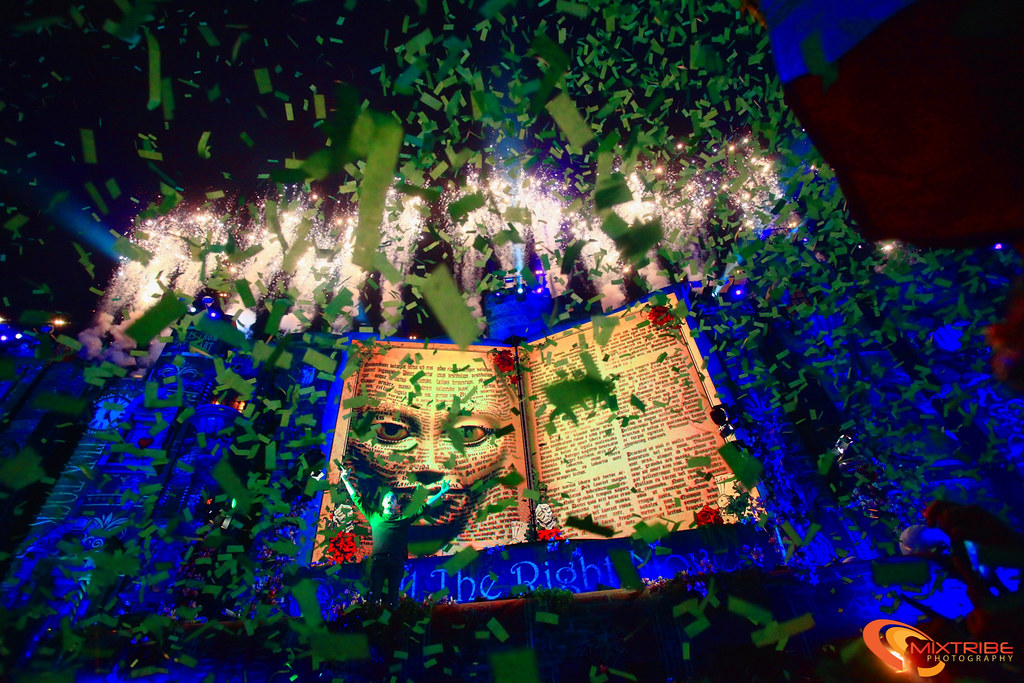 ALESSO - TomorrowWorld 2013 Chattahoochee Hills, Atlanta Georgia USAPhoto hosted by Mixtribe Photo (MIXTRIBE) - open the original
The house package and the Vegas superclub
A venue's house package - its installed PA, lighting, video and DJ booth - is what a touring DJ or production advances against on the rider. The Las Vegas residency clubs show the top end. Hakkasan at the MGM Grand, as documented in 2014, had more than 13,400 square feet of 6 mm LED, mostly Robe fixtures plus Sharpys, and a ChamSys console running 64 DMX universes, with a data gateway that lets emergency lighting take over the rig398. Omnia at Caesars Palace opened in 2015 at a reported $107 million, with a kinetic chandelier of eight rings on 21 winches weighing about 22,000 pounds and an L-Acoustics system399400. XS at the Wynn added pyro, lasers and a 14,000-LED DJ booth in 2015; Wikipedia reports a planned closure from September 2026 for renovation, which we could not confirm independently401.
That emergency-lighting detail at Hakkasan illustrates a general rule (our generalization): a club's lighting network must hand over to house lights when the fire alarm goes. The fire rules themselves are covered under effects above; one example of how they spread is Massachusetts, where a 2004 law after The Station fire required sprinklers in nightclubs with occupancy of 100 or more and added criminal penalties for blocked exits and unpermitted pyrotechnics402.
17The artist's rig, the stream and the rights
The short version: "DJ set" and "live set" sit on a spectrum, from improvised clip-launching to shows locked to timecode, and each point on it needs different production. Recording and streaming a set is easy technically and complicated legally: Twitch has a label license for live DJ streams, YouTube scans everything, and royalties for the tracks a DJ plays still depend on recognition technology that is being rebuilt as of 2026.
Beyond two decks
Ableton Live's Session View is the backbone of many live electronic sets: a grid of clips in tracks and scenes, where "clips can be played at any time and in any order", each track plays one clip at a time, and a scene launch fires a whole row403. Ableton's Push 3 controller can run Live standalone, without a laptop404.
Stem separation - splitting a finished track into drums, bass, vocals and the rest in real time - became a standard feature on the major DJ platforms in about four years:
| Platform | Stems arrived | Detail |
|---|---|---|
| Algoriddim djay | 2020 | Neural Mix, 3 parts405 |
| Serato DJ Pro/Lite 3.0 | 5 December 2022 | 4 real-time stems406 |
| rekordbox | version 6.7 (by early 2023) | 3 stems; 4-stem mode added in v7.2.8407408 |
| Traktor Pro 4 | July 2024 | 4 stems, machine-learning engine based on iZotope RX409 |
As of 2026, stems DJing is mainstream rather than experimental (our reading). What the production needs depends on where on the spectrum a set sits. A timecoded show needs an SMPTE or TCNet feed to lighting and video; an improvised set needs operators who react.
The bridges between them keep improving. In 2017 Pioneer announced that CDJs would send real-time waveforms and track data over PRO DJ LINK to ShowKontrol, which can generate SMPTE timecode synced to the decks and trigger Art-Net, TCNet and MIDI cues188. CDJ-3000 firmware added support for ShowKontrol and PRO DJ LINK Bridge in May 2021410.
"We all hit play"
One of the scene's longest-running arguments has a date. In June 2012, deadmau5 posted "we all hit play" on Tumblr: "i just roll up with a laptop and a midi controller and 'select' tracks n hit a spacebar", and "anyone with minimal knowledge of ableton and music tech in general could DO what im doing"411. It was reported on 25 June 2012 as a reply to the reaction to his comments about button-pushing DJs412. Read with this guide's thesis in mind, it explains why the production exists for this kind of show: if the music is played back, much of the show has to be built from everything else. Plenty of DJs and live performers disagree with his framing of what they do.
Recording and streaming
Pioneer's flagship mixers record and stream directly through the DJM-REC app; the DJM-A9 (2023) can keep the microphone off the recording, and its two USB ports let two DJs swap computers during back-to-back sets413. The DJM-V10 (2020) is likewise DJM-REC compatible414.
The curated livestream format came from two brands. Boiler Room was founded in London in March 2010 as a weekly webcast; ticketing company DICE bought it in 2021 and sold it to Superstruct Entertainment in January 2025, which drew artist cancellations over the parent company KKR's investments415. Cercle, founded in 2016, streams sets from heritage sites, beginning at the Eiffel Tower416.
The rules, as of October 2026:
- Twitch. In June 2020 a wave of copyright takedown notices hit streamers, and Twitch moved from muting clips to removing them and issuing strikes; DJ sets were listed as not allowed417418. In June 2024 Twitch announced its DJ Program, licensed by Universal, Warner, Sony, independents and Merlin. It covers live DJ streaming only; Twitch splits the music cost with most streamers 50/50 out of channel revenue; non-monetizing DJs pay nothing; and the opt-in applies to the whole channel, so Twitch suggests a separate DJ channel419. The DJ category launched on 8 August 2024420. Archived VODs are not covered and can still be muted421. Those are the 2024 launch terms; we could not confirm whether they have changed since.
- YouTube. Every live stream is scanned for third-party content, and a match can replace the picture, pause or end the stream. A license alone does not prevent this; the rights owner has to add your channel to their Content ID allowlist422. Content ID itself lets rights owners block, monetize or track matched material, country by country423.
- Mixcloud Live. Licensed through direct deals with the three majors and more than 250 independents; it needs a Pro subscription, pays artists through audio fingerprinting, and archives audio only, with no video424.
Production advice that follows (ours): plan the archive separately from the live stream, and remember that a simulcast to a platform without a license carries the same unlicensed audio.
Booth etiquette
The norms are consistent across sources:
- Arrive two or three songs before the previous DJ finishes, and know the club's equipment425.
- End on a long, loopy track the next DJ can mix out of, and do not close with a big hit before the headliner425.
- Carry a backup on USB, because PRO DJ LINK can fail; turn the booth monitors down at handover so the incoming DJ sets their own level425307.
- In a back-to-back, do not coach, do not hog the mixer, and do not EQ your partner's track while they are mixing in426.
- Keep headroom; redlining does not make the room louder147.
Firmware is part of etiquette now. The CDJ-3000 has had a steady stream of updates since 2020, and in December 2024 Pioneer posted a notice asking owners to update410. Advancing a show should confirm the exact player model and firmware, and whether a booth mixing CDJ-3000s and 3000Xs links properly; we found no primary source on that compatibility.
Getting the music paid
Live performance royalties are paid from setlists. The UK collecting society PRS collects fees from venues and promoters and pays four times a year, but cannot allocate royalties without a setlist; PRS paid £68.5 million in live royalties in 2024427. In the US, ASCAP OnStage and BMI Live let writers report their own performances428. Nobody writes a setlist for a two-hour DJ mix, so recognition technology fills the gap: PRS works with DJ Monitor, which "tracks when and where electronic music is played"429.
Pioneer's KUVO platform is the other route. It partnered with Canada's SOCAN in 2017 to supply club play data430, closed its consumer features in 2022431, and pivoted to rights data after AlphaTheta invested in DJ Monitor in 2023432. On 21 May 2026 AlphaTheta acquired DJ Monitor's technology and assets to make KUVO a hub for club performance data and music recognition for rights organizations433434. As of October 2026 that platform is consolidating, not finished. The practical advice for producers (our reading): register your works, upload them to the recognition services, and do not rely on DJs filing setlists.
18Who does what
The short version: The tour manager owns the money, the schedule and the people. Production, sound, lighting, video, lasers, rigging and effects crews sit under that umbrella, joined on show day by the venue's own staff. Some of those jobs - riggers, laser operators, pyro operators - need certificates or licenses; most are learned on the job.
 Mozza weekendPhoto hosted by David J (sebilden) - open the original
The roles with solid public definitions:
- Tour manager. Usually hired freelance per tour by the agent or artist manager. Builds the tour budget (crew pay, per diems, lodging, transport, equipment, visas, rehearsals, commissions), advances each show, settles the fee with the promoter after the show, pays per diems, prepares the next day's schedule and guest list, and handles passes435. A road manager handles one act's details; one person can do both jobs435.
- Front-of-house and monitor engineers. FOH runs the audience mix; monitors runs what performers hear436. At a DJ show, as noted above, much of the FOH job is managing level and protecting the system.
- System engineer. Arrives first, measures the room, assembles and tunes the PA, and walks the coverage during the show309.
- Lighting designer. Creates the look within the limits of visibility, safety and cost, and on small tours also programs and runs the desk221.
- Riggers. Hang the chain hoists that lift truss, LED walls and scenery from the building's structure. The head rigger often marks points on the floor and works out bridle lengths by trigonometry437. Certified in the US through ETCP (Arena and Theatre Rigger) and in the UK through the PLASA National Rigging Certificate437438.
- Laser operator. Must be "a trained, competent operator" in direct personal control who can see every beam path (or has a spotter), with emergency stops always within reach223.
- Pyro and flame operators. Licensed or certified under state and local rules; NFPA 1126's 2026 edition, per a published summary, requires "pyrotechnic professionals"334.
The rest are standard practitioner definitions that public sources do not formally pin down, so treat them as trade usage:
- Promoter - takes the financial risk on a show, rents or partners with the venue, pays the artist, and splits what is left.
- Agent - represents the artist and sells dates. The talent buyer works for the venue or promoter.
- Production manager - owns the technical advance, vendors, crew calls and production schedule.
- Stage manager - runs the stage and the changeovers on show day.
- Programmer and operator - build the lighting show file, then run it nightly.
- Backline tech - at an electronic dance music show, looks after the CDJs, mixer and any instruments.
- VJ and video director - the VJ performs the content; the video director runs cameras and IMAG.
- Up and down riggers - up riggers work at height; down riggers on the floor.
- Runner - errands and driving, often the first job in the trade.
38 jobs, one show
Tap a role for what it actually does, who it answers to, and when it's busiest.
DJ or live actThe performer the show is built around.
- Answers to
- Artist manager (business); the stage manager on show day
- Busiest
- Changeover and set time
Artist managerRuns the artist's career and business.
- Answers to
- The artist
- Busiest
- Before the tour, when budgets and dates are set
Tour managerOwns a tour's money, schedule and people.
- Answers to
- Artist manager and business manager
- Busiest
- Advance days, arrival, and settlement after the show
Road managerHandles one act's day-to-day details on the road.
- Answers to
- Tour manager
- Busiest
- All day, from travel to load-out
Backline techLooks after the performer's gear.
- Answers to
- Production manager or tour manager
- Busiest
- Setup, line check and every changeover
Booking agentSells the artist's dates.
- Answers to
- The artist and artist manager
- Busiest
- Months before the show
PromoterTakes the financial risk on the show.
- Answers to
- Their own company or investors
- Busiest
- On sale, doors and settlement
Talent buyerBooks artists for a venue or promoter.
- Answers to
- Promoter or venue owner
- Busiest
- Months before the show
Production managerOwns the technical side of the show.
- Answers to
- Tour manager (on tour) or promoter (for a festival)
- Busiest
- Advance and load-in
Stage managerRuns the stage on show day.
- Answers to
- Production manager
- Busiest
- Changeovers and show time
RunnerErrands and driving.
- Answers to
- Production manager or production coordinator
- Busiest
- All day
FOH engineerRuns the audience mix.
- Answers to
- Production manager
- Busiest
- Soundcheck and show
Monitor engineerRuns what performers hear on stage.
- Answers to
- Production manager
- Busiest
- Line check, soundcheck and show
System techBuilds and tunes the PA.
- Answers to
- FOH engineer or production manager
- Busiest
- Early load-in and tuning, then the show
Lighting designerCreates the lighting look.
- Answers to
- Production manager and the artist's creative team
- Busiest
- Pre-production and programming
Lighting programmerBuilds the show file.
- Answers to
- Lighting designer
- Busiest
- Pre-production and focus
Lighting operatorRuns the lights each night.
- Answers to
- Lighting designer
- Busiest
- Show time
Laser operatorRuns the lasers, in direct control.
- Answers to
- Laser safety officer or production manager
- Busiest
- Setup, alignment and show
Laser safety officerSets the controls that keep lasers safe.
- Answers to
- Production manager and the variance holder
- Busiest
- Setup and alignment checks before doors
VJPerforms the visuals live.
- Answers to
- Video director or production manager
- Busiest
- Show time
Video directorRuns cameras and IMAG.
- Answers to
- Production manager
- Busiest
- Show time
Head riggerPlans and leads the rigging.
- Answers to
- Production manager; works with the house rigger
- Busiest
- First thing at load-in, and again at load-out
Pyro and SFX operatorFires the pyro, flame, CO2 and confetti.
- Answers to
- Production manager and the local fire authority
- Busiest
- Setup, test fires and show
Production electricianDistributes and checks show power.
- Answers to
- Production manager
- Busiest
- Early load-in, then on call
House riggerGuards the building's structure.
- Answers to
- Venue production manager
- Busiest
- Load-in and load-out
Local stagehandsThe venue's or city's crew.
- Answers to
- Their crew chief and the production manager
- Busiest
- Load-in and load-out
Safety and security leadOwns crowd safety and security on site.
- Answers to
- Promoter and festival operations director
- Busiest
- Doors and peak crowd
Crowd managerWatches and manages crowd movement.
- Answers to
- Safety and security lead
- Busiest
- Doors, peak and egress
Fire watchA person acting as the smoke detector.
- Answers to
- Venue fire safety manager
- Busiest
- Whenever detectors are isolated
Harm reduction teamKeeps people who use drugs safer.
- Answers to
- Promoter, with medical and local authorities
- Busiest
- Doors through close
Show directorCalls the big moments live.
- Answers to
- Production manager
- Busiest
- Rehearsals and every show
Timecode and playback operatorRuns the clock a timecoded show follows.
- Answers to
- Production manager or show director
- Busiest
- Programming sessions and every show
Drone show remote pilotFlies the swarm under aviation rules.
- Answers to
- Production manager, within the aviation authority's approval conditions
- Busiest
- About 90 days ahead for a US waiver decision, then show night
Sign language interpreterInterprets performances for Deaf audiences.
- Answers to
- Accessibility coordinator or promoter
- Busiest
- Preparation in the weeks before, then the requested sets
Accessibility coordinatorMakes sure disabled guests can get in, see and get help.
- Answers to
- Promoter or festival operations
- Busiest
- From on-sale through show day
Welfare and peer-support workerLooks after people having a hard time.
- Answers to
- Welfare or medical lead
- Busiest
- Doors through close
Sustainability leadMeasures and cuts a show's footprint.
- Answers to
- Production manager and promoter
- Busiest
- Planning, show days and post-event reporting
Mental health first aiderTrained first responder for people in crisis.
- Answers to
- Production office or welfare lead
- Busiest
- Show days, backstage
Most US stagehands work through IATSE, founded in 1893, which counts more than 168,000 members in more than 360 independent locals that each negotiate their own contracts439. IATSE sits on the ETCP certification council438. How much festival and club work is union versus non-union varies widely, and we found no reliable figure.
One more role deserves naming because its absence keeps showing up in disaster reports: the person with clear authority to stop the show. See the safety section.
A note on scale. Electronic dance music tours often carry less audio than rock tours but much more light, video and laser, so the crew skews toward those departments (our observation). Costs have risen sharply since the pandemic, but public numbers are mostly anecdotes from rock acts: Megadeth's Dave Mustaine put his tour's cost at about $45,000 a day "just to sit still"440, and Shinedown's Brent Smith said trucks and buses alone were "six times more expensive" than in 2019441. Billboard Canada's sources said food, lodging and transport had "as much as doubled"442. An accounting firm's advice is that the number of trucks and buses drives "nearly every major expense category"443.
19The paperwork
The short version: Every show is negotiated in advance and documented on paper. The advance confirms what everyone is bringing; the rider says what the artist needs; the stage plot and input list tell the crew where everything goes and how it connects; the day sheet runs the day; and the settlement reconciles the money afterward. No standards body governs any of it, but good practice is consistent.
The advance
The advance is "the planning conversation that happens before the event", in which artist, venue, promoter and production confirm the details436. A tour manager's advance confirms the rider, contacts, load-in and soundcheck times, set times, support acts and curfews, and the results go into a tour book435. A club-level checklist runs: contacts with phone numbers; load-in, soundcheck and backline (send the plot and input list, and agree what the venue supplies); promotion; tickets and door; and payment - who pays, and when444.
The advance, as a checklist
Ticks are saved in this browser only, so you can keep it open across a week of emails.
The documents
- Technical rider. The artist's production requirements: PA, monitors, DJ booth gear and layout, lighting, power, stage size. For a DJ, usually the exact player and mixer models (trade definition).
- Hospitality rider. Food, drink, dressing rooms, hotels and ground transport (trade definition).
- Stage plot. "A visual map of where everyone and everything goes on stage"436.
- Input list. "The technical companion to the stage plot", telling audio what connects to what; the two must match436. Good practice: keep them as separate documents in large block text readable under stage light, share them as PDFs rather than cloud documents behind a login, date them, and put a contact on every page445.
- Day sheet. The one-page schedule for the day, which the tour manager prepares the day before435.
- Run of show. The minute-by-minute show-time cue sheet (trade definition).
- Credentials. Passes and laminates, handled by the tour manager435.
- Settlement. The post-show money reconciliation between tour manager and promoter: the TM settles the fee and collects anything owed435. The usual structure - gross ticket sales minus taxes, fees and agreed expenses, then the artist's guarantee against a percentage - is trade knowledge we could not source to a published template.
- The emergency plan. Paperwork too, and the one most likely to matter. Astroworld's 56-page operations plan covered shootings, bomb threats and severe weather, but not crowd surges446.
A show day
A typical festival or arena day runs: riggers mark and hang points first; then truss, lighting, video and PA fly in; power is distributed and checked; systems are tested, the PA is tuned, and lighting is focused; line check and soundcheck; changeovers between acts, where "beginners often underestimate transitions"436; the show; and then load-out, "the process of breaking down gear and clearing the venue after the show"436. The order is common practice; every venue's day sheet is the real schedule.
20Rigging
The short version: Rigging is how heavy things are hung safely above people: chain hoists from rated points in the building, or ground-supported towers and roofs outdoors. Hoists built to the D8+ standard can hang loads over people without extra safeties, standard D8 hoists cannot, and outdoor roofs are governed by an engineering standard whose importance the 2011 collapses made clear.
Chain hoists ("motors") attach to the building's structure with steel wire rope and shackles, then lift truss, LED walls and scenery437. A dead-hang point drops straight below a beam; a bridle spans two beams so the hook falls between them437. Weak link analysis - finding the lowest-rated component in the chain - is described as the most common rigging assessment437.
The German hoist standard has two levels that matter. A standard D8 hoist is not designed to suspend loads over people unless a secondary safety is fitted. A D8+ hoist has double brakes and higher safety factors and can suspend over people without one, which also spares a rigger the climb to fit secondaries and the risk of fitting them wrong. The choice should follow a project-specific risk assessment447.
Outdoors, ground support - towers and roofs standing on the ground rather than hanging from a building - is governed in the US by ANSI E1.21, "Temporary Structures Used for Technical Production of Outdoor Entertainment Events", which sets minimum design and performance parameters and does not cover fire or egress; the current edition is 2024448. The Event Safety Alliance lists ESTA standards for rigging, outdoor ground-supported structures and temporary special-event structures449.
The reference failure is again Indiana in 2011: the engineering review found the rigging "wasn't built strong enough to meet state building codes". It was required to withstand 68 mph gusts and came down in gusts of about 59450.
We could not source, and so do not state, ESTA's specific hoist and truss standards, typical arena point loads, or exactly who signs off a rigging plot. In practice the house rigger approves a tour's rigging plot against the building's limits; check the specifics with ESTA and the venue.
21Safety, and what it cost to learn it
The short version: Most of the rules in this guide were written after someone died. The recurring lessons are about crowd density and site geometry, structures rated for the weather, and - over and over - having someone with clear authority to stop the show in time. The UK keeps that knowledge in the Purple Guide; the US in Event Safety Alliance guidance and ANSI standards.
Crowds
Love Parade, Duisburg, 24 July 2010. Twenty-one people died and 652 were injured. A 240-meter tunnel and underpasses fed a single ramp that was effectively the only way in and out; police turned arrivals back by loudspeaker while people kept pushing in from behind. Autopsies found all deaths came from crushed rib cages, and a 2012 scientific analysis described "crowd turbulence", not a stampede451. The trial ended in May 2020 without a verdict, and the Love Parade was permanently cancelled the day after the disaster451. The vocabulary matters: "crowd crush" and "crowd turbulence" are accurate; "stampede", which the analysis rejects, wrongly implies the people caught in it caused it.
Astroworld, Houston, 5 November 2021. Ten people died of compression asphyxia, the youngest aged 9; about 300 were treated on site446. A mass casualty event was declared at 9:38 p.m., and the show ended around 10:10 or 10:15452. Plaintiffs' experts allege the site was planned at 5 square feet per person instead of the fire code's 7, with no density monitoring in the area where all ten were fatally injured, and that the safety lead had written beforehand: "there is no way we are going to fit 50k in front of that stage" - these are allegations, not court findings453. A grand jury declined to indict the headliner, Travis Scott, and five others446.
Structures and weather
Indiana State Fair, 13 August 2011. Seven dead. Sources differ on injuries: some give more than 40, while the Event Safety Alliance's own history and Live Design in 2026 give 58362454. Beyond the engineering failure, one review found preparedness "inadequate" and the emergency plan "not fully developed", and another cited "an ambiguity of authority" over postponing the show455. It was the third weather-related outdoor roof collapse in North America in about three weeks362.
Pukkelpop, Belgium, 18 August 2011. A sudden storm brought down a stage, a large tent and screens with up to 60,000-65,000 people on site, and the festival was cancelled. Early reports said three dead, then five; injury counts ranged from 40 to more than 70456457. Five is the commonly cited final toll, but we could not verify it from an official source.
Who keeps the knowledge
The Event Safety Alliance formed in response to Indiana, led by Linkin Park's tour manager Jim Digby, and debuted at the Indiana Statehouse in April 2012, modeling itself on the UK's Purple Guide362. Its founding date is ambiguous: its origins page says the group formed in early 2012, while it marked its 15th anniversary in 2026, which counts from 2011362454. Both are defensible - the cause was 2011, the organization was 2012. Its Event Safety Guide first appeared in February 2013 and now runs to 39 chapters; as of August 2026 it was developing a second version and an OSHA 10 course for live events362449454. ANSI ES1.9-2020, approved in July 2020, covers crowd management458.
The Purple Guide, originally published by the UK's Health and Safety Executive and taken over by the Events Industry Forum in 2012, is subscription-based, non-prescriptive and runs to 45 chapters, from crowd management and medical to weather, temporary structures and special effects459. The ESA traces it to the aftermath of Hillsborough in 1989362.
Lasers, effects and fire
Covered in their own sections above. The short reminder: no US laser show above 5 mW without an FDA variance, no audience scanning without a specific one, and outdoor beams need an FAA review filed about 90 days ahead223. Indoor sparks near combustible finishes are the pattern behind the deadliest club fires345346348.
Harm reduction
In November 2019 a New South Wales coroner investigating six MDMA-related festival deaths of people aged 18 to 23 made 28 recommendations, including a drug-checking trial "as soon as possible" and an end to drug dogs; the state government opposed pill testing460. In the UK, a new Home Office licensing requirement stopped on-site drug checking in 2023, until the drug-checking charity The Loop received the first license in May 2024461. In the US, DanceSafe (founded 1998) was integrated on site at TomorrowWorld, which the Drug Policy Alliance called a first for a major promoter462 - against the background of the liability fears described under the RAVE Act above.
The common thread
Our reading of the record: across Indiana and Astroworld, nobody with clear authority stopped the event in time. Indiana's reviews say so explicitly; in Houston, roughly half an hour passed between the mass-casualty declaration and the end of the show455452. Every production document in this guide can be perfect, and it still comes down to someone being empowered, and willing, to call it.
22The money
The short version: A promoter takes the financial risk, pays the artist under one of a handful of deal types, and settles up in cash and spreadsheets on the night. The headline percentage in a deal means little until you know what it is a percentage of. Out of a ticket price, a large slice goes to ticketing fees and production before anyone on stage sees a cent, and production costs jumped after 2020. The International Music Summit's annual report valued the electronic music business as a whole at a record $15.1 billion for 2025. Public data on what individual DJs earn per show is thin, and most of the famous numbers are estimates.
A warning about sources, because it shapes everything below. Deal terms are private, and most published explanations come from attorneys' guest posts, booking agencies and software vendors selling budgeting tools. We use them for definitions and label their figures as illustrative. Several of their own worked examples do not add up, which we flag where it happens.
Deal types
The standard menu, as an entertainment attorney lays it out, is: a flat fee; a flat fee plus a percentage of event earnings; a percentage only; a percentage of tickets the artist personally sells; and a "versus" deal, where the artist gets a guaranteed fee or a percentage, "whichever amount is greater"463. He calls versus deals rare and used by top acts463. A ticketing platform's offer form shows the same menu in practice - flat fee, guarantee or percentage (whichever is higher), guarantee plus percentage, and percentage only, which is the door deal - along with fields for the deposit, the radius clause, set length and the agency fee464.
The crucial word is what the percentage applies to. Gross box office receipts are ticket sales at face value with no deductions; net is gross minus defined deductions such as sales tax, ticketing and card fees, facility fees and the face value of comps465. A booking agency's example of a versus-gross deal: a $5,000 guarantee versus 60% of gross. If the show grosses $10,000, the artist gets $6,000, $1,000 over the guarantee, and the buyer keeps $4,000 for expenses; the agency notes that a gross deal avoids expense reporting and complicated settlement sheets466. Deals against net go further and can add a promoter profit to the expenses before the split - one vendor guide's example treats promoter profit as 15% of expenses467. The crossover where the percentage starts paying more than the guarantee is the split point467.
So "85%" can mean very different money (our reading of those definitions). Eighty-five percent of gross is most of the room's takings; eighty-five percent of net after taxes, fees, the promoter's costs and the promoter's profit may be nothing at all until the room is nearly full. The definitions in the contract matter more than the headline number. One talent-buying consultancy claims typical door-deal percentages for established headliners of 70-85% of net at clubs rising to 90-95% at arenas, but it is self-published marketing and one of its own split-point examples is wrong by several thousand dollars465.
Deposits, radius clauses and riders
A deposit of usually 50% of the fee, paid in advance, holds the date; the balance can be due a day or two before, on the day, on arrival or after the show463. If the promoter cancels after paying the deposit, the artist generally keeps it468. The 50% figure is widely repeated, but it comes from one attorney's guest post, not a survey.
A radius clause stops the artist playing within a set distance of the venue for a set time before and after the show, and the attorney's advice to artists is to limit both468. A vendor guide claims typical windows of 30-60 days before club dates, longer around festivals, over distances of roughly 50 to 150 miles; treat that as illustrative465.
The rider decides who provides and pays for what. In the attorney's sample contract, the promoter provides flights, hotel rooms and a per diem and carries licenses, permits, insurance and security, while the artist pays for its own backline, sound and lighting468. That reflects band touring. Most DJs play the house sound system (see the clubs section), so production usually sits with the venue or promoter unless the act carries its own show (our reading). In the DJ world, a 2015 Mixmag survey of unnamed agents, managers and promoters found that promoters usually cover travel and accommodation for nationally touring DJs, while for global touring DJs long-haul flights and visas are often on the DJ, and superstar rider spending can exceed a mid-level DJ's fee469. Converting travel and hospitality into a single cash sum - a buyout - is common industry usage, but we found no reputable source that defines it.
Settlement
Settlement is the meeting, usually during or right after the show, where promoter and artist reconcile the numbers and the artist is paid their share463. Deductible expenses can include staff, advertising, venue rental, sound and lighting rental, insurance, security, stage crew and public performance licenses, and the attorney's advice is to cap comps so the promoter cannot "paper the house" with free tickets that dilute a percentage463. A promoter-software vendor puts it neatly: "Settlement is just the budget after the show happens" - real ticket counts, receipted expenses and day-of adjustments decide the artist payout and the promoter's profit467. It groups costs into fixed (rent, base security, insurance), variable (facility fees, card processing), revenue-dependent (promoter profit, bonuses, commissions) and the ones people forget, such as performing rights licensing and weather contingency467.
The tour manager usually handles settlement for the artist (see who does what). The practical advice that follows from the definitions above (ours): get the deal's definition of net, the list of allowable expenses and the comp cap in writing before the show, because settlement is the wrong time to discover them.
Where a ticket dollar goes
Source: NITO, a trade group of independent agencies, as reported by Hypebot (Dec 2024). The same article cites fees averaging 28% nationwide, so treat the split as illustrative.
The most-quoted breakdown comes from NITO, the National Independent Talent Organization, a trade group of independent agencies. On a $100 ticket it estimates that more than $20 goes to ticketing fees, shared by venue, promoter and ticketer with none to the artist; about $30 goes to staging, production, venue staff, sound and security; and the remaining roughly $48 splits about 85/15 between artist and promoter-venue. The artist's own costs - crew, travel, management, agents - then eat 75-85% of the artist's share, leaving about $8.16470.
Read that with three caveats. NITO is an advocacy group in the ticketing and antitrust debate, so this is an estimate, not audited data. It is built around band touring, not DJs, who usually carry far fewer people. And the same article also cites fees averaging 28% of face value nationwide, which conflicts with the "over 20%" in the breakdown470. The shape is still useful: fees and production take roughly half of the ticket before the artist's share is calculated.
The firmest number in this area is regulatory. In the US, since May 2025 and still as of October 2026, the Federal Trade Commission has required sellers of live-event tickets to show the total price, including all mandatory fees, wherever a price is shown, with the all-in price most prominent471. The rule "does not prohibit any type or amount of fee" and does not ban particular pricing strategies, so dynamic pricing is unaffected471. In our reading it changes what the fan sees at checkout more than what the fan pays. In a deal against net, fees and taxes deducted before the split directly reduce what the artist's percentage is worth, which is why "net" gets negotiated so hard (our reading).
Production costs after 2020
When live music came back in 2022, the cost of putting on a show had jumped. The chief executive of Knitting Factory Entertainment said "everything - generators, lighting rigs, staging rigs - was now 20-30 percent more expensive, because everybody was spread so thin"472. A Pollstar recap of its 2023 production conference reported tour driver salaries up 40% and buses, trucks and jets booked out into 2024; one production manager called touring "cost-prohibitive, to be honest", and said the problem was skilled labor, not headcount473. A year earlier, stagehands were so scarce that one show used security and ushers for the load-out474, and crew were taking on extra roles without extra pay while freight and fuel costs climbed475.
Electronic dance music acts with big rigs felt it directly. In 2023 the Chemical Brothers said of North America, "The costs have gone up so much. It's just not really viable at the moment", and planned to cut the cost of their stage production476. A DJ who plays the house rig carries almost no production cost; an act with custom LED, lasers and its own crew needs a higher fee, a production line in the deal, a promoter-funded budget or a sponsor, and the Chemical Brothers example shows a big rig can make a whole market unviable (our inference). The reporting on cost rises is concentrated in 2022-23. We found no 2025-26 trade figures showing whether costs have since come back down.
The size of the business
The International Music Summit's annual Business Report, written by Mark Mulligan of MIDiA Research and presented at IMS Ibiza on 22 April 2026, valued the global electronic music industry at a record $15.1 billion for 2025, up 7% from $14.2 billion in 2024477. That total spans recordings, publishing, streaming, festivals and clubs, creator tools, merchandise and brand deals; the public coverage does not give a dollar split between them477. Recorded music grew 9% and publishing 11%478.
The live side is more mixed. Ibiza's club ticket revenue reached an all-time high of €160 million in 2025, up from €150 million, while the average number of events per venue fell from 144 to 140477. A panelist suggested that reflects higher prices and possibly fewer attendees478; "fewer, pricier nights" is a reasonable reading but not a reported finding. At the other end of the scale, 53% of UK grassroots venues made no profit in 2025, according to the Music Venue Trust figures cited in the coverage477. Mulligan forecasts general-admission tickets becoming more affordable in 2026-27, offset by pricier VIP; that is a forecast478.
Touring grosses and festival scale
The best-documented recent electronic numbers are box office totals. Pollstar's figures for Anyma across 14 headline reports came to 238,324 tickets and $35.1 million gross, an average of about 17,000 tickets and $2.5 million per show, though Pollstar does not say whether his Sphere shows are included479. His first six Sphere shows drew more than 120,000 people, according to his own law firm, which did not disclose the gross480. EDC Las Vegas reported "over 525,000 festival-goers" across three nights in 2024 - an organizer figure that counts daily admissions, not unique people - and sells next year's passes with "deposits starting at $5"481.
What DJs earn
This is where the numbers get soft. Forbes' annual list of top-earning DJs estimated total yearly income from touring, merchandise, endorsements, recordings and businesses, not fees per show. Its 2016 edition put Calvin Harris at $63 million for June 2015 to June 2016, followed by Tiësto at $38 million and David Guetta at $28 million482. A secondary report of the 2019 list, the most recent edition we could find, put the Chainsmokers top at $46 million and the top ten at about $270 million combined483. We could not confirm from Forbes whether 2019 was the final edition.
Per-show figures are weaker still. DJ Mag, reporting the 2016 list, repeated "some reports suggesting the DJ earns $400,000 per gig" for Harris - "reports suggest" is as firm as that number gets482. Mixmag's 2015 tiers, built from unnamed industry estimates in pounds, ran from about £100 a night or nothing for a local resident, through £250-£2,500 for a national up-and-comer and £2,000-£5,000 a gig for a global touring regular, to at least £10,000 at small venues and £20,000-plus on festival main stages for superstars, with agents and managers each taking 15-20%469. That is a decade old and illustrative, but it is the only tiered picture we found from a reputable outlet. Las Vegas residency fees are private, and we found no primary source for any of them.
The shape of the market, in our reading: a very small top tier earning tens of millions from a mix of fees, residencies and brands; a broad middle that lives on volume and travel; and a large base for whom DJing is part-time. The arms race in production widens that gap, because a headline show's rig is a cost the middle cannot carry (see the lineage section).
23Access, health and harm reduction
The short version: A show is for the whole audience, including the people it is easiest to forget: people with photosensitive epilepsy standing under the strobes, Deaf fans at a gig with no lyrics to interpret, wheelchair users trying to see over a standing crowd, people who need a quiet place to recover, and people who use drugs and may need help. The law covers some of this - disability access in the US and Great Britain, free water in licensed premises in England and Wales - and recommendations and voluntary schemes cover a lot more. Harm reduction, especially drug checking, depends heavily on where you are and has changed fast; as of October 2026 it ranges from licensed services to outright bans.
Strobes and photosensitive epilepsy
Strobe and flashing light can trigger seizures in people with photosensitive epilepsy, which affects roughly 3% of people with epilepsy and most often starts between the ages of 7 and 19484485. The risky band is usually given as roughly 3 to 30 flashes per second, but the two big charities draw its lower edge differently, so we attribute both. The UK's Epilepsy Society says rates "between 3 and 30 hertz" are the most common triggers, that some people are sensitive up to 60 Hz, and that flicker between 16 and 25 times a second is the most likely to trigger seizures484. The US Epilepsy Foundation says flashing between 5 and 30 per second is "most likely to trigger seizures", and that the threshold varies by person485.
The UK number most often quoted for clubs is a recommendation, not a law. The Epilepsy Society reports that the Health and Safety Executive recommends club strobes flash at "a maximum of four flashes per second", and states plainly that "Christmas lights and strobe lights are not covered by UK law"486484. We could not find the HSE document itself, so that figure comes to us via the charity. No source we found sets a legal requirement for strobe warning signs in the UK or US.
Video is different, because broadcast and web standards do set a number. Ofcom restricts flashing on UK television to three per second or less, limits how much of the screen may flash and requires warnings, according to the Epilepsy Society's summary (we could not load Ofcom's own guidance)484. The web accessibility standard WCAG 2.2 says content should not flash "more than three times in any one second period" unless the flash falls below defined luminance and red-flash thresholds, which come from the broadcast standard ITU-R BT.1702487. Those rules are not legally binding on live lighting, but they are the defensible benchmark for LED wall content and anything that goes out on a stream (our reading).
What that means in practice is an inference, because no source quantifies typical show strobe rates: electronic dance music shows often run strobe chases well above four flashes a second, so the realistic mitigations are clear warnings before people buy tickets and at the door, keeping LED-wall content within the three-flash rule where possible, and avoiding long full-field strobe at the most dangerous rates. The Epilepsy Society's advice to individuals is worth printing on the warning: covering one eye completely reduces the effect, but closing both eyes can cause a flicker effect of its own484. Even the festivals with detailed access guides can miss this; EDC Las Vegas's 2026-cycle accessibility page, thorough on platforms and interpreters, does not mention strobe or flashing-light warnings488.
Deaf and hard-of-hearing audiences
Three tools are established: sign language interpreting, vibration you can feel, and events run by Deaf people themselves.
Interpreting. At the big US festivals, sign language interpreting is usually on request. C3 Presents' program at Lollapalooza and Austin City Limits, as described in 2018, picked shows from patron requests, vetted interpreters through a panel that included Deaf evaluators, and had interpreters study past setlists and artist interviews; but "DJs without vocals generally are not" covered489. EDC Las Vegas offers ASL interpretation on request through an online form due "no later than 30 days before the event"488. Both details point to the same gap for electronic dance music (our reading): interpreting keys on lyrics, instrumental sets often go uninterpreted, and a 30-day deadline is a barrier for anyone who buys late.
Vibration. Wearable haptics fill part of that gap. Music: Not Impossible's wireless vests, with wrist and ankle bands whose vibration points map to different instruments, were demonstrated with Deaf and hearing attendees at Life is Beautiful in Las Vegas in 2018490. Falmouth University used Woojer haptic vests and Beat Blocks bass flooring in DJ workshops in 2023 with partners including Deaf Rave491. Bass you can feel through the floor is not new in this music: Fabric's Room One in London has a "bodysonic" floor built to vibrate (see the clubs section).
Deaf-led events. Deaf Rave, founded by Troi Lee, is an award-winning Deaf-led organization in which Deaf DJs and producers create spaces to experience music "through vibration, rhythm, and movement"492.
The legal hooks are general rather than music-specific. In the US, Title III of the Americans with Disabilities Act requires public accommodations to "communicate effectively" with people with disabilities493. In Great Britain, section 20 of the Equality Act 2010 requires reasonable steps to provide an auxiliary aid where a disabled person would otherwise be at a substantial disadvantage, and the disabled person cannot be charged for it494. We found no reliable data on how many festivals actually provide interpreters, and no source on live captioning at electronic events.
Mobility
The standard kit at a large festival is accessible viewing platforms, accessible entrances and camping, companion tickets, and accessible parking or shuttles. EDC Las Vegas's 2026-cycle guide is a typical example: viewing areas at designated stages on a first-come basis (a spot is reassigned after a 30-minute absence), one companion wristband per guest with a disability, a single accessible entrance, wheelchair-accessible shuttles booked two weeks ahead, charging for mobility devices, and only trained service animals, not emotional support animals488. The page is itself confused about which year it covers488.
US ticketing has hard rules. Under the Department of Justice's 2010 ADA regulations, venues "cannot charge higher prices for accessible seats than for non-accessible seats in the same seating section"; accessible seats must be sold through the same channels, hours and presales as other seats; a buyer may buy up to three companion seats in the same row; and unsold accessible seats may be released only when the other seats are gone495. The 2010 standards require, for example, ten wheelchair spaces in a 1,000-seat venue495. In Great Britain the Equality Act's reasonable-adjustments duty covers policies, physical features and auxiliary aids494.
The best evidence that platforms matter comes from the UK charity Attitude is Everything, which has worked on disabled access to live music since 2000496. Its 2014 State of Access report, based on 228 mystery-shopping reports from 2011-13, found that disabled patrons rated venues 7.1 out of 10 with a viewing platform and 5.1 without, and festivals 6.2 versus 4.3; 83% of disabled respondents said inaccessible booking had put them off buying a ticket497. Those figures are more than a decade old, and we found no newer survey. The charity's Live Events Access Charter, launched in 2000 and endorsed in 2017 by UK Music's Live Music Group and the UK government as best-practice standards, has four tiers from Bronze to Platinum and more than 210 venues and events with awards498.
Sensory access and quiet zones
The strongest citable anchor here is the World Health Organization's Global Standard for Safe Listening Venues and Events (2022), covered in the sound section for its 100-decibel average limit311. Two of its six features matter for access: making hearing protection available to audiences with instructions on use, and "access to quiet zones for people to rest their ears and decrease the risk of hearing damage"499. DanceSafe's booths and Boom's Kosmicare service both hand out earplugs500501.
The WHO's reason for quiet zones is hearing. They also serve autistic and other neurodivergent attendees who need somewhere to regulate, which makes them a two-for-one design decision (our framing, not the WHO's). In Great Britain, neurodivergent people who meet the Act's definition of disability are covered by the same reasonable-adjustments duty (our reading of section 20; we did not check the definition itself)494. We found no reputable source for festival sensory maps, low-sensory hours or calm-space policies, so we are not describing any specific scheme.
Heat, water and medical cover
In England and Wales, free drinking water is a mandatory condition of alcohol licenses: "Free potable water must be provided on request to customers where it is reasonably available on the premises"502. We found no equivalent statewide requirement in the US.
Heat is a documented load on medical services at summer and desert events. On the first night of EDC Las Vegas on 16-17 June 2017, during the city's first major heat wave of the year, with forecasts up to 117°F, there were 443 medical calls and six hospital transports among an estimated 136,000 attendees; officials would not say how many calls were heat-related503. So the calls cannot be blamed on heat alone, and we are not doing so. The NHS's lay guidance is the clearest to hand on: heat exhaustion usually is not an emergency "if you can cool down within 30 minutes", but heatstroke "needs to be treated as an emergency", with signs including hot skin without sweating and confusion504.
Medical staffing ratios and planning detail sit in the Purple Guide's medical chapter, which is subscription-only (see the safety section). We found no public standard for how many medics a given crowd needs.
Harm reduction
Drug checking means analyzing a sample of a drug and returning the result with advice. A 2017 background paper for the EU drugs agency is careful about the evidence: the arguments for it "are not scientific proof of its effectiveness", but studies found no rise in drug use after services opened, and that 25-100% of people discard a drug on learning it contains something harmful; critics worry about a false sense of security and crude tests505.
Its legal status varies so much that "legal" is usually the wrong word. The accurate verbs are licensed, permitted, funded or tolerated, with a place and a date:
- Netherlands. The health ministry funded Europe's first drug-checking system in 1992505.
- Austria, Switzerland, Portugal. Vienna's checkit! offers anonymous, free, confidential checking506, and the EU paper dates on-site services in Austria to 1997 and in Zürich and Portugal to 2001505. At Boom, Kosmicare's lab operates under "a special permit issued by the Portuguese authority SICAD", and the festival notes that drugs are not legal in Portugal but decriminalization law permits risk-reduction projects501.
- United Kingdom. The Loop ran the UK's first event-based drug checking at Secret Garden Party and Kendal Calling in 2016507. From 2023 a Home Office licensing requirement stopped some on-site festival checking - The Loop could not operate at Manchester's Parklife that year - until the Home Office confirmed licensed on-site testing on 24 May 2024 and The Loop obtained the first license for it, as the safety section describes461.
- Australia, as of October 2026. The ACT will continue its CanTEST service "until at least June 2027"; Queensland closed its sites in April 2025 and in September 2025 became the "first Australian state to ban pill testing"; Victoria runs mobile festival services and opened a fixed site in August 2025508. New South Wales ended its festival trial in February 2026 after testing more than 1,500 samples and committed A$4.3 million to continue testing at up to 15 festivals a year, with police sniffer dogs continuing509. Headlines called that "permanent"; the reporting describes funded continuation, not legislation509.
- United States, as of October 2026. DanceSafe, founded in 1998, checks drugs at events "with event producers' consent" and hands out information, earplugs, water and consent materials500. The barrier is liability. The 2003 law known as the RAVE Act made it illegal to knowingly lease, rent or use a space for drug use, and researchers interviewing drug checkers found promoters refusing, or revoking booth approval on the day, for fear of prosecution - though the checkers knew of no such prosecutions392. The background is in the clubs section.
Naloxone, which reverses opioid overdoses, is far more accepted at US festivals than drug checking. At Bonnaroo in 2022 the nonprofit This Must Be the Place handed out 2,500 doses of nasal naloxone and medics carried it, while fentanyl test strips were decriminalized in some states and still counted as drug paraphernalia in others510. KFF reported that naloxone then still required a prescription, with distributors relying on good Samaritan laws510. Its US status has changed since 2022; check the current rules where you are before writing a policy.
Peer support for difficult psychedelic experiences is its own discipline. The Zendo Project offers it at festivals and has served at Burning Man since 2012, under four principles: "Safe Space", "Sitting, Not Guiding", "Through, Not Down" and "Difficult Is Not Necessarily Bad"511. Kosmicare runs a psychedelic emergency service next to Boom's medical services, staffed by psychologists, psychiatrists, nurses and volunteers501.
Welfare and harassment
The verifiable schemes are UK-led. Ask for Angela is a codeword for a fictitious staff member: someone who asks for "Angela" is helped somewhere safer. It started in Lincolnshire in 2016, was devised by a police inspector, is named after Angela Crompton, who was killed in 2012, and has been adapted across the UK512. The Good Night Out campaign accredits and trains venues, clubs, festivals and local authorities to "understand, respond to, and prevent sexual violence", including spiking, and reports 298 organizations and 6,064 people trained513. DanceSafe runs consent education at its booths500.
We found no reputable source for named festival safer-spaces policies or for welfare-team staffing, and no reliable prevalence data on harassment at festivals, so we are not quoting any. The practical shape is still clear (our recommendation, not a standard): a written safer-spaces policy, staff trained by an accredited provider, a visible way to report a problem, and welfare staff who are not security.
24Greener shows
The short version: Travel is the largest share of a festival's carbon footprint, and flying is the largest share of a touring DJ's. How much is audience travel depends on who is counting: an old UK estimate said up to 80%, a 2023 analysis says about 41% on average. The part a production manager controls - power, haulage, catering, waste - can be cut steeply, as one battery-powered Bristol show demonstrated in 2024. Most of the big green claims in this business are self-reported by festivals and suppliers, so this section labels them as claims.
Where the emissions come from
The baseline UK study is The Show Must Go On (2015), from the festival-industry groups Powerful Thinking and Vision: 2025. It estimated that UK festivals emit about 100,000 metric tons of CO2 equivalent a year including audience travel, of which about 20,000 metric tons is on site; that audience travel is "up to 80%" of the total; that energy is about 65% of the on-site footprint; and that festivals burn about 5 million liters of diesel a year514.
That 80% still circulates, and it is now disputed. A Greener Festival's 2023 carbon analysis puts audience travel at about 41% of festival emissions on average, with a range from 18% to 76% by event and just under 50% for UK events, and says earlier studies inflated the travel share by leaving out food and drink; food and drink came out at just over 34%, the second-largest source515516. All transport combined - audience, artists, production and traders - was over 58%515. The write-ups we read do not give the sample size or method. Our position: treat 80% as an upper bound from an older estimate and about 41% as the more defensible average. Either way, transport is the biggest single category.
Festivals' own figures vary with their audiences. Tomorrowland, which draws heavily from abroad, said in 2026 that travel is over 70% of its footprint517. For UK live music as a whole, a 2019 scoping study by the Tyndall Centre for Climate Change Research, commissioned by Massive Attack, estimated about 405,000 metric tons of greenhouse gas a year, with 33% from audience travel and 34% from venues518.
For electronic dance music specifically, artist flights are an outsized lever. The Berlin collective Clean Scene's 2021 report Last Night a DJ Took a Flight studied the top 1,000 DJs in Resident Advisor's 2019 rankings and estimated they took more than 51,000 flights that year, producing about 35,000 metric tons of CO2, roughly the yearly electricity use of 20,000 households519. Its recommendations were to champion local scenes, route tours efficiently, share best practice and book more BIPOC artists, and it said its aim was accountability, not blaming individuals519520. We found no follow-up study since.
What a low-carbon show looks like
The most carefully measured example is Massive Attack's ACT 1.5 on Clifton Downs in Bristol over the August 2024 bank holiday, for more than 32,000 people. It was billed as the first 100% battery-powered festival of its size, with electric trucks shuttling batteries off site to recharge on renewable power; catering was entirely plant-based; and the show laid on five times the usual late trains, electric shuttles and incentives for rail travelers, including a localized presale and chartered trains521. The Tyndall Centre's analysis reported cuts of 81-98% for power, 89% for catering, 70% for equipment haulage and 73% for artist travel521.
Two caveats keep those numbers honest. The comparison is against a hypothetical "typical" outdoor concert where environmental measures were not prioritized, not a measured earlier event. And the travel problem did not go away: about 5% of attendees flew, and they caused 64% of the event's greenhouse emissions521. Cut everything you control and the total is still dominated by how people arrive.
The show grew out of a 2021 Tyndall Centre roadmap published by the band, which called for rail incentives and chartered trains, electric and rail freight, "plug-and-play" venue power and batteries replacing festival diesel522.
Power, fuel and waste
Energy is the main on-site lever, at about 65% of a festival's on-site footprint in the 2015 estimate514. The moves, roughly in order of ambition:
- Swap the fuel. HVO, hydrotreated vegetable oil, runs in standard diesel generators. At Glastonbury in 2019 the supplier Aggreko used an HVO blend made from used cooking oil and waste fats, plus hybrid solar-and-battery generators in some areas, and claimed more than 200 metric tons of CO2 saved by the hybrids and greenhouse cuts of more than 80% from the fuel523. Those are supplier claims. As general background, not something our sources established: HVO's benefit depends on genuinely waste-derived feedstock, and it is still burned on site, so it does much less for local air quality than for carbon.
- Add batteries. Festival loads are spiky, and generators sized for the peak spend most of the night running at low, inefficient load. A battery lets a smaller generator run steadily (our explanation of the principle). Boom piloted three battery systems in 2025 explicitly to "regulate generators" and cut fuel524.
- Go all-battery or grid. ACT 1.5 ran entirely on batteries521; the Tyndall roadmap argues for permanent grid connections at regular sites522. Boom's site was merged with the grid from 2018524.
- Meter it. Powerful Thinking's case study of energy monitoring at Glastonbury is the practical guide to sizing power to the actual load rather than the guess525.
On the lighting side, LED fixtures draw far less power than the discharge lamps they replaced (a general point; we found no show-specific measurement to cite).
Waste is the other visible stream. Tomorrowland says its reusable cups now carry chips linked to wristbands so deposits refund anywhere on site517. Amsterdam's DGTL tracks everything entering and leaving its site with a material flow analysis and reports cutting residual waste from about 93 grams per visitor per day in 2019 to about 20 in 2022526. LED wristbands are a waste stream of their own; see the new technology section.
Reading the claims
Festivals make bold promises, and most of them are self-assessed. A few as of October 2026:
- Tomorrowland says it runs entirely on HVO100, with "up to 90%" lower CO2 from energy, that its party flights use sustainable aviation fuel, and that it aims to be "the most sustainable festival in the world by 2030", with KPMG as a partner517527. "Up to" is a best case, and KPMG's page publishes no methods or results.
- DGTL says it aims to be "the first circular, climate-neutral major event"526. A Dutch business journalist who looked at its plans concluded that a fully circular festival "for now seems mainly a utopia", chiefly because of DJ flights; that is the journalist's conclusion, not DGTL's528.
- Boom reports running generators on waste vegetable oil, with 45,000 liters avoiding 117 metric tons of CO2 - though the identical figures appear for both 2008 and 2012, which is odd524.
- Coldplay, as a benchmark from outside dance music, said in 2024 that direct emissions per show in the first two years of its Music of the Spheres tour were 59% lower than on its 2016-17 tour, against a 50% pledge, in an analysis endorsed by an MIT professor. Its scope is production, freight and band and crew travel - not fan travel, the biggest slice in most studies - so it cannot be compared with festival-wide footprints529.
We found no independent audit of the Tomorrowland, DGTL or Boom figures. That does not make them wrong. It makes them claims.
The honest summary (ours): production teams can now cut their own share of a show's emissions dramatically, with batteries, better fuel, metering, rail freight and plant-based catering, and ACT 1.5 shows it can be done at scale. But the total is set by travel - the audience's and, in this genre especially, the DJs'. Booking more local talent and routing tours sensibly are production decisions too.
25Getting into the work, and lasting in it
The short version: Most production jobs are learned on crews, not in classrooms. Formal credentials exist mainly where mistakes kill people or cost a fortune - rigging, entertainment electrics - and in audio networking, where one vendor's free certification has become the common standard. Console, PA and media-server makers run their own training, which builds skill and credibility but is not a license. In the US, union stagehands join through an IATSE local. And the work is hard on people: the research on touring crews points to elevated depression and suicide risk, and the pandemic showed how little protection freelancers had.
Credentials that actually exist
ETCP (North America). The Entertainment Technician Certification Program, run by ESTA, certifies riggers and entertainment electricians in the US and Canada. Riggers choose one or both of two specialties, Arena and Theatre; candidates must be 21 or older and need 30 eligibility points530. The points come mostly from documented work: one point per 100 hours of entertainment rigging, with internships and apprenticeships capped, and education capped at 10 points in total - a bachelor's degree is worth 3, or 7 if it is in entertainment technology531. Courses taken outside a formal degree program do not count at all530. The arithmetic says something about the trade (our reading): 3,000 hours of rigging work alone gets you to the exam, while no amount of schooling gets you more than a third of the way.
The rigging exam is computer-based: 150 scored multiple-choice questions plus unscored pretest items in three hours, with a non-programmable calculator and an architect's scale recommended. It costs $650 ($550 for ESTA members), and certification is renewed every five years with 40 renewal credits, or by retaking the exam plus 10 credits531. The handbook lists the retake fee inconsistently, so check with ETCP531. The Entertainment Electrician exam also needs 30 points and is meant to validate "the top third" of entertainment electricians across theater, film and TV, arenas, touring and theme parks532.
PLASA National Rigging Certificate (UK). An assessment, not a training course. Level 2 is for riggers working without direct supervision; Level 3 is for supervisors and requires Level 2 plus 12 months of supervisory experience533. It combines written questions with practical tasks on chain hoists, truss and accessories, requires evidence of work experience, and excludes rope access533. As of October 2026 the Level 2 assessment is £715 plus VAT, Level 3 is £880 plus VAT, registration is £218 plus VAT, and cards last three years533.
Dante (audio networking). Audinate's third-edition Dante Certification, announced in October 2025, has three levels covering IP networking, system design, integration with AES67 and SMPTE ST 2110, and troubleshooting; it is free, valid for three years, and delivered online and in person534535. Given how much show audio now runs over Dante (see the networks section), it is the most standardized and accessible credential in this list (our reading).
Lasers. The US entertainment laser safety standard, ANSI Z136.10, is being revised: the committee page lists it at the comment-adjudication stage of development, without a current edition year536. The legal side of laser work, including the FDA variance, is in the lasers section.
Vendor training
Manufacturers train people on their own gear, and the honest description is "skills and credibility, not a license".
- MA Lighting runs "MA University", combining e-learning with face-to-face courses taught by certified trainers; its grandMA3 courses at Prolight + Sound 2025 sold out early. The source does not say whether participants receive a formal credential537.
- L-Acoustics has long run a ladder of system training; in 2013 it ran from K-system training to System Technician to K Systems Engineer, the last requiring five or more years in audio538. Its current site refers to "L System Engineer" and "L-ISA System Engineer" paths, so the names have changed539.
- Resolume, widely used VJ software, offers self-paced video training - about two hours in seven chapters for Avenue and Arena - with no certification mentioned540.
Schools
Degrees exist, and they help with the first door rather than the certificate. Two examples we verified from the schools' own pages: Full Sail University in Florida offers a campus-based BS in Live Event Production in an accelerated format, with courses in automated lighting, audio measurement and video production541; the Liverpool Institute for Performing Arts (LIPA) offers BA degrees in Theatre and Production Technology and in Sound Technology542. We did not verify others, and we are not ranking any.
Unions
Many US stagehands work through IATSE, which counts more than 168,000 members in more than 360 locals, each negotiating its own contracts439; Backstage puts membership at about 170,000543. You join through a local, which requires proof of experience and passing "a reasonable examination" in your craft under the union's bylaws, and some locals add interviews or orientation; fees and dues vary by local543. Apprenticeship and overhire routes also vary by local, and we could not verify them from IATSE itself.
We found no reputable source for a standard career ladder - stagehand to technician to crew chief to production manager, or runner to production coordinator - so we are not presenting one as fact. The common experience is that people move up by being reliable on the last job.
Lasting in it
The work is long hours, nights, travel and freelance income, and the research is starting to measure what that costs. Chayim Newman and Zack Borer surveyed touring professionals online in early 2020, with 1,154 respondents of whom 550 completed the full measures, and reported in Psychology of Music that trait mindfulness may protect against depression and suicidal behavior544. Pollstar also reports that their earlier survey of more than 1,100 touring professionals found rates of depression, anxiety and suicide risk "five to 10 higher" than in the general population544. That phrase is ambiguous - it could mean percentage points or multiples - and we could not check the original paper, so read it as "substantially higher" and no more precise than that.
Help exists. Music Support, a UK charity founded in April 2016 by people from the music industry, runs a confidential helpline (0800 030 6789), counselling, addiction and family support, Mental Health First Aid training, and "Festival Safe Hubs" - backstage spaces at UK festivals staffed by people trained in mental health first aid545. Behind the Scenes in the US and Backup in the UK also support entertainment workers; we could not read their sites, so we cannot describe what they offer546547.
The pandemic was the stress test. On 1 September 2020, from 9pm to midnight, more than 1,500 venues, landmarks and homes across the US were lit red for #WeMakeEvents' #RedAlertRESTART, modeled on a UK action on 11 August; the campaign called for small-business aid and extended unemployment support for freelance 1099 workers548549. It cited figures that 77% of employees had lost all income and 97% of 1099 workers had lost jobs548. Those numbers came from the campaign, not an independent census, but the picture they paint - a workforce of freelancers with no safety net when the shows stopped - is the context for the cost rises in the money section.
The practical advice is short (ours): get the certificates your trade actually requires, take the free ones, keep a log of your hours from day one because ETCP counts them, and save the helpline number before you need it.
26The toolbox
The short version: Four calculators for the sums people do on napkins at load-in: how close the crowd can stand to an LED wall, how many DMX universes a rig needs, how long ears can take a given level, and how many amps a load will pull. They are planning aids, built from the rules of thumb and limits cited in this guide - not a substitute for the vendor, the venue or the electrician.
Four calculators
LED viewing distance
DMX universes
Power draw
27The glossary
The short version: Every term of art in this guide, in plain words, searchable. If a word on a rider or a day sheet stopped you, it should be here.
303 words you'll hear on a show
28Where to go next
Sources outside this guide that are worth your time, grouped by topic, each with the reason it earns a place.
History and the lineage
- Bill Brewster and Frank Broughton, Last Night a DJ Saved My Life - the standard history of the DJ; the 2022 edition adds women's role550.
- Simon Reynolds, Energy Flash (US: Generation Ecstasy) - the rave-culture history from Detroit and Chicago onward, updated through US EDM551.
- John Kane, The Last Seat in the House: The Story of Hanley Sound - the story of Hanley Sound and festival sound's founding engineer; we know it through local-history coverage, not a publisher's page8.
- Dead Heads Newsletter #19 (December 1974) - the closest thing to a primary spec sheet for the Wall of Sound, written mid-tour by the band's own camp74.
- Owsley Stanley Foundation - Bear's mixing philosophy and an archive of soundboard tapes you can actually hear76.
- Water & Music on Daft Punk's pyramid - the best-sourced account of how it was built and what it did to the industry, with its designer interviewed95.
- Alan Krueger, "Rockonomics" (Princeton, 2002) - the foundational economics of why tickets and shows inflated102.
- Smithsonian, "What is the Mothership?" - the museum's own short explainer on the prop as artifact87.
- NPR, "Remembering Larry Levan" - first-hand quotes on the Paradise Garage's sound and its DJ's EQ habits146.
- Moog Foundation timeline - a clear, dated history of electronic instruments9.
- Library of Congress on the phonograph and gramophone - careful, caveated dates from people who own the objects34.
Scenes and history
- Tim Lawrence, Love Saves the Day (Duke University Press, 2003) - the definitive history of the Loft and New York disco, the source behind much of what is written about both23.
- NYC LGBT Historic Sites Project, Paradise Garage - short and authoritative on who the club was for and what it meant13.
- City of Chicago, The Warehouse landmark report (2023) - an official primary source with rare production detail on the room house was named after14.
- David Katz on Duke Reid, Coxsone Dodd and King Tubby - careful sound system history, including the myths he corrects1920.
- London Museum, origins of Notting Hill Carnival - how Caribbean sound system culture took root in London21.
- Dan Sicko, Techno Rebels - the standard book history of Detroit techno15.
- Graham St John, The Local Scenes and Global Culture of Psytrance (Routledge, 2010) - the academic standard on Goa and psytrance50.
- The Cambridge Companion to Electronic Dance Music (2026) - current, global and multi-perspective, edited by Hillegonda Rietveld and Toby Young16.
- Sisters with Transistors (2020) - Lisa Rovner's film on the women who pioneered electronic sound68.
- female:pressure FACTS reports - the long-running count of gender balance on festival line-ups69.
The booth
- RBMA Daily, "The Evolution of DJ Mixers" - a strong single read on mixer history and the rotary revival; the archive is no longer updated110.
- Resident Advisor, "Industry Standards" - a 2013 series on the gear that defined the booth; part two covers the CDJ552.
- Technics, History of the SL-1200 - the official illustrated history; read it knowing it is a brand source106.
- Roland, "The 303 Story" - Roland's own account of the box that made acid house140.
- Digital DJ Tips - a frequently updated practical source on gear, firmware and streaming compatibility138.
Networks and control
- Deep Symmetry's DJ Link Packet Analysis - the most detailed public description we found of how CDJs talk to each other, built from packet captures170.
- Beat Link Trigger User Guide - a practical troubleshooting guide for getting a laptop onto a CDJ network158.
- AlphaTheta PRO DJ LINK Setup Guide - the manufacturer's own wiring and player-number instructions, with current limits161.
- ESTA Technical Standards Program - the official home of DMX512-A, RDM, sACN and ACN, with current editions178.
- John Huntington, Show Networks and Control Systems - the standard textbook on entertainment control across lighting, sound, machinery and pyro553.
- Yamaha's Dante Network Design Guide - switch selection, QoS, EEE and IGMP explained in a way that applies to any real-time show network164.
- ENTTEC on Art-Net versus sACN - a plain side-by-side comparison, from a vendor182.
Light and lasers
- Richard Cadena, Automated Lighting - the standard text on moving lights, LEDs, optics and lighting networks554.
- PLSN "Backstage History" - well-sourced trade history, including the Vari-Lite story198.
- ETC's "Casual History of Moving Lights" - a short, readable timeline from the 1920s patents onward90.
- FDA, Laser Light Shows - the official US variance and reporting process and forms227.
- eCFR, 21 CFR Part 1040 - the current legal text, with its amendment history225.
- ILDA's lasershowsafety.info - plain-language US law, worldwide audience-scanning rules, the incident database and LSO classes245.
- ILDA Technical Standards - the file formats and connector specs244.
- HSE INDG224 - the UK legal framing for display lasers236.
Video
- ROE Visual's LED thesaurus - clear definitions of refresh, scan, bit depth, moiré, genlock, COB and GOB256.
- Planar on scan ratio and banding - a clear vendor explanation of why cameras and phones see bands on LED walls257.
- Resolume's manual - the practical VJ manual: mapping, NDI, Syphon and Spout, DMX, timecode266.
- Derivative's ISAM case study - a detailed look inside a landmark mapped show273.
- TPi magazine - the trade magazine for live production, with detailed production profiles of tours555.
Sound and power
- WHO Global Standard for Safe Listening Venues and Events - the international benchmark for audience sound levels311.
- Live DMA, Sound regulations in Europe - a country-by-country comparison of limits313.
- HSE, Noise in the music and entertainment sectors - UK worker rules and the Sound Advice guidance315.
- Precision Audio Services on cardioid sub arrays - a clear practical explanation of why and how subs are steered303.
- ESTA's electrical power working group - the home of the entertainment GFCI recommended practice323.
Effects, staging and safety
- NIST NCSTAR 2, The Station nightclub fire - the primary investigation that reshaped nightclub codes345.
- MagicFX Stage Flame manual - a real-world example of arm and fire channels, tilt sensors, emergency stops and danger zones332.
- Mesa Fire on cold spark devices - a fire authority's plain-language case that "cold spark" is still pyro341.
- NIOSH Pocket Guide: Carbon dioxide - the exposure limits behind any CO2 safety note327.
- Stageco's EDC 2014 reference and Insomniac's kineticFIELD build - rare builder- and promoter-sourced numbers on an electronic mainstage3561.
- The Purple Guide - the UK's event safety guide, subscription-based459.
- Event Safety Alliance - US guidance, standards and training449.
Paperwork, broadcast and rights
- Musicians Institute on advancing, stage plots and load-in - a clear beginner's guide to the paperwork436.
- ProSoundWeb on input lists and stage plots - what working engineers want from those documents445.
- Twitch DJ Program announcement - the primary source on licensed DJ livestreaming terms419.
- YouTube Help, Copyright issues with live streams - exactly how interruptions and allowlisting work422.
- Pioneer DJ CDJ-3000 product page - the full firmware changelog, for booth-readiness checks410.
- AlphaTheta's KUVO / DJ Monitor notice - the current state of club track identification for royalties433.
- PRS on setlist reporting - why setlists drive live royalties, with figures427.
- Ableton Live 12 Manual, Session View - the reference for clip-based live performance403.
Show control and new technology
- disguise Transports overview - how a media server chases LTC or MTC and takes cues285.
- PLSN on Illenium's Ascend tour - a documented timecoded tour by an electronic dance music act, with its full crew list288.
- PLSN on Swedish House Mafia's Paradise Again - a live-operated arena electronic dance music production in detail291.
- FAA Part 107 waivers - the US rules a drone show has to waive370.
- UK CAA Specific category overview - when swarms and near-crowd flights need authorization371.
- ControlGeek, "It's Not a F*cking Hologram Part II" - the plain physics of Pepper's ghost versus holography382.
- What Hi-Fi? on Dolby Atmos at Ministry of Sound - how object-based club audio actually worked for DJs372.
- Gough Lui's PixMob wristband teardown - an independent look inside crowd LED bands377.
Money
- Justin M. Jacobson on live performance agreements (Hypebot, parts 1 and 2) - an attorney's plain-English tour of fees, deposits, settlement, riders and radius clauses463468.
- Prism.fm's concert budget guide - how a promoter builds a budget and a settlement; a vendor guide, so check the math467.
- DJ Mag on the IMS Business Report 2026 - the headline numbers for the electronic music economy477.
- Mixmag, "What DJs really earn" (2015) - dated and illustrative, but the rare tiered picture469.
- Pollstar's Production Live! 2023 recap - production managers on post-pandemic costs and labor473.
- FTC all-in ticket pricing rule - what US buyers should now see at checkout471.
Access and safety
- Attitude is Everything, Live Events Access Charter - the UK's government-endorsed access standard for venues and festivals498.
- ADA.gov ticketing guidance - the US rules on pricing, selling and holding wheelchair and companion seats495.
- Epilepsy Society photosensitive epilepsy factsheet (2025) - flash-rate bands, the HSE club recommendation and the Ofcom TV rules in one place484.
- The Loop - UK drug-checking charity, with its history and drug alerts507.
- DanceSafe - US peer harm reduction, drug checking and consent education at events500.
- Zendo Project - the psychedelic peer-support model and its principles for welfare teams511.
- Good Night Out - accreditation and training on preventing sexual violence at venues and festivals513.
Sustainability
- Powerful Thinking, The Show Must Go On (2015) - the baseline UK festival emissions report and the source of the "up to 80%" travel figure514.
- A Greener Festival's 2023 carbon analysis - the updated breakdown that counts food properly516.
- Tyndall Centre results for Massive Attack's ACT 1.5 - measured outcomes of a battery-powered, rail-first show for 32,000 people521.
- Clean Scene, Last Night a DJ Took a Flight - the DJ-specific flight emissions study519.
- Powerful Thinking's Glastonbury energy case study - how festival power is metered and right-sized525.
Careers
- ETCP Rigging Candidate Handbook - the point tables, exam format, fees and renewal rules531.
- PLASA National Rigging Certificate - UK rigger levels, assessment centers and costs533.
- Audinate Dante Certification - the free three-level audio networking program534.
- Music Support - the UK helpline and festival Safe Hubs for music workers545.
- Mix on #RedAlertRESTART - the September 2020 crew protest and its demands548.
The full shelf: 131 places to go deeper
Books, standards, manuals and archives we leaned on, with one honest line on each.
29Open questions and known gaps
What we could not pin down, so you know where the edges of this guide are:
- Exact "firsts". The SL-P1200's 1986 date, Final Scratch's release year, the Denon DN-2000F's year (1991-92 versus 1993), the DJM-500's year (1994 versus 1995), the first full-color LED video display and the first laser-phosphor moving head all lack a neutral primary source.
- The Wall of Sound's numbers. Driver counts run from about 586 to 650, the published wattage does not match the published amplifier count, and "first line array" rests on a 2001 article we could not read.
- Crowd and attendance figures. Jarre's records are self-reported or Guinness figures nobody has independently checked; festival numbers are promoter-reported and count attendance across days.
- Incident tolls. Pukkelpop 2011 is commonly given as five dead, unverified from an official source; Indiana 2011 injuries are given as "more than 40" or 58; the Moscow 2008 laser injuries as 29 or 35. Tolls for recent fires moved after first reports (Kočani from 59 to 63, Crans-Montana from 40 to 41) and may move again.
- Tomorrowland 2025. The cause of the mainstage fire is unconfirmed, the destroyed stage's size is given as 45 by 160 meters or 50-plus by 140, and the replacement's build time as under 24, 36 or under 48 hours.
- The Event Safety Alliance's founding. Formed in early 2012 by its own account, but it marks its anniversary from 2011, the year of the collapse that prompted it.
- Corporate deals. inMusic is integrating Native Instruments, but we found no formal closing announcement; nor any statement that the CDJ-3000 is discontinued, as of October 2026.
- Standards and platform terms. Our 2026-edition details for NFPA 1126 and 160 come from a publisher's summary, not the standards themselves; Twitch DJ Program terms are as announced in 2024; Sphere's residency list comes from Wikipedia rather than Sphere.
- CDJ-3000 and 3000X interoperability on the same PRO DJ LINK network: no primary source.
- Audience-scanning exposure limits. We deliberately give no single number, because the real limit depends on wavelength and exposure time and the standards that define it were not available to us.
- Variance details. What a US variance holder may and may not do - operate under someone else's variance, rent to non-holders - is set in individual approval letters we have not seen.
- Booth and riser design. No citable source for booth heights, bass isolation or deck stability.
- Rigging specifics. ESTA's hoist and truss standards, typical arena point loads, and who formally signs off a rigging plot.
- Costs. No reputable public figures for crew day rates, per diems or trucking; the numbers we have are rock-act anecdotes.
- Sound limits. The European table is a 2019 snapshot; national rules may have moved since.
- US electrical code. Section numbers come from secondary sources, and jurisdictions adopt different editions of the NEC.
- Settlement mechanics and the technical-versus-hospitality rider split are trade knowledge without a published standard.
- Scene firsts and dates. The first house record, who named jungle, the origin of new beat, Shoom's opening date, when Frankie Knuckles left the Warehouse (late 1982 or 1983), and the Paradise Garage's closing date (26 September or 1 October 1987) all have competing accounts.
- Scenes we could not cover properly. Colombia's picó sound systems, Brazilian and Colombian club and festival scenes, Japan's club history, Australia, Israel's psytrance scene and kwaito's 1990s origins were not researched to the standard of the rest of this guide.
- Form 696. Its scrapping in 2017 is widely reported, but we did not verify it.
- The Live Nation-Insomniac deal. Usually described as a 50% stake for about $50 million; the official terms were never disclosed.
- DJ fees. No primary source for any per-show superstar fee or Las Vegas residency deal; Forbes' DJ earnings list appears to have stopped after 2019, which we could not confirm.
- Deal terms. No survey of how often DJ deals are flat, versus or door deals, no source defining a "buyout", and the 50% deposit norm rests on one attorney's account. No 2025-26 data on whether production costs have fallen back.
- The ticket split. NITO's breakdown is an advocacy estimate built on band touring, and its own coverage gives two different fee shares (over 20% and 28%).
- Strobe rules. We could not locate the HSE document behind the four-flashes-a-second club recommendation, could not read Ofcom's guidance directly, and found no legal requirement for strobe warning signs.
- Access data. The best UK figures on viewing platforms date from 2011-13; there is no data on how many festivals provide sign language interpreting, and no reputable source on sensory maps, calm spaces or welfare-team staffing.
- US naloxone and free water. Naloxone's US status has changed since the 2022 reporting we rely on, and we found no US statewide free-water requirement. A claim that the US Department of Justice clarified in 2017 that free water and drug education do not violate the RAVE Act appears in some coverage, but we could not find a primary source, so this guide does not repeat it.
- Drone records. The Liuyang count (15,947 or 15,974) is unconfirmed against Guinness, and the cause of the canceled Vietnam shows is unknown.
- Spatial audio and "AI". Sphere's audio claims have no published measurements; we found no source for d&b Soundscape in clubs, or for how Anyma's Sphere visuals were made.
- Timecode. No source documents a fully timecode-locked electronic dance music festival show across every department, or a defined "playback engineer" role in electronic touring.
- Green claims. No independent audit of Tomorrowland, DGTL or Boom's figures; the full A Greener Festival 2023 method and sample were not available to us; no Clean Scene follow-up since 2021.
- Crew mental health. The "five to 10 higher" figure for touring professionals is ambiguous between percentage points and multiples.
- Images. Several illustrations a guide like this should have - a Technics SL-1200, a gobo, a line array, a CO2 jet, the Wall of Sound, the Mothership - could not be found under an open license we could verify.
If you know the answer to any of these, and can point to where it is written down, that is exactly the kind of correction this guide exists to take.
30Corrections and updates
The short version: This guide will have mistakes in it, and the people who know best are the ones who do the work. If something here is wrong, out of date or missing credit, tell us and we will fix it and log the change below with the date.
Spotted something wrong?
Send a correction
Email hello@thirdpolararch.com with the section, the sentence, what is wrong, and a source if you have one. If you were there or worked on the show, say so - first-hand accounts are welcome, and we will cite them only with your permission.
We fix errors of fact, broken links, missing or wrong credit, and anything out of date. Opinions about which scene or format is best stay out of scope.
Change log
| Date | What changed |
|---|---|
| Oct 11, 2026 | First published. Pre-publication review made 68 factual corrections and a full wording and audience pass; the full lists stay with the editors. |
31Quick answers
Where did house and techno come from?
House grew up in Chicago around the Warehouse (1977-1982), a members-only club whose crowd was initially Black gay men and women and, to some extent, Latinos, where Frankie Knuckles was resident; most historians agree the name comes from the club, with some debate. Techno was made in Detroit by young Black musicians led by Juan Atkins, Derrick May and Kevin Saunderson, and its name was fixed by the 1988 UK compilation Techno! The New Dance Sound of Detroit. Both grew from disco, funk and electro, and from New York club culture built by and for Black and Latino, largely gay, dancers.
What does EDM mean?
Strictly, something narrower than electronic dance music. Electronic dance music has been an umbrella term since the 1980s; close to 2010 the US music industry promoted rave-related festivals as "EDM", and the label came to mean a pop-oriented, big-room festival sound. This guide uses "EDM" only for that US industry era.
Why is it called a gobo?
Nobody knows. Merriam-Webster gives the origin as unknown, with a first known use in 1923 for a dark panel that blocked light from a film camera; "goes before optics" and similar acronyms are later backronyms, and "go-between" is only a possible guess.
Why do CDJs need an Ethernet cable?
PRO DJ LINK, introduced with the CDJ-2000 in 2009, connects players, mixer and rekordbox over Ethernet so one USB stick can feed every deck and the players can share beat and tempo data for sync and quantize. It does not carry audio, and more than two players need a network switch.
What is a DMX universe?
One DMX512 cable's worth of lighting control: 512 channels, each a value from 0 to 255, sent one way down a daisy chain of up to 32 devices and refreshed about 44 times a second. Big rigs need many universes, so they carry them over Ethernet with Art-Net or sACN.
What is the difference between haze and fog?
Fog is a dense, visible cloud. Haze is a fine, near-invisible suspension whose job is to make light beams and laser lines show up in the air; it can also set off photoelectric smoke detectors, so it is agreed with the venue in advance.
Do you need a license for a laser show in the US?
Yes, above the Class IIIa limit of 5 mW visible, which covers almost every show laser. You need an FDA variance before the first show, audience scanning needs specific approval on top, and outdoor shows need an FAA review filed about 90 days ahead.
What pixel pitch do I need for an LED wall?
Pixel pitch is the distance in millimeters between pixel centers. Planar's rule of thumb is pitch times 10 equals comfortable viewing distance in feet, so a 3 mm wall looks good from about 30 feet, but manufacturers' formulas disagree widely.
Why do LED screens look stripy on my phone?
LEDs are dimmed by pulsing them very fast, and a phone's rolling shutter catches different numbers of pulses on different rows of its sensor, which shows up as dark bands. Higher refresh rates and genlock reduce it.
Can strobe lights trigger seizures?
Yes, in people with photosensitive epilepsy, roughly 3% of people with epilepsy. The UK's Epilepsy Society gives 3 to 30 flashes a second as the most common trigger range; the US Epilepsy Foundation says 5 to 30. The Epilepsy Society reports that the UK Health and Safety Executive recommends club strobes flash no more than four times a second, a recommendation rather than a law, and web and broadcast rules for video use three flashes a second.
Are cold spark machines safe because they are cold?
No. They heat titanium-zirconium powder to around 560 C, and fire officials treat them as pyrotechnics that need permits, certified operators and clearance from anything combustible.
What rules apply to a drone show?
Aviation rules, which vary by country. In the US, drone shows fly under FAA waivers to the Part 107 rules, chiefly section 107.35, which normally limits one remote pilot to one aircraft, and section 107.39 for flight over people; the FAA aims to decide within 90 days. In the UK, swarms, flights close to crowds and flights above 120 meters need a Civil Aviation Authority authorization in the Specific category, assessed under UK SORA since 23 April 2025.
How loud is too loud at a club or festival?
The World Health Organization recommends no more than 100 dB LAeq averaged over 15 minutes. Country limits vary, and the US has no federal audience limit; OSHA's 90 dBA limit covers workers only.
Why shouldn't a DJ redline the mixer?
The venue's limiter caps the maximum level, so pushing the mixer into the red does not make the room louder. It only flattens and distorts the music, so keep headroom at every gain stage.
How do DJs get paid?
Through a deal with the promoter: a flat fee, a guarantee plus a percentage, a "versus" deal that pays a guarantee or a percentage, whichever is greater, or a percentage only, called a door deal. A deposit, often 50%, usually holds the date, and the rest is reconciled at settlement on the night. Whether the percentage is of gross or net matters more than the headline number.
Where is drug checking permitted?
It depends on the country and changes fast. As of October 2026: the Netherlands has funded drug checking since 1992, and services operate in Vienna and, under a special permit, at Portugal's Boom Festival; in the UK on-site checking needs a Home Office license, which The Loop received in May 2024; in Australia the ACT and Victoria run services and NSW funds festival testing, while Queensland banned it in September 2025. In the US, DanceSafe checks drugs at events with producers' consent, but promoters' fear of RAVE Act liability limits it.
What does a production manager do?
The production manager owns the technical side of a show: the technical advance, vendors, crew calls and the production schedule. The tour manager, by contrast, owns the tour's money, schedule and people, including settlement with the promoter.
How do you become a lighting tech?
Mostly by working on crews rather than in classrooms. In the US most stagehands join an IATSE local, which asks for proof of experience and an exam in the craft; console makers such as MA Lighting run training courses that build skill but are not a license; schools such as Full Sail offer live event production degrees; and ETCP's Entertainment Electrician certification, for experienced electricians, requires 30 eligibility points earned mostly from logged work hours.
“The Show File: How an Electronic Dance Music Show Gets Made.” cold.fyi, Third Polar Arch, October 2026. https://showfile.cold.fyi/
Data: glossary · timeline · scenes · reading listReferences
555 sources, numbered in order of first use. Photo credits sit under each photo.
-
Insomniac: Building kineticFIELD - insomniac.com ↩↩↩
-
Wikipedia: Savoy Theatre - en.wikipedia.org ↩↩↩↩
-
Library of Congress: History of the Cylinder Phonograph - loc.gov ↩↩↩
-
Library of Congress: Emile Berliner and the Gramophone - loc.gov ↩↩
-
Radio World: In Search of the Truth About Fessenden - radioworld.com ↩
-
ETHW: Milestones - Westinghouse Radio Station KDKA, 1920 - ethw.org ↩
-
COMSOL: The Loudspeaker Celebrates 100 Years of Use and Influence - comsol.com ↩↩
-
Moog Foundation: Timeline - moogfoundation.org ↩↩↩
-
Britannica: Musique concrete - britannica.com ↩↩↩
-
Wikipedia: Sound system (Jamaican) - en.wikipedia.org ↩↩↩↩↩↩↩↩↩↩
-
Rolling Stone: The History (and Mystery) of Hip-Hop's First Day - rollingstone.com ↩
-
NYC LGBT Historic Sites Project: Paradise Garage - nyclgbtsites.org ↩↩↩↩↩↩↩
-
City of Chicago: The Warehouse landmark designation report (2023, PDF) - chicago.gov ↩↩↩↩↩↩↩↩↩↩↩↩↩
-
Wikipedia: Detroit techno - en.wikipedia.org ↩↩↩
-
Cambridge University Press blog: The Cambridge Companion to Electronic Dance Music (2026) - cambridgeblog.org ↩↩↩
-
DJ Mag: EDM is not an umbrella term (Charlotte Lucy Cijffers, 2018) - djmag.com ↩↩
-
Rolling Stone UK: Sound of the streets - how sound systems shaped Notting Hill Carnival (2023) - rollingstone.co.uk ↩↩↩↩↩
-
RBMA Daily: Duke Reid, Sir Coxsone Dodd and the beef patty (David Katz, 2013) - daily.redbullmusicacademy.com ↩↩↩
-
FACT: A beginner's guide to King Tubby (David Katz, 2015) - factmag.com ↩↩↩↩↩↩
-
London Museum: The origins of Notting Hill Carnival - londonmuseum.org.uk ↩↩↩
-
Wikipedia: Francis Grasso - en.wikipedia.org ↩↩
-
Wikipedia: The Loft (New York City) - en.wikipedia.org ↩↩↩↩↩↩↩↩
-
Wikipedia: Paradise Garage - en.wikipedia.org ↩↩↩↩
-
Aeon: The night when straight white males tried to kill disco (Hadley Meares, 2017) - aeon.co ↩↩↩↩
-
Wikipedia: Warehouse (nightclub) - en.wikipedia.org ↩↩↩
-
Wikipedia: Chicago house - en.wikipedia.org ↩↩↩
-
Wikipedia: Acid Tracks - en.wikipedia.org ↩↩
-
Wikipedia: Trax Records - en.wikipedia.org ↩
-
Wikipedia: Techno! The New Dance Sound of Detroit - en.wikipedia.org ↩
-
Wikipedia: Underground Resistance - en.wikipedia.org ↩
-
Wikipedia: Movement (music festival) - en.wikipedia.org ↩
-
Shoom: Shoom and the Summer of Love - shoom.london ↩↩
-
Wikipedia: Second Summer of Love - en.wikipedia.org ↩↩↩
-
Wikipedia: Castlemorton Common Festival - en.wikipedia.org ↩↩
-
Wikipedia: Jungle music - en.wikipedia.org ↩↩
-
Wikipedia: UK garage - en.wikipedia.org ↩↩
-
Wikipedia: Grime music - en.wikipedia.org ↩↩
-
Wikipedia: Dubstep - en.wikipedia.org ↩↩
-
Wikipedia: Tresor (club) - en.wikipedia.org ↩↩↩
-
Wikipedia: Love Parade - en.wikipedia.org ↩↩
-
Wikipedia: Berghain - en.wikipedia.org ↩↩↩↩
-
DJ Mag: Berlin techno culture added to UNESCO intangible cultural heritage list (2024 headline) - djmag.com ↩
-
Rave The Planet: Techno culture in Berlin - intangible cultural heritage - ravetheplanet.com ↩
-
Google Arts & Culture: Frankfurt and Offenbach club history - artsandculture.google.com ↩
-
Wikipedia: Alfredo Fiorito - en.wikipedia.org ↩
-
DJ Mag: DJ Alfredo, Ibiza legend and father of Balearic beat, dies aged 71 (2024) - djmag.com ↩
-
Wikipedia: The Pacha Group - en.wikipedia.org ↩↩
-
Wikipedia: Space (Ibiza nightclub) - en.wikipedia.org ↩
-
Wikipedia: Goa trance - en.wikipedia.org ↩↩↩
-
Wikipedia: Boom Festival - en.wikipedia.org ↩↩
-
Wikipedia: New beat - en.wikipedia.org ↩↩
-
Wikipedia: Gabber - en.wikipedia.org ↩↩
-
Wikipedia: ID&T - en.wikipedia.org ↩↩↩
-
FACT: SFX Entertainment files for bankruptcy (2016) - factmag.com ↩↩
-
Pollstar: Insomniac hooks up with Live Nation (June 2013) - news.pollstar.com ↩
-
Pollstar: Report - Live Nation taking half of Insomniac (May 2013) - news.pollstar.com ↩
-
Wikipedia: Amapiano - en.wikipedia.org ↩↩
-
GRAMMY.com: Tyla wins Best African Music Performance for "Water" (2024) - grammy.com ↩
-
Wikipedia: Gqom - en.wikipedia.org ↩
-
Wikipedia: Sonidero - en.wikipedia.org ↩
-
Wikipedia: Funk carioca - en.wikipedia.org ↩
-
Wikipedia: Sunburn Festival - en.wikipedia.org ↩
-
Wikipedia: ZoukOut - en.wikipedia.org ↩
-
DJ Mag Top 100 Festivals 2026: #64 Djakarta Warehouse Project - djmag.com ↩
-
Roland: Corporate History - roland.com ↩↩
-
Europeana: Delia Derbyshire and Daphne Oram (2023) - europeana.eu ↩
-
NPR via WFAE: Sisters with Transistors, pioneers of electronic music (2021) - wfae.org ↩↩↩
-
Resident Advisor: female:pressure FACTS 2024 report (2024) - ra.co ↩↩
-
shesaid.so: About - shesaid.so ↩
-
FOH Online: Owsley Stanley obituary (2011) - fohonline.com ↩↩↩↩↩↩↩
-
Mix: Grateful Dead's Wall of Sound PA to Be Auctioned (2021) - mixonline.com ↩↩↩↩↩↩↩↩↩
-
Wikipedia: Wall of Sound (Grateful Dead) - en.wikipedia.org ↩↩↩↩↩↩↩↩↩↩
-
Grateful Dead Sources: 1974 Wall of Sound Technical Specs (Dead Heads Newsletter #19) - deadsources.blogspot.com ↩↩↩↩
-
What Hi-Fi?: From Alice D Millionaire to World's Biggest Hi-Fi (2011) - whathifi.com ↩↩↩↩
-
Owsley Stanley Foundation: About Owsley - owsleystanleyfoundation.org ↩↩
-
Wikipedia: Owsley Stanley - en.wikipedia.org ↩
-
Wikipedia: Azimuth Co-ordinator - en.wikipedia.org ↩
-
Ultimate Classic Rock: Pink Floyd's The Wall Tour (2020) - ultimateclassicrock.com ↩↩
-
Wikipedia: The Wall Tour - en.wikipedia.org ↩
-
Britannica: Kiss - britannica.com ↩
-
Louder: Gene Simmons Set His Hair on Fire - loudersound.com ↩
-
Jean-Michel Jarre: Official Biography - jeanmicheljarre.com ↩↩
-
Wikipedia: Jean-Michel Jarre - en.wikipedia.org ↩
-
Wikipedia: Kraftwerk - en.wikipedia.org ↩↩
-
Pollstar: George Clinton on Landing a New Mothership (2026) - news.pollstar.com ↩↩
-
Smithsonian Music: What Is the Mothership and Why Is It in the Museum? - music.si.edu ↩↩↩
-
Hyattsville Wire: The P-Funk Mothership and Route 1 (2026) - hyattsvillewire.com ↩
-
Live Design: Jim Bornhorst Named Winner of 2001 Wally Russell Award - livedesignonline.com ↩
-
ETC Blog: A Casual History of Moving Lights (2020) - blog.etcconnect.com ↩↩↩↩↩↩
-
Wikipedia: Zoo TV Tour - en.wikipedia.org ↩↩↩
-
Wikipedia: U2 360 Tour - en.wikipedia.org ↩↩↩
-
Wikipedia: Steel Wheels/Urban Jungle Tour - en.wikipedia.org ↩↩
-
Wikipedia: A Bigger Bang Tour - en.wikipedia.org ↩↩
-
Water & Music: 15 Years Ago, Daft Punk's Coachella Set Helped Spark an Arms Race (2021) - waterandmusic.com ↩↩↩↩↩↩↩
-
Wikipedia: Deadmau5 - en.wikipedia.org ↩↩
-
TPi: Brilliant Stages at Tomorrowland - tpimagazine.com ↩
-
Eventplanner.co.uk: From Ashes to Euphoria in 36 Hours (2025) - eventplanner.co.uk ↩
-
TPi: Tomorrowland 2025 Mainstage Rebuild - tpimagazine.com ↩↩↩↩
-
MusicTech: Tomorrowland Main Stage Destroyed by Fire (2025) - musictech.com ↩
-
Wikipedia: Sphere (venue) - en.wikipedia.org ↩↩↩
-
Princeton University: Economist Alan Krueger Examines Pricing of Concert Tickets (2002) - princeton.edu ↩↩
-
Rolling Stone (via leroybennett.com): How Instagram Is Deciding Concerts (2018) - leroybennett.com ↩
-
Mixmag: How Instagram Is Changing the Design of Festivals and Clubs (2020) - mixmag.net ↩
-
Tokyo Reporter: Panasonic Discontinues Technics Analog Turntables (2010) - tokyoreporter.com ↩
-
Ars Technica: The Legendary Technics SL-1200 Turntable Is Back (2016) - arstechnica.com ↩↩
-
Technics: SL-1200MK7 Announcement (2019) - technics.com ↩↩
-
RBMA Daily: The Evolution of DJ Mixers (2019) - daily.redbullmusicacademy.com ↩↩↩↩↩↩↩↩
-
Mixdown: Gear Icons - Pioneer DJ - mixdownmag.com.au ↩↩↩↩↩↩↩↩↩
-
Wikipedia: Pioneer DJ - en.wikipedia.org ↩↩↩
-
Mixmag Asia: Are Rotary Mixers the Newest Cult? (2021) - mixmag.asia ↩
-
The Vinyl Factory: Condesa Rotary Mixer Interview (2018) - thevinylfactory.com ↩
-
Wikipedia: CDJ - en.wikipedia.org ↩↩↩↩
-
EDM Is Life: Denon DN-2000F Retrospective - edmislife.com ↩↩
-
Pioneer DJ: CDJ-3000 Professional DJ Multi Player Announcement (2020) - pioneerdj.com ↩↩↩↩↩↩↩↩↩
-
MusicRadar: Pioneer Announces CDJ-2000 (2009) - musicradar.com ↩↩↩↩↩↩↩↩
-
AlphaTheta: Next-Generation Professional DJ Player CDJ-3000X (2025) - alphatheta.com ↩↩
-
Digital DJ Tips: AlphaTheta Launches CDJ-3000X (2025) - digitaldjtips.com ↩↩↩
-
Digital DJ Tips: Apple Music Comes to AlphaTheta's CDJ-3000X (2026) - digitaldjtips.com ↩
-
Reuters: Pioneer to Spin Off DJ Audio Unit to KKR (2014) - reuters.com ↩↩
-
AlphaTheta: Parent Company Name Change Notice (2019) - alphatheta.com ↩↩
-
MusicTech: Pioneer DJ Products Will Now Carry the AlphaTheta Name (2024) - musictech.com ↩↩
-
Resident Advisor: CMA Finds AlphaTheta-Serato Deal Could Reduce Competition (2024) - ra.co ↩
-
DJ Mag: Tiny Acquires Majority Stake in Serato (2025) - djmag.com ↩↩
-
Digital DJ Tips: Rane Sold to inMusic (2016) - digitaldjtips.com ↩
-
RouteNote: inMusic Acquires Native Instruments (2026) - create.routenote.com ↩
-
DJ Mag: Native Instruments to be acquired by inMusic (8 May 2026) - djmag.com ↩
-
Digital DJ Tips: inMusic Buys Native Instruments (2026) - digitaldjtips.com ↩
-
EDM Identity: inMusic closes Native Instruments UK following merger (10 Aug 2026) - edmidentity.com ↩
-
Wikipedia: Traktor - en.wikipedia.org ↩
-
DJWORX: History of Serato - djworx.com ↩
-
Wikipedia: Ableton Live - en.wikipedia.org ↩
-
Digital DJ Tips: Best Music Streaming Services for DJs in 2026 - digitaldjtips.com ↩↩↩↩↩
-
Engadget: Pioneer Launches RMX-1000 (2012) - engadget.com ↩
-
Roland: The 303 Story - roland.com ↩↩↩
-
Wikipedia: Roland TR-909 - en.wikipedia.org ↩↩
-
Wikipedia: Akai MPC - en.wikipedia.org ↩
-
Mixmag: DJ Craze says sync is your friend (2019) - mixmag.net ↩
-
Mixcloud blog: Should DJs be using the sync button? (2026) - mixcloud.com ↩↩
-
rekordbox: rekordbox for Mac/Windows and PRO DJ LINK Bridge Support SoundSwitch (2026) - rekordbox.com ↩↩↩↩
-
Digital DJ Tips: Gain Staging and Redlining - digitaldjtips.com ↩↩↩↩
-
Dubspot: Harmonic Mixing with DJ Endo, Part 1 - blog.dubspot.com ↩↩↩↩↩
-
Wikipedia: Harmonic mixing - en.wikipedia.org ↩
-
Wikipedia: Mixed In Key - en.wikipedia.org ↩
-
Stereogum: US vinyl sales surpass $1 billion for the first time since 1983 (2026) - stereogum.com ↩
-
DJ Mag: Vinyl sales growth outperformed CDs in US during first half of 2026 - djmag.com ↩↩
-
Electronic Groove: US vinyl sales, first half of 2026 - electronicgroove.com ↩
-
Wikipedia: Ethernet frame - en.wikipedia.org ↩↩
-
Wikipedia: Network switch - en.wikipedia.org ↩↩
-
Wikipedia: Dynamic Host Configuration Protocol - en.wikipedia.org ↩
-
Wikipedia: Link-local address - en.wikipedia.org ↩
-
Deep Symmetry: Beat Link Trigger User Guide - blt-guide.deepsymmetry.org ↩↩↩↩↩↩↩
-
Wikipedia: Ethernet over twisted pair - en.wikipedia.org ↩↩
-
Wikipedia: Gigabit Ethernet - en.wikipedia.org ↩↩
-
AlphaTheta: PRO DJ LINK Setup Guide ver. 2 (PDF) - cdn.rekordbox.com ↩↩↩↩↩↩↩↩↩↩
-
Wikipedia: Power over Ethernet - en.wikipedia.org ↩
-
Wikipedia: VLAN - en.wikipedia.org ↩
-
Yamaha: Dante Network Design Guide - Selecting Network Devices - au.yamaha.com ↩↩↩↩↩↩
-
Deep Symmetry: DJ Link Packet Analysis - Startup - djl-analysis.deepsymmetry.org ↩↩↩
-
Deep Symmetry: DJ Link Packet Analysis - Beats - djl-analysis.deepsymmetry.org ↩↩
-
Deep Symmetry: DJ Link Packet Analysis - Track Metadata - djl-analysis.deepsymmetry.org ↩↩
-
DJ TechTools: PRO DJ LINK - How to Set Up Pioneer DJ Setups Properly (2018) - djtechtools.com ↩↩↩↩↩
-
Deep Symmetry: beat-link (GitHub) - github.com ↩↩↩
-
Deep Symmetry: dysentery (GitHub) - github.com ↩↩↩
-
Pioneer DJ: New Lighting Mode Coming to rekordbox (2018) - pioneerdj.com ↩
-
Pioneer DJ: PRO DJ LINK Bridge - pioneerdj.com ↩
-
TC Supply - tc-supply.com ↩
-
chrisle/StageLinq (GitHub) - github.com ↩
-
Ableton Blog: Link Now Available in Live (2016) - ableton.com ↩
-
Ableton Link Documentation - ableton.github.io ↩
-
ESTA Technical Standards Program: Published Documents - tsp.esta.org ↩↩↩↩↩
-
Art-Net (Artistic Licence) - art-net.org.uk ↩↩↩
-
Wikipedia: Art-Net - en.wikipedia.org ↩↩↩
-
Wikipedia: Architecture for Control Networks - en.wikipedia.org ↩
-
ENTTEC: Art-Net vs sACN - Which Should You Use? - support.enttec.com ↩↩↩↩↩↩↩↩↩↩
-
Wikipedia: Linear timecode - en.wikipedia.org ↩↩
-
Wikipedia: MIDI timecode - en.wikipedia.org ↩↩
-
Wikipedia: MIDI beat clock - en.wikipedia.org ↩
-
Open Sound Control (CNMAT/Stanford) - opensoundcontrol.stanford.edu ↩
-
DJ TechTools: CDJs Will Send Track Data to ShowKontrol (2017) - djtechtools.com ↩↩↩
-
Wikipedia: Dante (networking) - en.wikipedia.org ↩
-
Wikipedia: AES67 - en.wikipedia.org ↩
-
Wikipedia: Audio Video Bridging - en.wikipedia.org ↩
-
Milan (Avnu Alliance) - milanav.com ↩
-
Wikipedia: Network Device Interface - en.wikipedia.org ↩↩
-
Wikipedia: Liquid light show - en.wikipedia.org ↩↩↩
-
ISSUE Project Room: Joshua White at the Fillmore East, 1968-70 - issueprojectroom.org ↩
-
PLSN: Backstage History - Vari-Lite (2021) - timeless.mydigitalpublication.com ↩↩↩↩
-
Wikipedia: Clay Paky - en.wikipedia.org ↩
-
Wikipedia: High End Systems - en.wikipedia.org ↩↩
-
Wikipedia: Martin Professional - en.wikipedia.org ↩
-
Robe: 30th Anniversary News (PDF) - cdn.aws.robe.cz ↩
-
Wikipedia: Avolites - en.wikipedia.org ↩↩
-
Claypaky: New Products at PLASA 2010 - claypaky.it ↩
-
Wikipedia: Stage lighting instrument - en.wikipedia.org ↩↩
-
Claypaky: Protec Scores Firsts with Massive Xtylos Purchase (2019) - claypaky.it ↩
-
e-TechAsia: Cameo Presents Oron H2 (2024) - e-techasia.com ↩
-
PLSN: Martin Atomic 3000 LED Strobe (2016) - timeless.mydigitalpublication.com ↩
-
Merriam-Webster: gobo - merriam-webster.com ↩
-
Wiktionary: gobo - en.wiktionary.org ↩
-
TheatreHaus: Gobo - A Lighting Term (2024) - theatrehaus.com ↩
-
Wikipedia: Theatrical smoke and fog - en.wikipedia.org ↩↩↩↩
-
4Wall Entertainment: Will Haze Set Off Fire Alarms or Smoke Detectors? - 4wall.com ↩↩
-
Malmesbury Town Council: Haze Machine Hirer Conditions (PDF) - malmesbury.gov.uk ↩
-
MA Lighting: Company History - malighting.com ↩
-
ETC Blog: When Pigs Fly - Birth of the Wholehog - blog.etcconnect.com ↩
-
Cortec Group: Chauvet Acquires ChamSys - cortecgroup.com ↩
-
CAST Software: WYSIWYG - cast-soft.com ↩
-
Capture - capture.se ↩
-
Wikipedia: Lighting designer - en.wikipedia.org ↩↩
-
Wikipedia: Laser safety - en.wikipedia.org ↩↩
-
ILDA: Laser Light Show Safety Overview v7 (PDF) - ilda.com ↩↩↩↩↩↩↩↩↩↩
-
ILDA lasershowsafety.info: U.S. Laser Laws - lasershowsafety.info ↩↩↩↩
-
ILDA lasershowsafety.info: FAQ - lasershowsafety.info ↩
-
RAPS: After Decades of Delay, FDA Releases Updated Laser Standard (2013) - raps.org ↩
-
Federal Register: FDA Laser Products Performance Standard Documents - federalregister.gov ↩
-
Federal Register: Final Rule 2023-00922 (Radiological Health) - federalregister.gov ↩
-
HSE: INDG224 The Safety of Laser Lighting Displays - hse.gov.uk ↩↩↩
-
ILDA lasershowsafety.info: Audience Scanning Laws Worldwide - lasershowsafety.info ↩
-
Mail & Guardian (Reuters): Ravers Lose Sight at Russian Laser Show (2008) - mg.co.za ↩
-
ILDA lasershowsafety.info: Incidents - lasershowsafety.info ↩↩
-
ILDA lasershowsafety.info: Laser Safety Officer - lasershowsafety.info ↩
-
Laserworld: Laser Sources - laserworld.com ↩
-
Laserworld: The 2013 Revolution - Green Laser Diodes - laserworld.com ↩
-
Pangolin: Beyond - pangolin.com ↩
-
ILDA: lasershowsafety.info - lasershowsafety.info ↩↩
-
Wikipedia: Jumbotron - en.wikipedia.org ↩↩
-
Nobel Prize: Physics 2014 Press Release - nobelprize.org ↩
-
Wikipedia: Light-emitting diode - en.wikipedia.org ↩
-
Wikipedia: PopMart Tour - en.wikipedia.org ↩↩
-
Live Design: Daft Punk Disbands - The Duo's Set Design Standards - livedesignonline.com ↩
-
VFX Voice: Las Vegas Sphere - World's Largest High-Res LED Screen - vfxvoice.com ↩↩↩
-
Planar: What Is Pixel Pitch and Why Does It Matter? (2025) - planar.com ↩↩
-
invidis: The Rule of Thumb for Direct View LED Viewing Distances Is All Over the Place (2017) - invidis.com ↩
-
Logando: LED Wall 9 x 5 m INFiLED ER5pro Rental Listing - logando.de ↩
-
ViewSonic: What Is COB LED Technology? - viewsonic.com ↩↩
-
ROE Visual: Thesaurus - LED Technology for Virtual Production - roevisual.com ↩↩↩↩↩↩↩↩↩↩
-
Planar: Lower Scan Means Higher Performance for On-Camera LED (2023) - planar.com ↩↩↩
-
Brompton Technology: ShutterSync - bromptontech.com ↩
-
Brompton Technology - bromptontech.com ↩
-
Megapixel: HELIOS - megapixelvr.com ↩
-
NovaStar - novastar.tech ↩
-
Unilumin: LED Wall Mounting - unilumin.com ↩
-
Dynamo LED Displays: LED Screen Hire - Rigging vs Ground Stack - dynamo-led-displays.co.uk ↩
-
4Wall: What Other Factors Should I Consider When Choosing an LED Wall? - europe.4wall.com ↩
-
Resolume: Software - resolume.com ↩
-
Resolume: Support Manual - resolume.com ↩↩
-
disguise: About - disguise.one ↩
-
AV Network: d3 Technologies Rebrands as disguise (2017) - avnetwork.com ↩
-
Green Hippo - green-hippo.com ↩
-
Wikipedia: TouchDesigner - en.wikipedia.org ↩
-
Grammy.com: deadmau5 to Take His Brand New Cube V3 Show on Tour - grammy.com ↩↩
-
Derivative: Visualizing Amon Tobin's ISAM - derivative.ca ↩↩↩
-
Production Club: Skrillex - The Cell - production.club ↩↩
-
MadMapper - madmapper.com ↩
-
Millumin - millumin.com ↩
-
Syphon - syphon.info ↩
-
Spout - spout.zeal.co ↩
-
Wikipedia: VJing - en.wikipedia.org ↩↩↩
-
Production Club: Skrillex Spaceship - production.club ↩
-
Sphere Entertainment: Afterlife Presents Anyma - The End of Genesys - sphereentertainmentco.com ↩
-
Hackaday: The 16K Display That Ate Las Vegas (2026) - hackaday.com ↩
-
Pangolin: Timecode laser shows using BEYOND software - pangolin.com ↩↩
-
disguise help: Transports overview - help.disguise.one ↩↩
-
TPi: Visual Productions TimeCore (2020) - tpimagazine.com ↩
-
Ticket Fairy blog: Lighting for BPM festivals - timecode vs busking - ticketfairy.com ↩↩↩↩
-
TPi: Illenium Trilogy at Allegiant Stadium (2021) - tpimagazine.com ↩↩
-
TPi: Eric Prydz HOLO (2018) - tpimagazine.com ↩
-
PLSN: Swedish House Mafia Paradise Again (2022) - plsn.com ↩↩↩
-
LSi: Martin Garrix live show launches with Robe (2017) - lsionline.com ↩
-
Robe: Martin Garrix launches ANIMA show (2018) - it-next.robe.cz ↩
-
MusicTech: Interview - Illenium on ODYSSEY at Sphere (2026) - musictech.com ↩
-
Wikipedia: Richard Long (sound designer) - en.wikipedia.org ↩↩↩↩↩
-
ProSoundWeb: Tony Andrews on Sound Systems at Glastonbury (2026) - prosoundweb.com ↩↩↩
-
Void Acoustics: History - voidacoustics.com ↩
-
Wikipedia: L-Acoustics - en.wikipedia.org ↩
-
Wikipedia: d&b audiotechnik - en.wikipedia.org ↩
-
Wikipedia: Meyer Sound Laboratories - en.wikipedia.org ↩
-
Popular Science: L-Acoustics and Line Array History (2024) - popsci.com ↩↩
-
McMaster University: Want to Fire Up the Dance Floor? Play Low-Frequency Bass (2022) - news.mcmaster.ca ↩
-
Precision Audio Services: Understanding 2-Element Cardioid Subwoofer Arrays - precisionaudioservices.com ↩↩↩
-
ProSoundWeb: Bob McCarthy on End-Fire Subwoofer Arrays (2019) - prosoundweb.com ↩
-
ProSoundWeb: L-Acoustics Announces LA4X (2013) - prosoundweb.com ↩
-
Midnight Rebels: Why Redlining a DJ Mixer Destroys Club Sound (2026) - midnightrebels.com ↩↩
-
DJ TechTools Forum: Backline Tech AMA (2015) - forum.djtechtools.com ↩↩
-
Santos et al. 2007: Hearing in DJs (CDC Stacks PDF) - stacks.cdc.gov ↩↩↩
-
ProSoundWeb: Jim Yakabuski on System Engineers (2025) - prosoundweb.com ↩↩
-
FRONT of HOUSE: On the Digital Edge - Weighting (2025) - timeless.mydigitalpublication.com ↩↩
-
WHO: Global Standard for Safe Listening Venues and Events (2022) - who.int ↩↩↩
-
WHO: Hearing Guidelines Implemented at Major Arts Festival (2024) - who.int ↩
-
Live DMA: Sound Regulations in Europe - live-dma.eu ↩↩
-
HSE: Noise in the Music and Entertainment Sectors - hse.gov.uk ↩↩↩
-
Ramakers et al. 2016: Effectiveness of Earplugs (JAMA Otolaryngology, PDF) - veiligheid.nl ↩
-
Ticket Fairy: Power and Electrical Safety on Festival Stages - ticketfairy.com ↩↩↩↩↩
-
ToolGrit: Event Power Distribution Guide (2026) - toolgrit.com ↩↩↩
-
Leviton Captain Code: NEC 2020 406.13 - captaincode2020.leviton.com ↩↩
-
ControlBooth Forum: Cam-Lok - controlbooth.com ↩
-
EC&M: NEC Rules for Carnivals, Circuses and Fairs (2018) - ecmweb.com ↩↩
-
EC&M: The Apprentice's Guide to Article 525 (2024) - ecmweb.com ↩
-
ESTA: Electrical Power Working Group - tsp.esta.org ↩↩
-
ANSI Webstore: ESTA E1.19-2009 Preview (PDF) - webstore.ansi.org ↩
-
Wikipedia: Ground loop (electricity) - en.wikipedia.org ↩↩
-
CryoFX: CO2 Jets - cryofx.com ↩↩↩↩
-
Air Products: Safetygram - Liquid CO2 or N2 Injection Systems (PDF) - airproducts.com ↩
-
HSE Blog: Oxygen Depletion Risks from Cryogenic Liquids - hseblog.com ↩
-
Huss Licht und Ton: MagicFX Electric Confetti Cannon PRO - huss-licht-ton.de ↩
-
Artistry in Motion: Materials - artistryinmotion.com ↩
-
MagicFX: Stage Flame Manual (PDF) - finale3d.com ↩↩↩↩
-
Blue Room Forum: Hybrid Firing of Effects and Pyro - blue-room.org.uk ↩↩↩
-
NFPA 1126-2026 Listing (reseller summary) - fire-police-ems.com ↩↩↩
-
NFPA 160-2026 Listing (reseller summary) - fire-police-ems.com ↩
-
Cornell LII: 675 IAC 22-2.2-26 - law.cornell.edu ↩
-
Santa Fe County Fire Department: Pyrotechnics Before a Proximate Audience Permit Application (2025) - santafecountynm.gov ↩
-
NC Office of State Fire Marshal: 1.4G Pyrotechnic License - ncosfm.gov ↩↩
-
Justia: US Patent 10,852,105 (cold spark machine) - patents.justia.com ↩
-
City of Mesa Fire: Cold Spark Devices - mesaaz.gov ↩↩
-
West Milford Fire Marshal: Cold Spark Requirements (PDF) - westmilford.org ↩
-
LSi Online: Electro Kabuki from Magnet Schultz (2007) - lsionline.co.uk ↩
-
Wikipedia: The Station nightclub fire - en.wikipedia.org ↩↩
-
NIST NCSTAR 2: Report of the Technical Investigation of The Station Nightclub Fire (PDF) - tsapps.nist.gov ↩↩↩
-
Channels TV: What We Know About North Macedonia's Fatal Nightclub Fire (2025) - channelstv.com ↩↩
-
Wikipedia: Kočani nightclub fire - en.wikipedia.org ↩
-
FPA Fire & Risk Management Journal: 40 Dead and 119 Injured in Swiss New Year Party Fire - thefpa.co.uk ↩↩
-
L'Unione Sarda: Crans-Montana death toll rises to 41 (1 Feb 2026) - unionesarda.it ↩
-
Wikipedia: Formosa Fun Coast explosion - en.wikipedia.org ↩
-
DJ Mag: Tomorrowland 2025 Mainstage Fire Reportedly Caused by Ethanol Spill (2026) - djmag.com ↩
-
Stageco - stageco.com ↩
-
Mountain Productions: About - mountainproductions.com ↩
-
LSi Online: Star Extends VerTech Stage Range (2011) - lsionline.co.uk ↩
-
Stageco: Electric Daisy Carnival 2014 Reference - stageco.com ↩↩
-
IQ Magazine: Tomorrowland Mainstage Rebuild - iqmagazine.com ↩↩
-
Pollstar: From Ashes to Anthem - Tomorrowland Overcomes Main Stage Fire (2025) - news.pollstar.com ↩↩↩
-
Kinesys - kinesys.com ↩
-
KINETIC lights - kinetic-lights.com ↩
-
Wikipedia: Indiana State Fair stage collapse - en.wikipedia.org ↩↩
-
Event Safety Alliance: Origins - eventsafetyalliance.org ↩↩↩↩↩↩↩
-
Event Safety Alliance - eventsafetyalliance.org ↩
-
The Drive: Lady Gaga's Super Bowl drones weren't performing live (2017) - thedrive.com ↩↩
-
TechRadar: More than 10,000 drones in a record-breaking and controversial light show (2025) - techradar.com ↩↩
-
Guinness World Records: 11,000-drone light show creates record-breaking image (2025) - guinnessworldrecords.com ↩
-
Inavate APAC: Around 16,000 drones break Guinness World Records in firework show (2025) - inavateapac.com ↩
-
invidis/sixteen:nine: China sets world record with 15,974-drone sky show in Liuyang (2025) - invidis.com ↩
-
Guinness World Records: Drone show lights up the sky in Texas with a record-breaking week (2026) - guinnessworldrecords.com ↩
-
UK Civil Aviation Authority: Specific category overview - caa.co.uk ↩↩
-
What Hi-Fi?: Behind the scenes with Dolby Atmos at Ministry of Sound (2016) - whathifi.com ↩↩↩↩
-
Wikipedia: Ministry of Sound - en.wikipedia.org ↩↩
-
Mixmag: Ministry of Sound to get first Dolby club sound system (2016) - mixmag.net ↩
-
L-Acoustics L-ISA case study: Mercury Space, Moscow - l-isa.l-acoustics.com ↩
-
SVG: Sphere Entertainment unveils Sphere Immersive Sound (2023) - sportsvideo.org ↩↩
-
Gough Lui: Teardown - PixMob LED wristband (2025) - goughlui.com ↩↩↩
-
Xylobands blog: How LED wristband technology works - xylobands.com ↩↩
-
Unreal Engine spotlight: Moment Factory and Phish at Sphere (2024) - unrealengine.com ↩
-
Digital Music News: Anyma The End of Genesys stage production at Sphere (2025) - digitalmusicnews.com ↩
-
Digital DJ Tips: MaestroDMX is an AI-powered lighting designer in a box (2022) - digitaldjtips.com ↩
-
ControlGeek (John Huntington): It's Not a F*cking Hologram, Part II (2012) - controlgeek.net ↩↩↩↩
-
ASA ruling on Musion Systems Ltd (2012) - asa.org.uk ↩
-
Wikipedia: Studio 54 - en.wikipedia.org ↩↩
-
Wikipedia: The Hacienda - en.wikipedia.org ↩↩
-
Wikipedia: Fabric (club) - en.wikipedia.org ↩↩
-
legislation.gov.uk: Criminal Justice and Public Order Act 1994, s.63 - legislation.gov.uk ↩
-
Wikipedia: Criminal Justice and Public Order Act 1994 - en.wikipedia.org ↩
-
Wikipedia: RAVE Act - en.wikipedia.org ↩
-
Congress.gov: S.226 (108th Congress) - congress.gov ↩
-
Filter: Festival Drug Checking (2024) - filtermag.org ↩
-
DrugPolicyFacts: RAVE Act and drug checking (summarising Palamar et al., 2019) - drugpolicyfacts.org ↩↩
-
Wikipedia: Electric Daisy Carnival - en.wikipedia.org ↩
-
EDMTunes: EDC Las Vegas 2025 - A Festival for the Record Books - edmtunes.com ↩
-
Wikipedia: Ultra Music Festival - en.wikipedia.org ↩↩
-
Miami New Times: Ultra Will Return to Bayfront Park Through 2027 - miaminewtimes.com ↩↩
-
Wikipedia: Tomorrowland (festival) - en.wikipedia.org ↩
-
Live Design: Hakkasan Las Vegas Nightclub (2014) - livedesignonline.com ↩
-
Wikipedia: Omnia (nightclub) - en.wikipedia.org ↩
-
L-Acoustics: Omnia Tech Brief - l-acoustics.com ↩
-
Wikipedia: XS (nightclub) - en.wikipedia.org ↩
-
Security Sales: Massachusetts Enacts Fire Safety Legislation for Nightclubs (2004) - securitysales.com ↩
-
Ableton Live 12 Manual: Session View - ableton.com ↩↩
-
Ableton: Push - ableton.com ↩
-
Algoriddim: Neural Mix - algoriddim.com ↩
-
Digital DJ Tips: Serato DJ Pro/Lite 3.0 with Stems Launched (2022) - digitaldjtips.com ↩
-
Digital DJ Tips: rekordbox Stems on Any Controller (2023) - digitaldjtips.com ↩
-
Digital DJ Tips: rekordbox v7.2.8 Adds 4-Stem Separation - digitaldjtips.com ↩
-
Resident Advisor: Native Instruments Announces Traktor Pro 4 (2024) - ra.co ↩
-
Pioneer DJ: CDJ-3000 Product Page and Firmware History - pioneerdj.com ↩↩↩
-
deadmau5 Tumblr: we all hit play - deadmau5.tumblr.com ↩
-
Boulder Weekly: deadmau5's "We All Hit Play" (2012) - archives.boulderweekly.com ↩
-
Pioneer DJ: DJM-A9 Product Page - pioneerdj.com ↩
-
Pioneer DJ: DJM-V10 Product Page - pioneerdj.com ↩
-
Wikipedia: Boiler Room (music broadcaster) - en.wikipedia.org ↩
-
Wikipedia: Cercle (company) - en.wikipedia.org ↩
-
Digital Music News: Twitch DMCA Takedowns and TOS Changes (2020) - digitalmusicnews.com ↩
-
DJ Mag: Twitch Channels Face Fresh Ban over Music Copyright Takedowns (2020) - djmag.com ↩
-
Twitch Blog: Introducing the Twitch DJ Program (2024) - blog.twitch.tv ↩↩
-
Digital Music News: Twitch DJ Category Launches (2024) - digitalmusicnews.com ↩
-
Digital DJ Tips: Livestreaming to Go Legal on Twitch (2024) - digitaldjtips.com ↩
-
YouTube Help: Copyright Issues with Live Streams - support.google.com ↩↩
-
YouTube Help: How Content ID Works - support.google.com ↩
-
Mixcloud Blog: How to Live Stream Music Without Copyright Takedown Issues (2024) - mixcloud.com ↩
-
Serato Blog: Four Tips for Smooth DJ Changeovers (2016) - serato.com ↩↩↩
-
Mixmag Asia: B2B Etiquette (2022) - mixmag.asia ↩
-
Music Business Worldwide: Setlist Reporting Isn't an Optional Extra (2025) - musicbusinessworldwide.com ↩↩
-
Hypebot: How to Report Setlists to PROs After Performing Live (2025) - hypebot.com ↩
-
PRS for Music: DJ Monitor - prsformusic.com ↩
-
Pioneer DJ: KUVO Partners with SOCAN (2017) - pioneerdj.com ↩
-
rekordbox: KUVO Function Terminated (2022) - rekordbox.com ↩
-
Pioneer DJ: KUVO Is Evolving (2023) - pioneerdj.com ↩
-
AlphaTheta: KUVO Technology B.V. (2026) - alphatheta.com ↩↩
-
Mixmag DE: AlphaTheta Acquires DJ Monitor (2026) - mixmagde.com ↩
-
Musicians Institute: Plan a Live Concert - Show Advance, Stage Plots and Load-In - mi.edu ↩↩↩↩↩↩↩
-
ESTA: Entertainment Technician Certification Program (ETCP) - etcp.esta.org ↩↩
-
Blabbermouth: Dave Mustaine on the Cost of Touring (2023) - blabbermouth.net ↩
-
Blabbermouth: Shinedown's Brent Smith on Post-Pandemic Touring (2024) - blabbermouth.net ↩
-
Billboard Canada: Higher Costs Will Impact Acts, Venues and Promoters (2023) - ca.billboard.com ↩
-
MGO CPA: Making a Music Tour More Profitable (2026) - mgocpa.com ↩
-
Hypebot: 5-Step Checklist for Advancing a Show Like a Pro - hypebot.com ↩
-
ProSoundWeb: Eric Ferguson on Input Lists and Stage Plots (2024) - prosoundweb.com ↩↩
-
ABC7 / AP: Astroworld HPD Final Report (2023) - abc7news.com ↩↩↩
-
CX Network: D8 vs D8 Plus Chain Hoists - cxnetwork.com.au ↩
-
ANSI Webstore: ANSI E1.21-2023 - webstore.ansi.org ↩
-
Event Safety Alliance: Standards and Guidance - eventsafetyalliance.org ↩↩↩
-
CBS News / AP: Report - Collapsed Indiana Fair Stage Not to Code (2012) - cbsnews.com ↩
-
Wikipedia: Love Parade disaster - en.wikipedia.org ↩↩
-
Houston Landing: Astroworld Planners Foresaw Crowding - houstonlanding.org ↩
-
Live Design: Event Safety Alliance Marks 15 Years (2026) - livedesignonline.com ↩↩↩
-
NBC News: Collapsed Indiana Fair Stage Rigging Not Built to Code - nbcnews.com ↩↩
-
IOL / AFP: Storm Kills Five at Belgian Rock Fest (2011) - iol.co.za ↩
-
Blabbermouth / AP: Storm Hits Belgium's Pukkelpop Festival (2011) - blabbermouth.net ↩
-
USITT: ESTA's Second Event Safety Standard Approved (2020) - usitt.org ↩
-
The Purple Guide: About - thepurpleguide.co.uk ↩↩
-
The New Daily: NSW Coroner Recommends Pill Testing (2019) - thenewdaily.com.au ↩
-
DJ Mag: UK Festival Drug Testing to Resume (2024) - djmag.com ↩↩
-
Drug Policy Alliance: DanceSafe at TomorrowWorld - drugpolicy.org ↩
-
Hypebot: Live Performance Agreements - A Brief Look (Justin M. Jacobson, 2018) - hypebot.com ↩↩↩↩↩↩
-
Ticket Fairy: How to make an offer to an artist's agent - ticketfairy.com ↩
-
TSE Entertainment: Booking Headliner Deal Structures (PDF, 2026) - tseentertainment.com ↩↩↩
-
Jeff Roberts & Associates: What does a versus gross deal mean? - jeffroberts.com ↩
-
Prism.fm: Tips on building a concert budget template - prism.fm ↩↩↩↩↩
-
Hypebot: A Brief Look at Live Performance Agreements, Part 2 (Jacobson, 2018) - hypebot.com ↩↩↩↩
-
Mixmag: What DJs really earn (2015) - mixmag.net ↩↩↩
-
Hypebot: What artists earn from ticket sales - a revealing revenue breakdown (2024) - hypebot.com ↩↩
-
FTC: Bipartisan rule banning junk ticket and hotel fees (December 2024) - ftc.gov ↩↩↩
-
GRAMMY.com: How touring changed after the pandemic (2023) - grammy.com ↩
-
Pollstar: Production Live! recap - fuel prices, labor, gear and 2023 outlook - news.pollstar.com ↩↩
-
Pollstar: Touring's post-COVID crash test dummies navigate labor shortage (2022) - news.pollstar.com ↩
-
Pollstar: Doing more with less - road crews contend with labor shortages (2023) - news.pollstar.com ↩
-
Mixmag: Chemical Brothers say touring North America is not viable (2023) - mixmag.net ↩
-
DJ Mag: Global electronic music industry value hits record $15.1 billion, IMS Business Report reveals (2026) - djmag.com ↩↩↩↩↩
-
MusicTech: IMS electronic music business report 2026 - musictech.com ↩↩↩
-
Pollstar: Anyma announces AEDEN World Tour and UNVRS Ibiza residency (2026) - news.pollstar.com ↩
-
Pryor Cashman: Congratulates client Anyma on his historic Las Vegas Sphere residency (2025) - pryorcashman.com ↩
-
KSNV News 3 Las Vegas: EDC 2025 ticket rush begins as over 500k fans attend (2024) - news3lv.com ↩
-
Bonedo: 270 million for 10 DJs - the top EDM earners of 2019 (German) - bonedo.de ↩
-
Epilepsy Society: Photosensitive epilepsy factsheet (April 2025, PDF) - epilepsysociety.org.uk ↩↩↩↩↩↩
-
Epilepsy Foundation: Photosensitivity and seizures - epilepsy.com ↩↩
-
Epilepsy Society: Minimising risk from flashing lights - epilepsysociety.org.uk ↩
-
W3C: Understanding WCAG 2.2 SC 2.3.1 Three Flashes or Below Threshold - w3.org ↩
-
EDC Las Vegas: Accessibility guide - lasvegas.edc.com ↩↩↩↩
-
Stereogum: How sign language interpreters prepare for festival performances (2018) - stereogum.com ↩
-
DJ Mag: New technology allows deaf people to experience live music (2018) - djmag.com ↩
-
Falmouth University: Harnessing technology to make live events more inclusive (2023) - falmouth.ac.uk ↩
-
legislation.gov.uk: Equality Act 2010, section 20 - legislation.gov.uk ↩↩↩
-
ADA.gov (archive): Ticketing - 2010 ADA regulations guidance - archive.ada.gov ↩↩↩
-
Attitude is Everything - attitudeiseverything.org.uk ↩
-
Attitude is Everything: State of Access Report 2014, executive summary (PDF) - attitudeiseverything.org.uk ↩
-
Attitude is Everything: Live Events Access Charter - attitudeiseverything.org.uk ↩↩
-
Hearing Review: WHO releases new safe listening standard (2022) - hearingreview.com ↩
-
DanceSafe: About us - dancesafe.org ↩↩↩↩
-
Boom Festival: Kosmicare - boomfestival.org ↩↩↩
-
Adur & Worthing Councils: Licensing Act 2003 mandatory conditions - adur-worthing.gov.uk ↩
-
KNPR: 400 medical calls for first night of Electric Daisy Carnival (2017) - knpr.org ↩
-
EMCDDA background paper: Drug checking as a harm reduction intervention (Brunt, 2017; HSE mirror) - hse.ie ↩↩↩
-
checkit! (Suchthilfe Wien) - checkit.wien ↩
-
The Loop: Our history - wearetheloop.org ↩↩
-
Alcohol and Drug Foundation: Pill testing in Australia (updated July 2026) - adf.org.au ↩
-
Border Mail/AAP: Festival pill testing to become permanent after trial (2 Sep 2026) - bordermail.com.au ↩↩
-
KFF Health News: Music festivals, overdose-reversal drugs and fentanyl test kits (2022) - kffhealthnews.org ↩↩
-
Zendo Project - zendoproject.org ↩↩
-
Ipswich Borough Council: Ask for Angela - ipswich.gov.uk ↩
-
Good Night Out Campaign - goodnightoutcampaign.org ↩↩
-
Powerful Thinking: The Show Must Go On report (2015) - powerful-thinking.org.uk ↩↩↩
-
CMU: Festival industry overstating environmental impact of audience travel, study finds (2023) - completemusicupdate.com ↩↩
-
Yourope: AGF report - new insight into festival carbon footprint (2023) - yourope.org ↩↩
-
Billboard Brasil: Tomorrowland sustainability actions (July 2026) - billboard.com.br ↩↩↩
-
Tyndall Centre: Tyndall Manchester creates plans for zero-carbon concerts (2019) - tyndall.ac.uk ↩
-
Mixmag: Touring DJs took 51,000 flights in 2019, Clean Scene report finds (2021) - mixmag.net ↩↩↩
-
DJ Mag: Touring DJs' impact on climate change explored in new report (2021) - djmag.com ↩
-
University of Manchester: Tyndall Centre roadmap helps deliver lowest-carbon live music event of its kind (ACT 1.5) - manchester.ac.uk ↩↩↩↩↩
-
University of Manchester: Massive Attack publish Tyndall Centre live music roadmap (2021) - manchester.ac.uk ↩↩
-
HostCity: How Glastonbury Festival got greener with Aggreko - mail.hostcity.com ↩
-
Boom Festival: Environment - Energy - boomfestival.org ↩↩↩
-
Powerful Thinking: Glastonbury Festival energy case study - powerful-thinking.org.uk ↩↩
-
Yourope case study: DGTL (PDF, 2023) - yourope.org ↩↩
-
KPMG Belgium: Love Tomorrow and KPMG, building a sustainable future together (2025) - kpmg.com ↩
-
MT/Sprout: A fully circular festival turns out to be a utopia (Dutch) - mtsprout.nl ↩
-
Pollstar: Coldplay announce current tour has reduced carbon emissions by 59% (2024) - news.pollstar.com ↩
-
ETCP: Rigger certification - etcp.esta.org ↩↩
-
ETCP: Rigging Candidate Handbook (PDF) - etcp.esta.org ↩↩↩↩
-
ETCP: Entertainment Electrician certification - etcp.esta.org ↩
-
ProSoundWeb: Audinate announces revamped Dante training program (2025) - prosoundweb.com ↩↩
-
Audinate: Dante training and certification - getdante.com ↩
-
LIA: Z136 SSC-10, Entertainment, Displays and Exhibitions - z136.lia.org ↩
-
Prolight + Sound blog: MA Lighting MA University training courses fully booked early (2025) - prolight-sound-blog.com ↩
-
ProSoundWeb: L-Acoustics training and certification (2013) - prosoundweb.com ↩
-
L-Acoustics: Training - l-acoustics.com ↩
-
Resolume: Training - resolume.com ↩
-
Full Sail University: Live Event Production bachelor's degree - fullsail.edu ↩
-
Liverpool Institute for Performing Arts (LIPA) - lipa.ac.uk ↩
-
Backstage: How (and Why) to Join IATSE - backstage.com ↩↩
-
Pollstar: Dr. Chayim Newman and Zack Borer launch Amber Health, publish new study (2023) - news.pollstar.com ↩↩
-
Music Support - musicsupport.org ↩↩
-
Behind the Scenes (home page) - behindthescenes.org ↩
-
Backup: The Technical Entertainment Charity (home page) - backup-charity.org ↩
-
Mix: Live events industry set for #RedAlertRESTART (2020) - mixonline.com ↩↩↩
-
ABTT: #LightItInRed supports #WeMakeEvents Global Day of Action - abtt.org.uk ↩
-
Wikipedia: Last Night a DJ Saved My Life (book) - en.wikipedia.org ↩
-
Wikipedia: Energy Flash - en.wikipedia.org ↩
-
Resident Advisor: Industry Standards - The CDJ (2013) - ra.co ↩
-
Live Design: Updated Edition of Show Networks and Control Systems by John Huntington (2012) - livedesignonline.com ↩
-
Routledge: Automated Lighting by Richard Cadena, 3rd ed. - routledge.com ↩
-
TPi Magazine - tpimagazine.com ↩